Supreme Court Ruling on Bribe Probes Without Prior Sanction
Source:The Hindu ↗
આ શા માટે મહત્વનું છે
This ruling strikes a crucial balance between protecting public servants from frivolous complaints under Section 17A of the Prevention of Corruption Act and ensuring accountability and swift investigation into corruption within law enforcement agencies.
સારાંશ
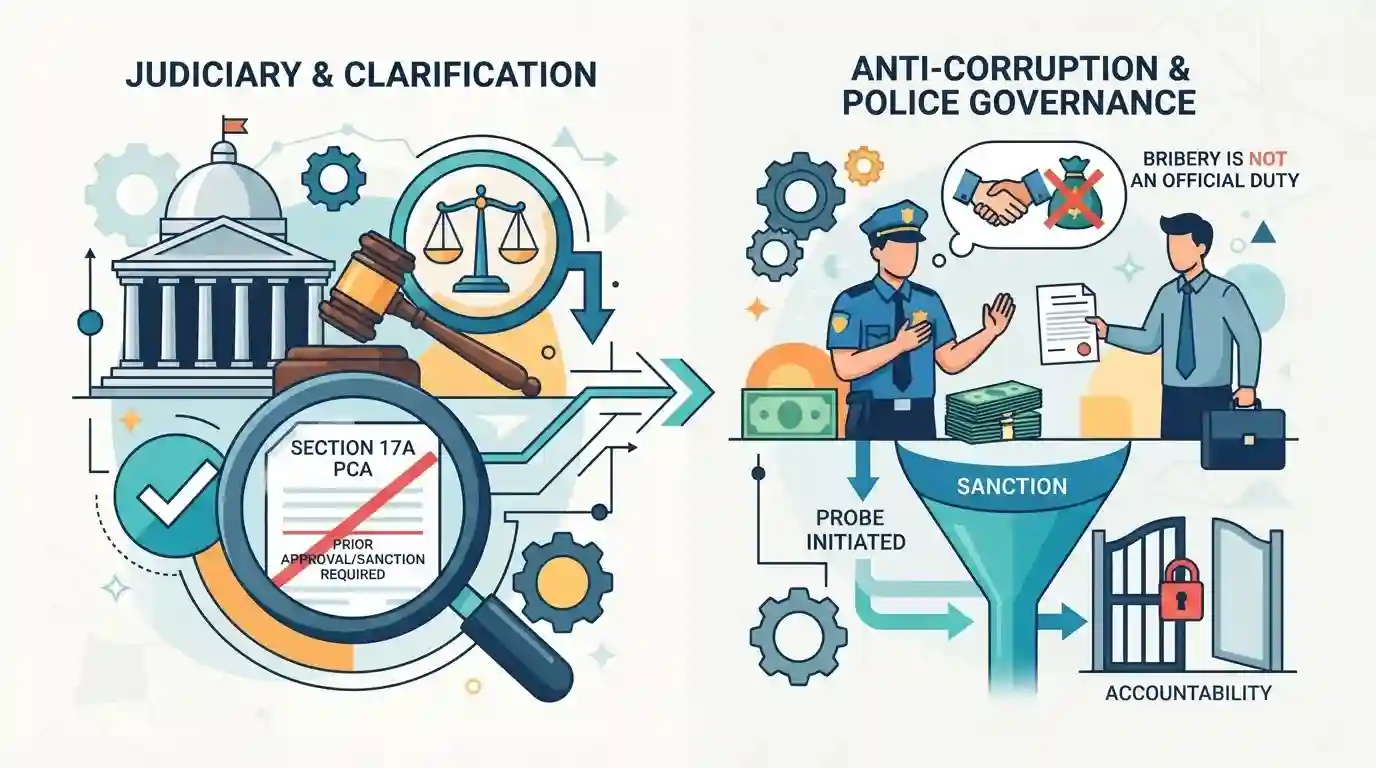
The Supreme Court has clarified that prior approval or sanction under Section 17A of the Prevention of Corruption Act is not needed to probe police personnel accused of demanding bribes. The Court held that accepting bribes does not constitute an act done in the discharge of official duties, thus preventing misuse of the statutory protection meant for bona fide administrative decisions.
મુખ્ય મુદ્દા
- The Supreme Court ruled that a prior sanction or approval under Section 17A of the Prevention of Corruption Act is not required to investigate police personnel accused of demanding bribes, as taking a bribe cannot be considered an act done in the discharge of official duty.
- Section 17A was introduced via the 2018 amendment to protect public servants from malicious or vexatious prosecution for decisions taken in good faith during official duties.
- The apex court emphasized that corrupt practices such as bribe-taking fall entirely outside the scope of legitimate official duty, thereby streamlining anti-corruption probes against law enforcement officials.
મહત્વપૂર્ણ શબ્દો
Section 17A of the Prevention of Corruption Act

A key provision under the anti-graft statute requiring prior approval or sanction from the competent authority before conducting any inquiry or investigation into offences alleged to have been committed by public servants while discharging official functions.
UPSC context
Relevant for GS Paper II (Polity & Governance — Statutory provisions, anti-corruption frameworks, and accountability mechanisms).
Supreme Court
The apex court of India, which interpreted anti-corruption laws to clarify that demanding a bribe is a criminal act unconnected to official duties, thus excluding it from statutory protection.
UPSC context
Crucial for GS Paper II (Indian Judiciary, Judicial Review, and constitutional interpretation of statutory safeguards).
સંલગ્ન સ્થિર ખ્યાલો
What are the key provisions and amendments under the Prevention of Corruption Act, 1988?
- Section 13 Amendment: Criminal Misconduct: Redefined criminal misconduct under Section 13 to focus on dishonest or fraudulent misappropriation of property.
- Section 17A Addition: Protection Provision: Section 17A was added via the 2018 amendment, requiring prior approval for probes into bona fide official decisions.
- Bribe Giver Liability: Bribe Giver Liability: Explicitly criminalized the act of giving a bribe, with provisions for penalty and imprisonment, except under coercion.
આંતર-વિષય પેટર્ન
Anti-corruption laws vs Police Reforms
Section 17A rulings directly affect police accountability, intersecting with long-pending police reforms and judicial oversight of law enforcement agencies under the Prakash Singh guidelines.

Expect a conceptual statement on Section 17A of the Prevention of Corruption Act and whether bribe-taking qualifies as 'official duty'.
સંલગ્ન PYQ · 1
સંલગ્ન PYQ · 1
- 2025MainsGS2
Discuss the 'corrupt practices' for the purpose of the Representation of the People Act, 1951. Analyze whether the increase in the assets of the legislators and/or their associates, disproportionate to their known sources of income, would constitute 'undue influence' and consequently a corrupt practice.
