Mann ki baat addresses tribal history and cooperative farming
Source:The Hindu ↗
Why It Matters
The article touches upon multiple key UPSC syllabus areas. The Santhal Rebellion is a direct Prelims and Mains topic under Modern Indian History. The Vattalakki Cooperative Farming Society serves as an excellent contemporary case study for GS2 answers on Self-Help Groups (SHGs) and women's social capital. The 'Ek Ped Maa Ke Naam' campaign can be cited as a government initiative for afforestation in GS3 or Essays.
Summary
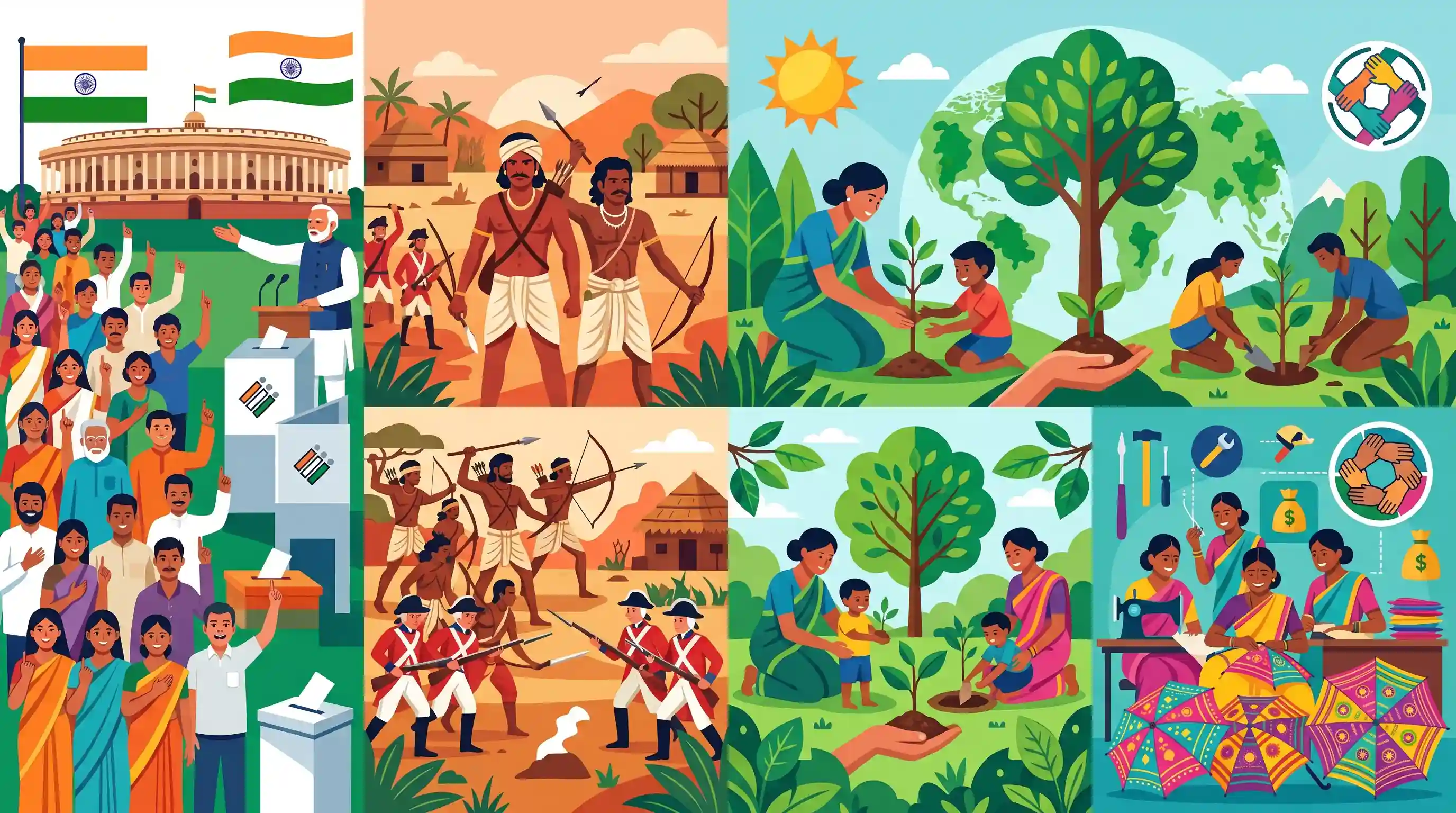
In his first 'Mann Ki Baat' after the 2024 general elections, PM Narendra Modi congratulated citizens for their unwavering faith in the Constitution and democratic systems, noting the massive participation of 65 crore voters. He highlighted the upcoming 'Hool Diwas' (June 30), which honors tribal leaders Veer Sidhu and Kanhu for the Santhal uprising against the British in 1855. Modi also discussed the 'Ek Ped Maa Ke Naam' campaign launched on World Environment Day to encourage tree plantation. Additionally, he praised the Vattalakki Cooperative Farming Society in Kerala, where tribal women produce 'Karthumbhi Umbrellas', exemplifying local entrepreneurship and self-help.
Key Points
- PM Modi celebrated the success of the 2024 general elections, noting the massive participation of 65 crore voters as a reaffirmation of India's democratic system and Constitution.
- Highlighted 'Hool Diwas' on June 30, commemorating the 1855 Santhal rebellion led by Veer Sidhu and Kanhu against British rule, occurring two years before the 1857 revolt.
- Urged citizens to participate in the 'Ek Ped Maa Ke Naam' campaign to promote afforestation and environmental conservation.
- Praised the tribal women of Attappady, Kerala, for producing 'Karthumbhi Umbrellas' under a cooperative farming society, highlighting rural entrepreneurship and women's empowerment.
Important Terms
Santhal Rebellion (Hul)

A major tribal uprising (1855–56) led by the Santhal people in Rajmahal Hills against British colonial exploitation and the oppressive zamindari system.
UPSC context
GS Paper I: Modern History. Essential for understanding tribal resistance and the subsequent creation of Santhal Parganas.
Hool Diwas
Observed annually on June 30 to commemorate the beginning of the Santhal Rebellion in 1855 and honor tribal martyrs like Sidhu and Kanhu Murmu.
UPSC context
GS Paper I: Art and Culture/History. Tests knowledge of tribal movements and significant historical dates.
Ek Ped Maa Ke Naam
A nationwide environmental campaign launched on World Environment Day 2024, encouraging citizens to plant trees as a tribute to their mothers to boost green cover.
UPSC context
GS Paper III: Environment. Relates to climate action, SDGs 13 & 15, and the 'Mission LiFE' initiative.
Vattalakki Cooperative Farming Society
A women-led cooperative in Palakkad, Kerala, empowering tribal women from the Muduga, Irula, and Kurumba communities through the manufacture of 'Karthumbhi' umbrellas.
UPSC context
GS Paper II: Social Justice. A case study for women’s empowerment, tribal welfare, and cooperative models.
Sidhu and Kanhu Murmu
The brothers who spearheaded the 1855 Santhal uprising, mobilizing thousands against 'Dikus' (outsiders) to protect tribal land and autonomy.
UPSC context
GS Paper I: History. Key personalities in the freedom struggle and tribal heritage.
Karthumbhi Umbrellas
A tribal-made umbrella brand from Kerala's Attappady region, symbolizing 'Vocal for Local' and the successful integration of traditional skill with modern entrepreneurship.
UPSC context
GS Paper I/III: Social Issues and Economy. Example of local entrepreneurship and sustainable livelihoods for vulnerable groups.
Prelims Trap
The Santhal Rebellion was triggered by the aftermath of the 1857 Revolt.
The Santhal rebellion (1855-56) actually preceded the 1857 revolt. It was primarily directed against oppressive zamindars and moneylenders (dikus) backed by British revenue policies, not a fallout of 1857.
Static Concepts Connected
What were the key characteristics and outcomes of the Santhal Rebellion (1855-56)?
- Leadership & Target: Led by Sidhu and Kanhu Murmu against oppressive 'dikus' (outsiders, primarily moneylenders and zamindars).
- Geographic Focus: Centered in the Rajmahal hills (Damin-i-Koh) where Santhals were settled by the British to clear forests.
- Major Outcome: Led to the creation of a separate Santhal Pargana district and the enactment of the Santhal Parganas Tenancy Act (1876).
How does the Indian Constitution protect and promote Cooperative Societies?
- Fundamental Right: Article 19(1)(c) guarantees the right to form cooperative societies, added by the 97th Constitutional Amendment Act.
- Directive Principle: Article 43B (DPSP) directs the State to promote voluntary formation, autonomous functioning, and democratic control of cooperatives.
- Part IXB: Articles 243ZH to 243ZT detail the incorporation, regulation, and democratic functioning of cooperative societies.
Cross-Topic Patterns
Tribal Uprisings & Land Tenure Acts
UPSC often pairs specific tribal revolts with their resulting legislative outcomes, such as the Santhal Rebellion (1855) leading to the protective Santhal Parganas Tenancy Act (1876).
Women's Cooperatives & Micro-entrepreneurship
The Attappady 'Karthumbhi Umbrellas' model serves as a prime GS2/GS3 case study for how women's cooperatives and SHGs leverage social capital to drive rural micro-entrepreneurship.

Santhal rebellion's pre-1857 chronology and the resulting Santhal Parganas Tenancy Act are prime targets for a 2026 Prelims statement.
Linked PYQs · 3
Linked PYQs · 3
- 2018PrelimsGS1
After the Santhal Uprising subsided, what was/were the measure/measures taken by the colonial government? 1. The territories called 'Santhal Paraganas' were created. 2. It became illegal for a Santhal to transfer land to a non-Santhal. Select the correct answer using the code given below:
- 2021MainsGS2
Can the vicious cycle of gender inequality, poverty and malnutrition be broken through microfinancing of women SHGs? Explain with examples.
- 2025MainsGS2
Women's social capital complements in advancing empowerment and gender equity. Explain.
