India and Philippines Elevate Bilateral Ties to Strategic Partnership
Source:The Hindu ↗
Why It Matters
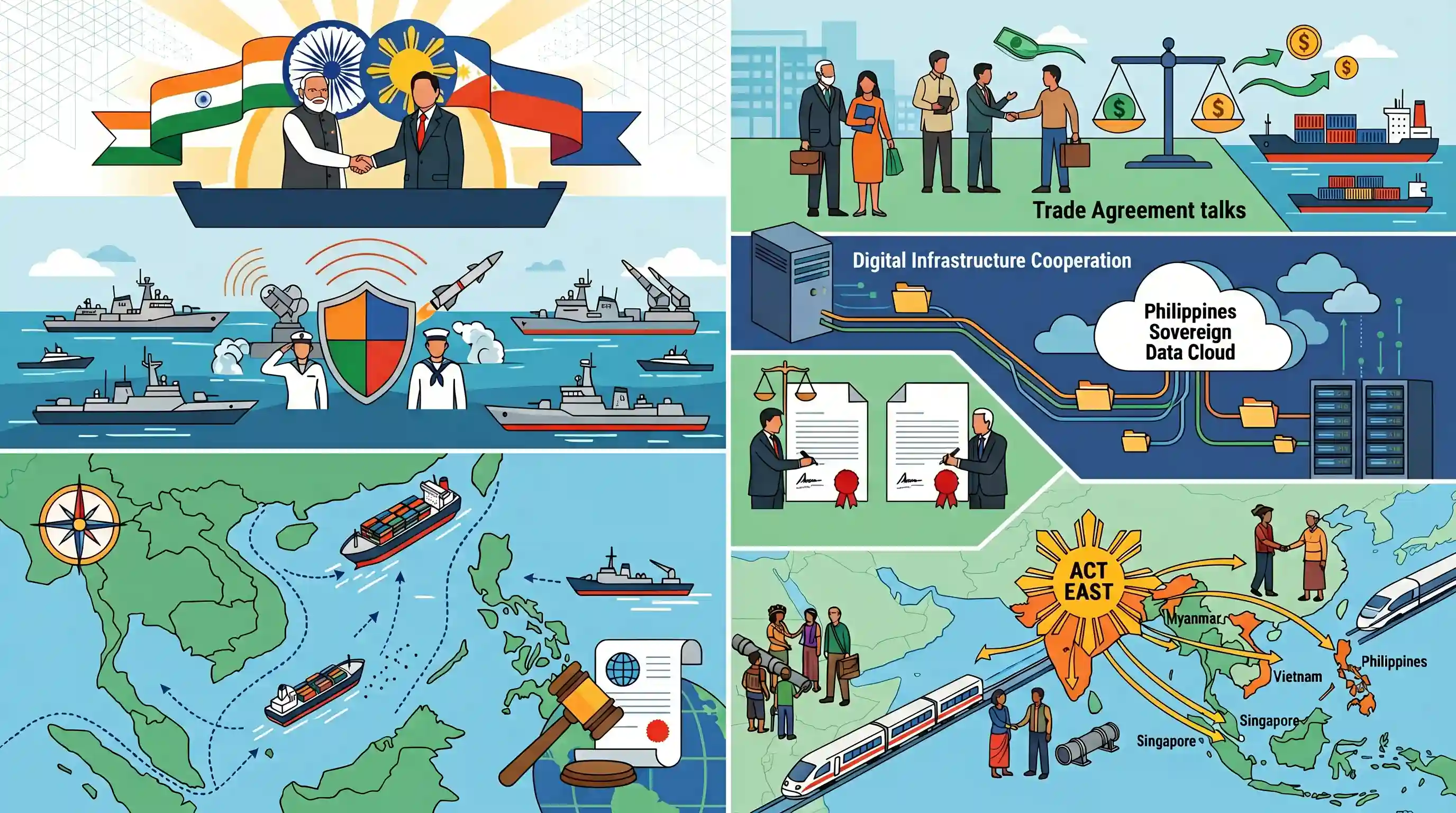
The elevation of India-Philippines relations to a Strategic Partnership underscores India's deepening engagement in the Indo-Pacific through its Act East Policy. It reflects India's proactive diplomatic stance on regional maritime security, freedom of navigation, and international law (UNCLOS) amidst rising geopolitical contestations in the South China Sea.
Summary
During a meeting between Indian Prime Minister Narendra Modi and Philippine President Ferdinand R. Marcos Jr., the two countries elevated their bilateral ties to a 'Strategic Partnership'. The agreement emphasized robust defence and maritime cooperation, with a strong commitment to freedom of navigation and adherence to UNCLOS amidst ongoing tensions in the South China Sea. Additional outcomes included initiating talks for a preferential trade agreement, enhancing digital infrastructure cooperation through the Philippines Sovereign Data Cloud, signing legal assistance treaties, and bolstering regional integration under India's Act East Policy framework.
Key Points
- India and the Philippines upgraded their bilateral relations to a 'Strategic Partnership', marking the 10th anniversary of India's Act East Policy.
- Both nations committed to enhancing defence and maritime ties, notably through naval exercises involving Indian ships in the Philippines and upholding 'freedom of navigation' and UNCLOS in the context of the South China Sea.
- Negotiations commenced for a new preferential trade agreement to boost economic engagement, alongside the introduction of direct flights and an e-tourist visa facility for Indian nationals.
- New bilateral treaties on mutual legal assistance in criminal matters and the transfer of sentenced persons were signed.
- India pledged infrastructure support for the Philippines Sovereign Data Cloud, while the Philippines announced its participation in the Information Fusion Centre for the Indian Ocean Region.
Important Terms
Act East Policy

India's proactive diplomatic initiative to promote economic, strategic, and cultural ties with Southeast Asia and the wider Indo-Pacific, prioritizing 'action-oriented' cooperation through Culture, Commerce, Connectivity, and Capacity Building.
UPSC context
GS Paper II: International Relations; tests India’s regional diplomacy, ASEAN centrality, and the strategic shift from the 1991 Look East Policy.
UN Convention on the Law of the Sea (UNCLOS)
A 1982 international treaty establishing the legal framework for all maritime activities, defining nations' rights over territorial waters (12nm) and Exclusive Economic Zones (200nm) while ensuring freedom of navigation.
UPSC context
GS Paper II & III: IR and Maritime Security; tests knowledge of international law and rules-based order in contested waters.
Preferential Trade Agreement (PTA)
A trade pact between countries that provides preferential access to specific products by reducing tariffs on an agreed 'positive list' rather than eliminating them entirely like an FTA.
UPSC context
GS Paper III: Indian Economy; tests understanding of trade liberalization stages and India’s economic engagement with partner nations.
Mutual Legal Assistance Treaty (MLAT)
A formal agreement between countries for gathering and exchanging evidence/information to enforce criminal laws. In India, the Ministry of Home Affairs is the nodal agency for these requests.
UPSC context
GS Paper II & III: Governance and Internal Security; tests mechanisms for international legal cooperation against transnational crime and terrorism.
Information Fusion Centre – Indian Ocean Region (IFC-IOR)
A maritime information-sharing hub hosted by the Indian Navy in Gurugram (est. 2018) to enhance Maritime Domain Awareness by tracking non-military 'white shipping' across the Indian Ocean Region.
UPSC context
GS Paper III: Security; tests India’s role as a 'Net Security Provider' and regional collaborative frameworks for maritime safety.
Strategic Partnership
A formal diplomatic status indicating deep, multi-dimensional cooperation between nations across defense, security, economy, and technology, signifying a higher level of trust and long-term commitment.
UPSC context
GS Paper II: Bilateral Relations; tests understanding of the hierarchy of diplomatic ties and multi-sectoral engagement with key partners.
Prelims Trap
India and the Philippines recently signed a Comprehensive Economic Partnership Agreement (CEPA) to boost trade.
They only commenced negotiations for a Preferential Trade Agreement (PTA). A PTA operates on a positive list of tariff reductions, unlike a broader FTA.
Static Concepts Connected
What is the Information Fusion Centre for the Indian Ocean Region (IFC-IOR)?
- Setup and Location: Established in 2018 by the Indian Navy in Gurugram to track shipping traffic and coordinate maritime incident responses.
- Core Objective: Enhances Maritime Domain Awareness (MDA) by tracking non-traditional threats like piracy, maritime terrorism, and IUU fishing.
- International Cooperation: Hosts International Liaison Officers (ILOs) from partner nations (now including the Philippines) for real-time information sharing.
What are the key maritime territorial zones defined under UNCLOS?
- Territorial Sea: Extends up to 12 nautical miles from the baseline; the coastal state exercises full sovereignty over airspace, water, and seabed.
- Exclusive Economic Zone: Extends up to 200 nautical miles; the state has sovereign rights for exploring and exploiting natural resources.
- Freedom of Navigation: Within the EEZ (beyond territorial waters), all states enjoy freedom of navigation and overflight, a key flashpoint in the South China Sea.
Cross-Topic Patterns
Act East shifts to defense diplomacy
The 'Strategic Partnership' and prior BrahMos missile exports mark a shift in India's Act East Policy—from predominantly economic and cultural ties to robust strategic defense frameworks.
Digital capabilities as a foreign policy tool
India's support for the Philippines Sovereign Data Cloud shows how India is leveraging its digital capabilities and Digital Public Infrastructure (DPI) as a strategic soft power tool in the Global South.
Minilaterals and South China Sea geopolitics
The Philippines' defense engagements with India, alongside the US and Japan, reflect how middle powers are building overlapping minilateral security architectures to balance China's maritime assertiveness.

Expect a 2026 Mains question on the shift of India's Act East policy from economic cooperation to defense diplomacy and maritime security.
Linked PYQs · 3
Linked PYQs · 3
- 2014MainsGS2
With respect to the South China sea, maritime territorial disputes and rising tension affirm the need for safeguarding maritime security to ensure freedom of navigation and over flight throughout the region. In this context, discuss the bilateral issues between India and China.
- 2020MainsGS2
What is the significance of Indo-US defence deals over Indo-Russian defence deals? Discuss with reference to stability in the Indo-Pacific region.
- 2016MainsGS2
Evaluate the economic and strategic dimensions of India's Look East Policy in the context of the post Cold War international scenario.
