Mann Ki Baat Address on Cultural Heritage and Conservation
Source:The Hindu ↗
Why It Matters
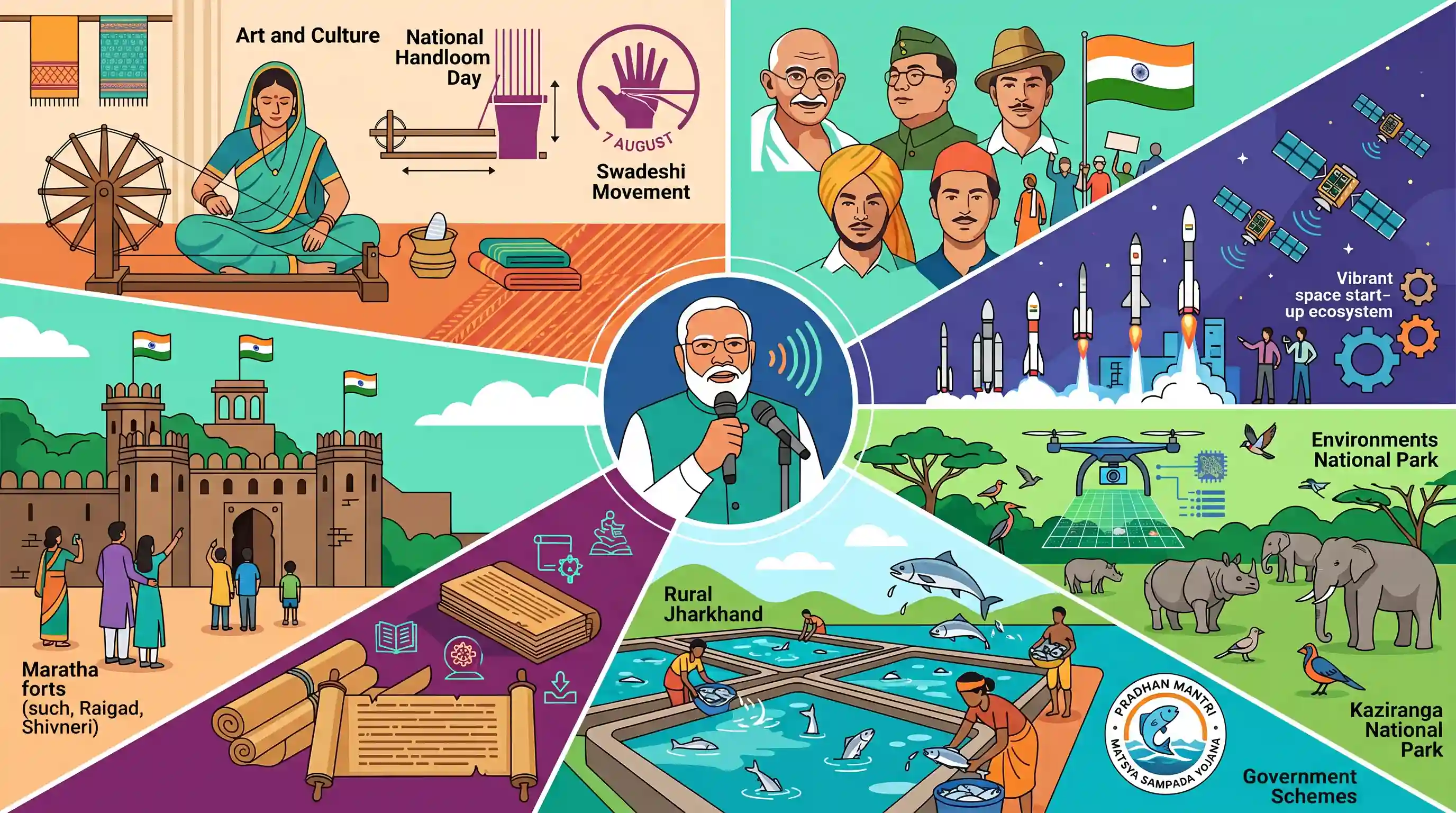
This broadcast encapsulates multiple themes pertinent to the UPSC syllabus, including the legacy of the Swadeshi Movement, architectural heritage (Maratha forts, UNESCO tags), tech applications in conservation (AI in Kaziranga), and rural livelihood schemes (PM Matsya Sampada Yojana).
Summary
Prime Minister Narendra Modi's Mann Ki Baat address highlighted India's cultural heritage, scientific advancements, and grassroots economic successes. Emphasizing the significance of National Handloom Day, he linked it to the historic Swadeshi Movement and praised artisans in the textile sector. The address celebrated the inclusion of Maratha forts in UNESCO's World Heritage list and highlighted ongoing efforts to preserve ancient texts through the Gyan Bharatam Mission. PM Modi also acknowledged the vibrant space start-up ecosystem, the successful application of AI for bird censuses in Kaziranga National Park, and the transformative impact of the Pradhan Mantri Matsya Sampada Yojana in boosting aquaculture in rural Jharkhand. Tributes were paid to freedom fighters ahead of Independence Day.
Key Points
- August 7 is observed as National Handloom Day, commemorating the launch of the Swadeshi Movement.
- 12 Maratha forts, including Salher and Shivneri, were recently recognized by UNESCO as World Heritage Sites.
- Space sector start-ups and young students participating in international science Olympiads were commended, reflecting growth in scientific temper.
- Kaziranga National Park utilized AI and sound recording devices to conduct a census of grassland birds, showcasing tech adoption in conservation.
- Gumla district in Jharkhand successfully transitioned from Maoist influence to fish farming under the Pradhan Mantri Matsya Sampada Yojana.
- The Gyan Bharatam Mission and Tamil Suvadiyiyal initiative are actively working towards digitizing and preserving ancient palm-leaf manuscripts.
Important Terms
Gyan Bharatam Mission

A national mission (Budget 2025) to digitize and preserve over one crore ancient manuscripts by 2031, creating a National Digital Repository for global researchers.
UPSC context
GS-I (Indian Culture) and GS-II (Governance); tests knowledge of heritage preservation initiatives and digital governance.
Maratha Military Landscapes
Inscribed in 2024-25 as India’s 44th UNESCO World Heritage Site, this network of 12 forts (e.g., Raigad, Shivneri) showcases 17th-19th century Maratha strategic military architecture.
UPSC context
GS-I (Art and Culture); significant for questions on medieval/early modern fortification and heritage conservation.
Pradhan Mantri Matsya Sampada Yojana (PMMSY)
A flagship scheme (2020–2026) for the sustainable development of the fisheries sector, aiming for a 'Blue Revolution' and doubling the income of fishers.
UPSC context
GS-III (Economy/Agriculture); tests awareness of rural livelihood schemes and sectoral economic growth.
Swadeshi Movement
A 1905 anti-partition movement that championed indigenous industries and boycotted British goods, forming the historical basis for National Handloom Day.
UPSC context
GS-I (Modern Indian History); core topic for the freedom struggle and economic nationalism.
Inspire-Manak Abhiyan
A Department of Science and Technology (DST) initiative (Million Minds Augmenting National Aspirations and Knowledge) promoting original science and technology-based innovation among school students.
UPSC context
GS-II (Education) and GS-III (Science and Technology); relevant for innovation and human resource development policies.
National Handloom Day
Observed annually on August 7 since 2015 to honor India’s weaving community and commemorate the launch of the 1905 Swadeshi Movement.
UPSC context
GS-I (Socio-economic history) and GS-III (Industry); tests historical continuity and support for cottage industries.
UNESCO
The United Nations body that designates World Heritage Sites of 'Outstanding Universal Value' (like the Maratha Military Landscapes) to ensure their international protection and preservation.
UPSC context
GS-II (International Relations); focuses on global cultural governance and heritage status impact.
Prelims Trap
"All 12 forts under the Maratha Military Landscapes UNESCO site are located exclusively in Maharashtra."
While the majority of the 12 inscribed forts (like Raigad and Shivneri) are in Maharashtra, the inclusion of Gingee Fort in Tamil Nadu is a critical exception highlighting Maratha expansion.
Static Concepts Connected
What are the core economic pillars of the Swadeshi Movement (1905)?
- Boycott of Goods: Mass picketing and burning of foreign-manufactured items, especially Manchester cloth and Liverpool salt, to cripple British economic interests.
- Indigenous Enterprise: Establishment of local industries like P.C. Ray's Bengal Chemical Factory, alongside indigenous textile mills, national banks, and insurance companies.
- Charkha & Handlooms: Revival of traditional weaving and artisan crafts, which is directly commemorated today by observing National Handloom Day on August 7.
What is Passive Acoustic Monitoring (PAM) in wildlife conservation?
- Bioacoustic Recording: Autonomous devices record environmental sounds over long periods, capturing the vocalizations of camouflaged, shy, or nocturnal species.
- Non-invasive: It allows for continuous ecological monitoring without direct human presence, minimizing stress on sensitive wildlife habitats.
- AI Processing: Machine learning algorithms (like BirdNET) are utilized to filter vast audio datasets to isolate, match, and identify specific species calls.
Cross-Topic Patterns
AI acoustics in protected areas
Kaziranga's AI bird census mirrors UPSC's focus on tech-in-conservation, similar to past questions on M-STrIPES (tiger tracking) and drone-based ecological monitoring.
LWE resolution via aquaculture
Gumla's shift from Left Wing Extremism to fish farming under PMMSY perfectly illustrates the 'development as counter-insurgency' thesis for GS3 Mains.
Soft power via digital archives
The Gyan Bharatam Mission merges ancient cultural preservation with India's modern Digital Public Infrastructure (DPI) framework, acting as a unique soft-power tool.

Expect a 2026 Prelims question merging Kaziranga's unique ecology with the application of AI-based bioacoustics in conservation.
Linked PYQs · 4
Linked PYQs · 4
- 2023PrelimsGS1
Consider the following statements: Statement-I: 7th August is declared as the National Handloom Day. Statement-II: It was in 1905 that the Swadeshi Movement was launched on the same day. Which one of the following is correct in respect of the above statements?
- 2024PrelimsGS1
Consider the following properties included in the World Heritage List released by UNESCO: 1. Shantiniketan 2. Rani-ki-Vav 3. Sacred Ensembles of the Hoysalas 4. Mahabodhi Temple Complex at Bodhgaya How many of the above properties were included in 2023 ?
- 2019PrelimsGS1
With reference to Swadeshi Movement, consider the following statements: 1. It contributed to the revival of the indigenous artisan crafts and industries. 2. The National Council of Education was established as a part of Swadeshi Movement. Which of the statements given above is/are correct?
- 2016MainsGS3
Discuss India's achievements in the field of Space Science and Technology. How the application of this technology has helped India in its socio-economic development?
