Commemoration of the 150th anniversary of Vande Mataram in Parliament
Source:The Hindu ↗
Why It Matters
Vande Mataram's 150th anniversary makes it a highly probable topic for UPSC Prelims (its origins, Anandamath, role in Swadeshi Movement) and Mains (cultural nationalism, literary contributions to the freedom struggle). The reference to the 1975 Emergency also ties into post-independence democratic challenges in GS2.
Summary
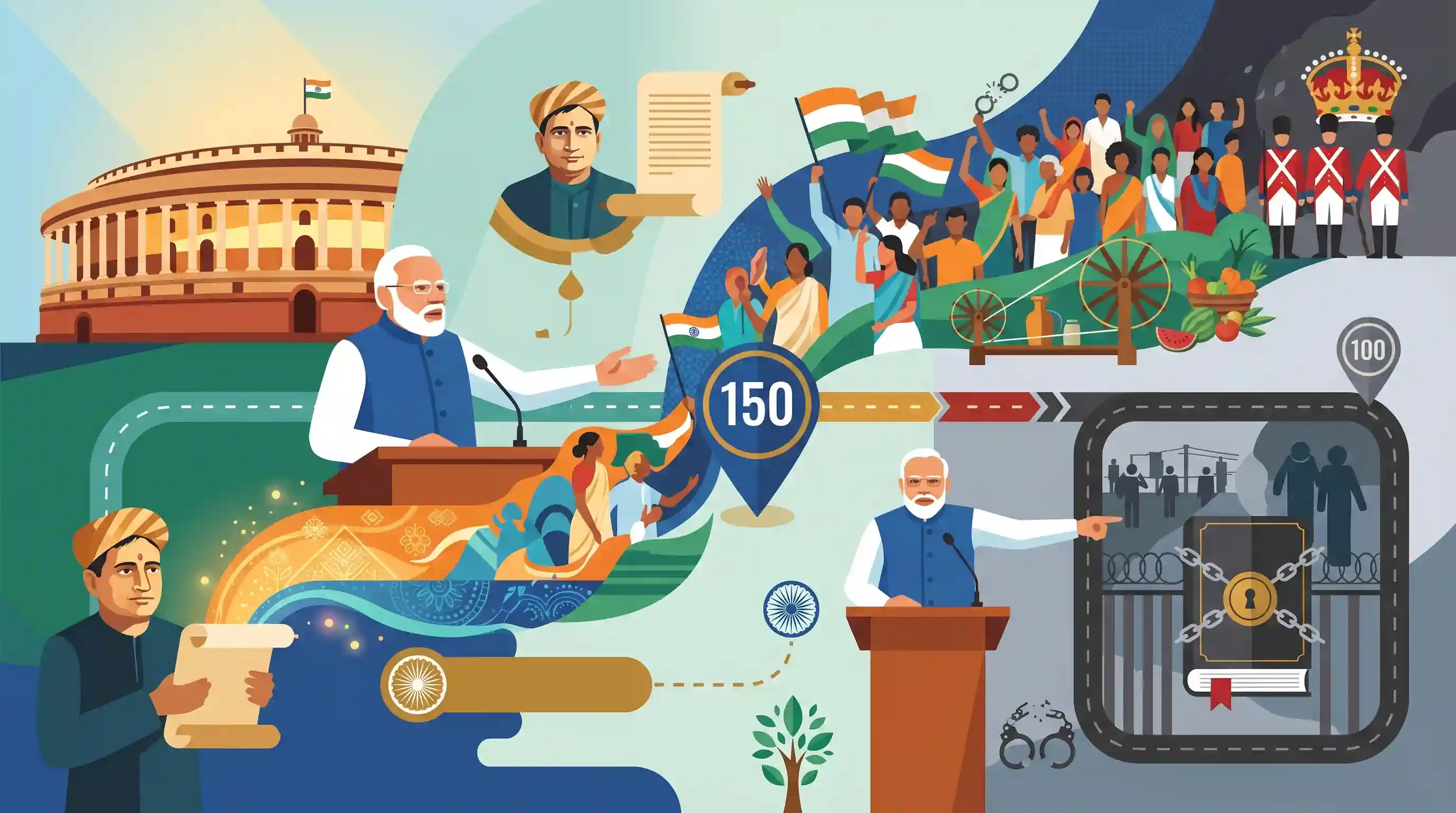
During the Winter Session of Parliament, Prime Minister Narendra Modi addressed the Lok Sabha to mark the 150th anniversary of 'Vande Mataram'. He celebrated the national song, composed by Bankim Chandra Chattopadhyay, as a unifying force that catalyzed the freedom struggle, particularly during the 1905 Bengal Partition. He also utilized the occasion to highlight the resilience of the song against British colonial oppression, while simultaneously taking a political swipe at the Congress by pointing out that the nation was under the Emergency and the Constitution was suspended during the song's 100th anniversary.
Key Points
- The Lok Sabha held a discussion to commemorate the 150th anniversary of the national song 'Vande Mataram'.
- PM Narendra Modi highlighted that the song remained a solid rock of inspiration for freedom fighters despite severe British oppression and censorship.
- The song was penned by Bankim Chandra Chattopadhyay after the 1857 uprising, serving as a nationalist response to the British anthem 'God Save the Queen', and played a pivotal role in the 1905 Swadeshi movement against the partition of Bengal.
- In a political remark, the Prime Minister noted that when the song completed its centenary (during the 1975-1977 Emergency), the Constitution was throttled and the nation was chained, drawing a contrast with the democratic ethos of the freedom struggle.
Important Terms
Vande Mataram

India's National Song, composed by Bankim Chandra Chattopadhyay in the 1870s. It became a central rallying cry against British rule, particularly during the 1905 anti-partition protests.
UPSC context
GS Paper I (Modern History); tests knowledge of cultural symbols and their role in the Indian National Movement.
Bankim Chandra Chattopadhyay
A 19th-century intellectual and novelist whose works pioneered cultural nationalism. He is widely regarded as the 'father of the modern Bengali novel' and wrote the seminal work 'Anandamath'.
UPSC context
GS Paper I (History & Culture); focuses on intellectual contributions and the Bengal Renaissance's impact on nationalism.
Partition of Bengal (1905)
A territorial reorganization by Viceroy Lord Curzon, officially for administrative convenience but strategically designed to 'divide and rule' by separating Hindu-majority and Muslim-majority areas.
UPSC context
GS Paper I (Freedom Struggle); essential for understanding the transition from moderate to extremist politics.
Swadeshi Movement
An anti-colonial movement sparked by the 1905 Partition. It advocated for 'Atmashakti' (self-reliance) through the boycott of British goods and the promotion of indigenous industries and education.
UPSC context
GS Paper I (Modern History); tests understanding of early mass mobilization and economic nationalism.
The Emergency (1975-77)
A 21-month period where the President, on the advice of PM Indira Gandhi, declared a National Emergency, leading to the suspension of fundamental rights and civil liberties.
UPSC context
GS Paper I (Post-Independence) and GS Paper II (Polity); tests knowledge of constitutional safeguards and executive power.
Lok Sabha
The lower house of India's Parliament, consisting of directly elected representatives. It serves as the primary body for legislation and holding the Union executive accountable.
UPSC context
GS Paper II (Polity); fundamental topic for understanding parliamentary democracy and the legislative process.
Anandamath
A 1882 nationalist novel set against the backdrop of the Sannyasi Rebellion. It contains the song 'Vande Mataram' and promoted the concept of the motherland as a divine entity.
UPSC context
GS Paper I (Modern History); tests the intersection of literature, rebellion, and the development of nationalist ideology.
Prelims Trap
Vande Mataram was composed specifically during the 1905 Swadeshi Movement to protest Bengal's partition.
It was composed around 1875 and published in the 1882 novel Anandamath. It only became the primary rallying cry later during the 1905 Swadeshi movement.
Static Concepts Connected
What is the historical context behind Bankim Chandra Chattopadhyay's Anandamath?
- Sannyasi Rebellion: The 1882 novel is set against the backdrop of the late 18th-century Sannyasi rebellion in Bengal, following the devastating famine of 1770.
- Song Integration: Vande Mataram was incorporated into this novel after being independently composed in the 1870s as a response to British anthems.
What are the key facts regarding the official adoption of Vande Mataram?
- Constituent Assembly: Adopted officially as India's National Song on January 24, 1950, during the final session of the Constituent Assembly.
- First Sung: Publicly sung for the first time by Rabindranath Tagore at the 1896 Calcutta session of the Indian National Congress.
- Equal Status: Dr. Rajendra Prasad officially declared it would have equal honor and status with the National Anthem, Jana Gana Mana.
Cross-Topic Patterns
Literature as a mass political mobilizer
Parallels exist between 'Vande Mataram' in the Swadeshi movement and later tools like the Charkha, showing how literature and cultural symbols actively catalyzed Indian mass nationalism.
Centenaries and Constitutional Crises
The PM's speech contrasts colonial-era democratic resistance with post-independence suspensions of rights, directly merging GS1 (Modern History) with GS2 (The Emergency / Constitutional history).

Expect a Prelims chronological question linking Anandamath's publication, the 1896 INC session, and the 1905 Swadeshi movement.
Linked PYQs · 5
Linked PYQs · 5
- 2003PrelimsGS1
Which one of the following statements is correct?
- 2023PrelimsGS1
Consider the following statements: Statement-I: 7th August is declared as the National Handloom Day. Statement-II: It was in 1905 that the Swadeshi Movement was launched on the same day. Which one of the following is correct in respect of the above statements?
- 2019PrelimsGS1
With reference to Swadeshi Movement, consider the following statements: 1. It contributed to the revival of the indigenous artisan crafts and industries. 2. The National Council of Education was established as a part of Swadeshi Movement. Which of the statements given above is/are correct?
- 2019MainsGS1
The 1857 Uprising was the culmination of the recurrent big and small local rebellions that had occurred in the preceding hundred years of British rule. Elucidate.
- 2025MainsGS2
Indian Constitution has conferred the amending power on the ordinary legislative institutions with a few procedural hurdles. In view of this statement, examine the procedural and substantive limitations on the amending power of the Parliament to change the Constitution.
