PM Modi at G7 Summit: Resetting India-Canada Bilateral Ties
Source:The Hindu ↗
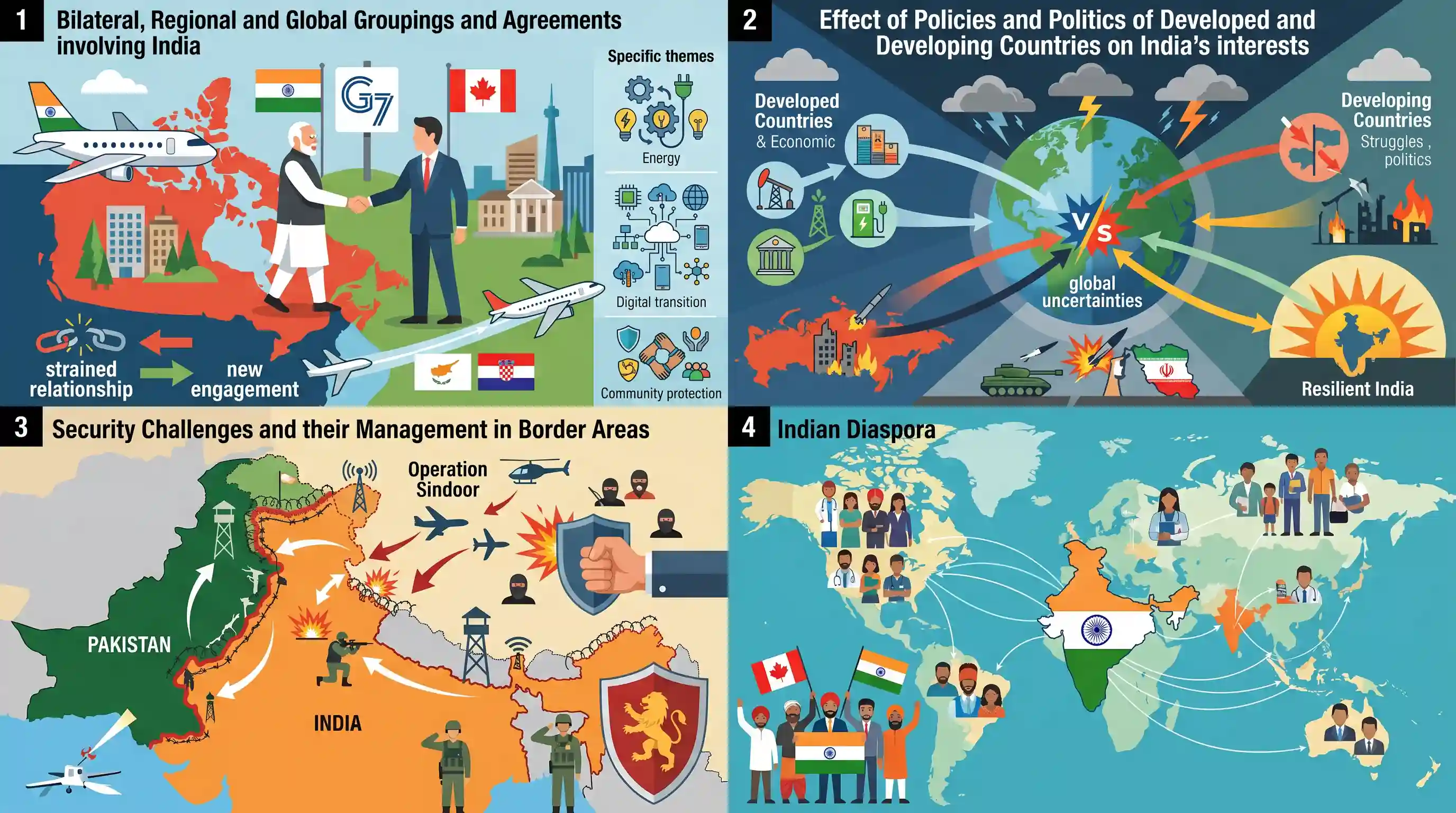
Why It Matters
The article is highly relevant for UPSC GS Paper 2 (International Relations) as it touches upon India's engagement in major global groupings (G-7) and the dynamics of bilateral relations, specifically the recent turbulence and potential recalibration of India-Canada ties. It also touches on GS Paper 3 (Security) concerning cross-border anti-terror operations (Operation Sindoor).
Summary
Prime Minister Narendra Modi is visiting Canada to participate in the G-7 Outreach Summit in Kananaskis, hosted by newly elected Canadian Prime Minister Mark Carney. Amidst global geopolitical uncertainties such as the Russia-Ukraine and Israel-Iran conflicts, the summit focuses on energy security, digital transition, and community protection. The visit is highly significant as it provides a platform to reset India-Canada bilateral relations, which were severely strained during Justin Trudeau's tenure over the Hardeep Singh Nijjar assassination row. Furthermore, it represents PM Modi's first multilateral appearance since India launched 'Operation Sindoor' against terror targets in Pakistan. Canada forms the second leg of Modi's three-nation tour covering Cyprus and Croatia.
Key Points
- Prime Minister Narendra Modi arrived in Calgary, Canada to attend the G-7 Outreach Summit at Kananaskis, hosted by new Canadian Prime Minister Mark Carney.
- The summit takes place against the backdrop of escalating global geopolitical tensions, particularly the Israel-Iran and Russia-Ukraine conflicts.
- This visit offers a crucial opportunity to mend India-Canada bilateral ties that had deteriorated under former PM Justin Trudeau over allegations concerning the murder of pro-Khalistan activist Hardeep Singh Nijjar.
- The G-7 Outreach Summit is Modi's first major multilateral engagement following India's 'Operation Sindoor' anti-terror strikes in Pakistan.
- Key focuses of the summit include community protection, building energy security, accelerating the digital transition, and securing future partnerships.
Important Terms
G-7 (Group of Seven)

An informal intergovernmental forum of seven advanced economies (USA, UK, France, Germany, Italy, Japan, Canada) that coordinates global policies on economy, security, and climate issues.
UPSC context
GS Paper II (International Groupings); evaluates India’s strategic autonomy and its engagement with major global powers.
Operation Sindoor
A strategic 2025 military operation launched by India against terror targets in Pakistan; it marks a shift toward technology-driven, non-contact warfare and cost-imposition deterrence.
UPSC context
GS Paper III (Internal Security); tests understanding of border management, surgical strikes, and India's evolving counter-terrorism doctrine.
G-7 Outreach Summit
A framework where G-7 members invite non-member leaders (like India) to participate in summit discussions, facilitating dialogue between developed and developing nations on global commons.
UPSC context
GS Paper II (International Relations); tests India's role as a 'Voice of the Global South' in multilateral platforms.
Bilateral Relations
The political, economic, and strategic interactions between two nations; in the current context, it refers to normalizing India-Canada ties after the Nijjar row.
UPSC context
GS Paper II (Bilateral Relations); tests diplomatic crisis management and the impact of the Indian diaspora on foreign policy.
Energy Security
The national ability to ensure consistent, affordable energy supplies while transitioning to sustainable sources, a key theme for international strategic cooperation.
UPSC context
GS Paper III (Environment/Energy); focuses on India's energy transition and climate change commitments in global diplomacy.
Digital Transition
The integration of digital technologies into all sectors, emphasizing AI governance, quantum innovation, and secure digital infrastructure as priorities for global economic stability.
UPSC context
GS Paper III (Science and Technology); evaluates India's leadership in digital public infrastructure and emerging technology governance.
Prelims Trap
India holds a permanent guest status in the G-7 Outreach summits.
India is not a G-7 member. Outreach invitees are chosen entirely at the discretion of the host country each year; there is no permanent guest status or fixed rotating mechanism.
Static Concepts Connected
How does the G-7 Outreach mechanism function?
- No formal treaty: The G-7 operates without a permanent secretariat or formal charter, making its proceedings largely informal and consensus-based among advanced economies.
- Host's discretion: The host nation holds the exclusive prerogative to invite non-member countries (like India) and international organizations to Outreach sessions to broaden consensus on global issues.
What governs the expulsion of diplomats during bilateral rows?
- Vienna Convention 1961: Article 9 allows a receiving state to declare any member of a diplomatic mission 'persona non grata' without having to explain or justify its decision.
- Reciprocity principle: Expulsions are often met with reciprocal expulsions by the sending state to maintain parity, as seen during the nadir of India-Canada ties under Justin Trudeau.
Cross-Topic Patterns
Diaspora: Asset vs. Security Irritant
The India-Canada friction over Khalistani extremism highlights how a host nation's domestic vote-bank politics involving the diaspora can directly clash with a sending nation's core national security interests.
Pre-emptive strikes & UN Charter
Operations like 'Sindoor' reflect India's shift towards proactive deterrence, often legally justified under Article 51 (right to self-defense) against non-state actors when the host state fails to act.

Expect a 2026 Mains question linking diaspora extremism to bilateral diplomatic friction, using the India-Canada reset as a core case study.
Linked PYQs · 3
Linked PYQs · 3
- 2023MainsGS2
Indian diaspora has scaled new heights in the West. Describe its economic and political benefits for India.
- 2020MainsGS3
Analyze internal security threats and transborder crimes along Myanmar, Bangladesh and Pakistan borders including Line of Control (LoC). Also discuss the role played by various security forces in this regard.
- 2024MainsGS2
‘Terrorism has become a significant threat to global peace and security.’ Evaluate the effectiveness of the United Nations Security Council's Counter Terrorism Committee (CTC) and its associated bodies in addressing and mitigating this threat at the international level.
