Union Budget 2026 Lays Foundation for Viksit Bharat
Source:The Hindu ↗
Why It Matters
Provides crucial insights into the government's long-term economic strategy, explicitly linking the Union Budget to the 'Viksit Bharat 2047' vision. It emphasizes the intersection of structural macroeconomic reforms, demographic dividend, and technology-driven welfare—key thematic areas frequently tested in GS2 and GS3 Mains.
Summary
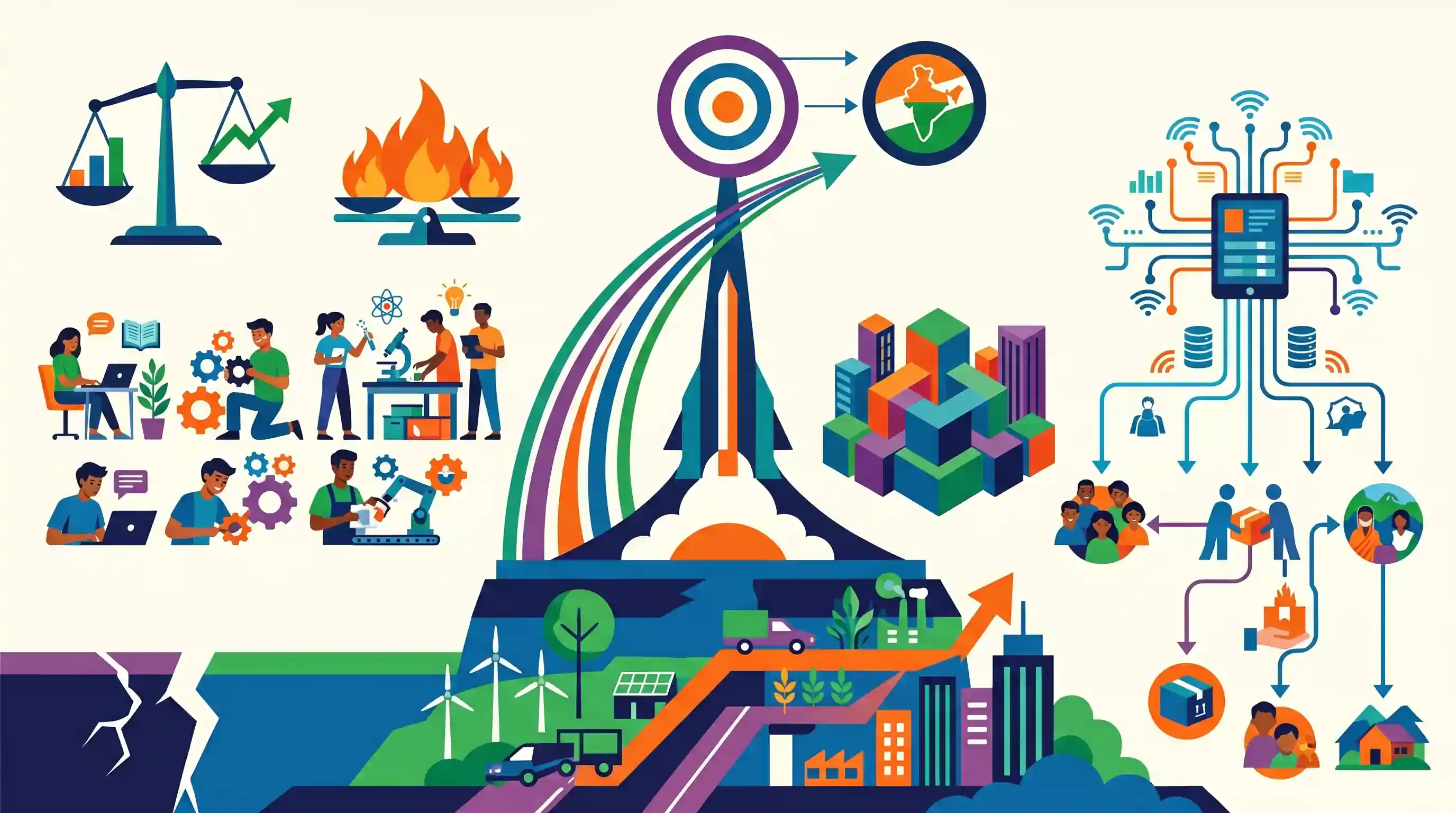
In a recent interview, Prime Minister Narendra Modi described the Union Budget 2026 not as a compulsory routine document but as a strategic launchpad for India\'s goal to become a developed nation (Viksit Bharat) by 2047. Highlighting a transition from a 'now or never' mindset to a 'we are ready' resolve, he emphasized the country's macroeconomic stability, low inflation, and the advantages of a young, skilled population. The government aims to sustain this momentum through bold structural reforms and a technology-driven, inclusive welfare architecture that ensures last-mile delivery, laying a robust foundation for the next quarter-century of India's development.
Key Points
- PM Modi characterized the Union Budget 2026 as a "we-are-ready" moment born out of preparation, reflecting India\'s resolve to become a developed nation (Viksit Bharat) by 2047.
- The budget departs from run-of-the-mill accounting documents to serve as a strategic roadmap with clear timelines, consolidating gains since 2014 for the next quarter-century.
- India\'s post-pandemic growth relies on macroeconomic stability, low inflation, and leveraging its young, increasingly skilled demographic dividend.
- The administration highlighted structural reforms addressing historical gaps, paired with a tech-driven, inclusive, human-centric welfare architecture.
Important Terms
Viksit Bharat 2047

The government's long-term vision to transform India into a developed nation by 2047, the 100th anniversary of its independence, targeting a $30-40 trillion economy.
UPSC context
GS Paper 3: Economic Development and Planning; tests understanding of long-term national growth strategies and socio-economic goals.
Union Budget
Formally known as the 'Annual Financial Statement' under Article 112, it estimates the government's receipts and expenditures for a fiscal year, acting as a key fiscal policy tool.
UPSC context
GS Paper 3: Government Budgeting; critical for questions on fiscal deficit, resource mobilization, and sectoral allocations.
Structural Reforms
Measures designed to change the fundamental fabric of an economy—such as labor, land, and tax systems—to improve efficiency, productivity, and long-term growth potential.
UPSC context
GS Paper 3: Effects of liberalization on the economy; tests ability to analyze systemic changes like GST or IBC.
Macroeconomic Stability
An economic condition where a nation minimizes vulnerability to external shocks, characterized by low inflation, manageable debt-to-GDP ratios, and stable currency.
UPSC context
GS Paper 3: Growth and Development; essential for discussing the foundations of sustainable economic expansion.
Inclusive Welfare Architecture
A digitally integrated system (e.g., using JAM trinity) designed to provide social security and benefits with precision targeting, reducing leakages and ensuring universal coverage.
UPSC context
GS Paper 2: Welfare schemes for vulnerable sections; tests knowledge of e-governance and social safety nets.
Last-mile Delivery
The final stage of the governance process where services and welfare benefits reach the intended beneficiaries, often the most challenging part of implementation.
UPSC context
GS Paper 2: Governance and e-governance applications; vital for discussing the success of public service delivery models.
Azadi Ka Amrit Mahotsav
A government initiative to celebrate 75 years of India's independence, serving as a transition period to plan the nation's journey toward its 2047 developed status.
UPSC context
GS Paper 2: Government policies and interventions; marks the symbolic start of the 'Amrit Kaal' development phase.
Prelims Trap
India is currently classified as an upper-middle-income 'Viksit Bharat' by the World Bank.
The 2047 target is an aspirational domestic political goal. Officially, international bodies classify development status based on GNI per capita thresholds, where India is currently lower-middle-income.
Static Concepts Connected
What defines a Demographic Dividend and what is India's time window?
- Definition: Economic growth potential resulting from a declining dependency ratio, where the working-age population (15-64 years) outnumbers non-working dependents.
- India's Window: According to the UNFPA, India's demographic dividend window is expected to last until 2055-56, peaking around 2041.
- Prerequisites: Harnessing this dividend requires active policy focus on health, education, skilling, and job creation to prevent a demographic disaster.
How is a 'Developed Nation' classified by international institutions?
- GNI per capita: The World Bank uses Gross National Income (GNI) per capita (Atlas method) to classify economies annually into four income groups.
- High-income status: The colloquial term 'developed economy' generally aligns with the World Bank's high-income threshold (currently >$13,845 GNI per capita).
- India's Status: India is currently classified as a lower-middle-income economy, needing sustained high compounding GDP growth to cross thresholds by 2047.
Cross-Topic Patterns
E-governance scaling inclusive growth
The shift from physical welfare to digital public infrastructure (DPI) and direct benefit transfers (DBT) ensures macro-level budget allocations yield micro-level last-mile delivery without leakages.
Inflation control as a growth prerequisite
Stable macroeconomics and low inflation are essential to protect the purchasing power of the aspiring middle class, driving the sustained domestic consumption needed for the 'Viksit Bharat' trajectory.

Mains 2026 will likely test the 'Viksit Bharat' framework by linking demographic dividend with tech-driven welfare (DBT) architecture.
Linked PYQs · 4
Linked PYQs · 4
- 2024MainsGS3
Examine the pattern and trend of public expenditure on social services in the post-reforms period in India. To what extent this has been in consonance with achieving the objective of inclusive growth?
- 2022MainsGS3
Is inclusive growth possible under market economy ? State the significance of financial inclusion in achieving economic growth in India.
- 2014MainsGS3
While we flaunt India's demographic dividend, we ignore the dropping rates of employability. What are we missing while doing so? Where will the jobs that India desperately needs come from? Explain.
- 2025MainsGS2
e-governance projects have a built-in bias towards technology and back-end integration than user-centric designs. Examine.
