India Maldives Bilateral Relations and Neighborhood First Policy
Source:The Hindu ↗
Why It Matters
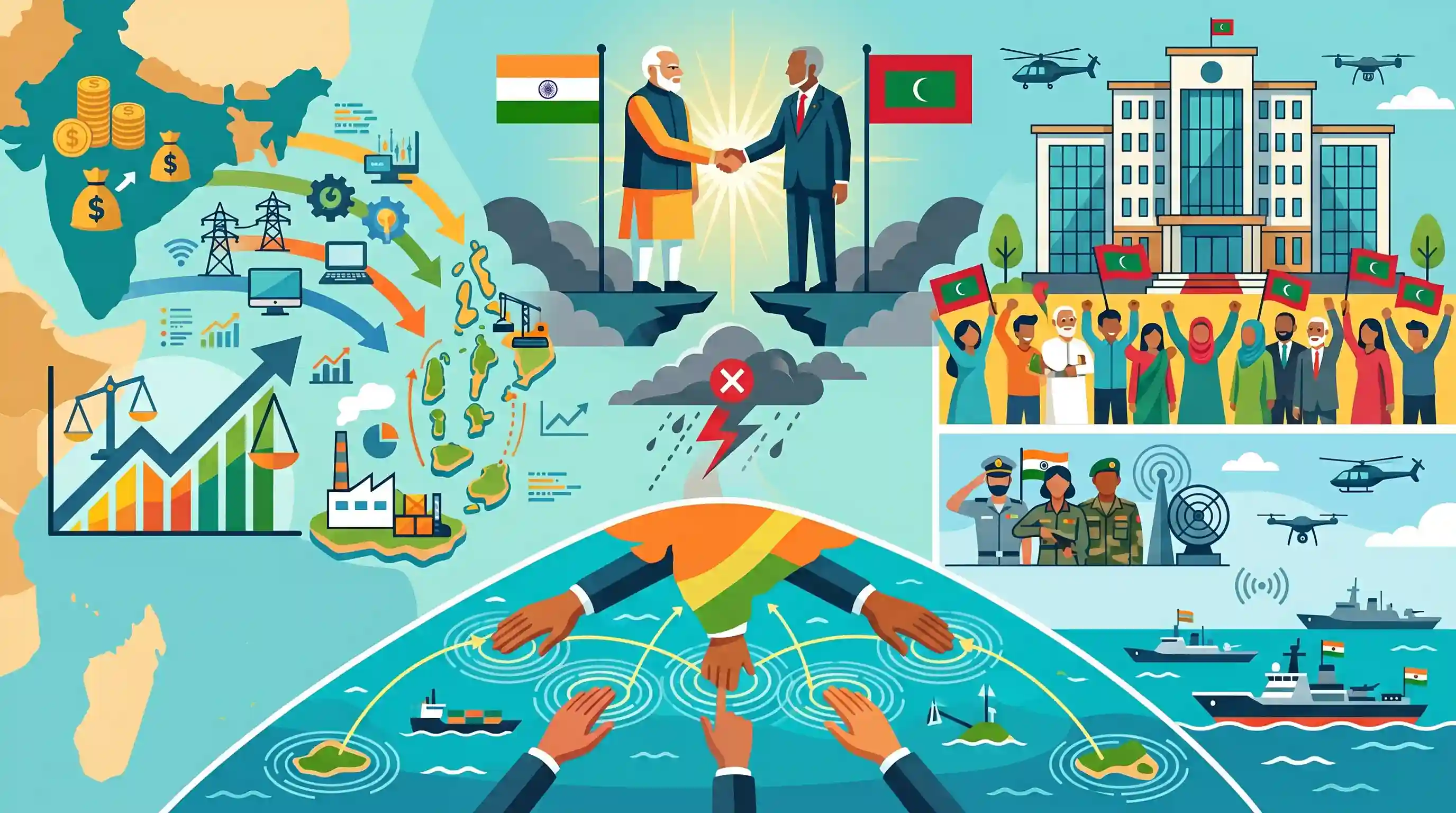
The Maldives is a critical maritime neighbor for India in the Indian Ocean Region (IOR). The diplomatic reset highlights the importance of India's strategic patience, economic assistance, and infrastructure diplomacy in countering anti-India political narratives, securing maritime trade routes, and maintaining regional stability amidst international competition.
Summary
Prime Minister Narendra Modi’s two-day state visit to the Maldives in July 2025 marked a significant reset in India-Maldives relations, moving past the diplomatic strain triggered by President Mohamed Muizzu’s earlier 'India Out' stance. Acknowledging domestic economic pressures, President Muizzu emphasized the need for external technical and resource support without compromising sovereignty. The visit underscored broad bipartisan support in the Maldives for ties with India, highlighted by the inauguration of key infrastructure, including a new Defence Ministry building in Malé. Ultimately, it reaffirmed India's 'Neighbourhood First' policy and 'Mahasagar' vision for Indian Ocean regional stability.
Key Points
- PM Modi's state visit to the Maldives signifies a "major reset" in bilateral ties following diplomatic strains under President Muizzu's earlier 'India out' campaign.
- President Muizzu noted the necessity of external technical expertise and resources to manage economic pressures, while vowing to safeguard Maldivian sovereignty.
- The visit featured the joint inauguration of the Maldives' new Ministry of Defence building in Malé alongside other infrastructure projects.
- PM Modi emphasized that the Maldives remains a valued pillar of India's 'Neighbourhood First' policy and 'Mahasagar' maritime vision.
- The trip demonstrated substantial cross-party consensus in the Maldives favoring strong, resilient ties with India as the two nations mark 60 years of diplomatic relations.
Important Terms
Neighbourhood First Policy

India's core foreign policy priority aimed at building cooperative and mutually beneficial relations with immediate neighbors through developmental aid, connectivity, and non-reciprocal security assistance to ensure regional stability.
UPSC context
GS-II: International Relations. Tests understanding of regional diplomacy, developmental partnerships, and India's strategic influence in South Asia.
MAHASAGAR Vision
Standing for "Mutual and Holistic Advancement for Security and Growth Across Regions," this doctrine expands the SAGAR vision to include global maritime partnerships and broader economic-geopolitical concerns.
UPSC context
GS-II & III: Maritime Security. Critical for understanding India's leadership in the Indian Ocean and its outreach to the Global South.
'India Out' Campaign
A political movement in the Maldives, spearheaded by the Progressive Party of Maldives (PPM), advocating for the removal of Indian military personnel and reduction of Indian influence, citing sovereignty concerns.
UPSC context
GS-II: International Relations. Tests awareness of domestic political shifts in neighboring countries that impact India's strategic interests.
Maldives National Defence Force (MNDF)
The Maldives' combined security organization responsible for national defense. India provides approximately 70% of its training and collaborates on major projects like the Uthuru Thila Falhu (UTF) harbor.
UPSC context
GS-II: Bilateral Relations. Key for discussing defense cooperation, capacity building, and India's role as a "net security provider."
Maritime Security
A multidimensional security concept covering the protection of national interests at sea, including territorial integrity, freedom of navigation (SLOCs), and countering non-traditional threats like piracy and illegal fishing.
UPSC context
GS-III: Internal Security. Essential for analyzing Indian Ocean geopolitics and the protection of India's "Blue Economy."
Economic Diplomacy
The strategic use of economic tools—such as grants, currency swaps, and developmental loans—to achieve foreign policy goals and stabilize neighboring economies during periods of domestic financial pressure.
UPSC context
GS-II: International Relations. Evaluates how India leverages financial assistance to manage regional stability and bilateral ties.
Prelims Trap
"MAHASAGAR is an infrastructure initiative linking Indian Ocean ports."
MAHASAGAR is an Indian Navy-led high-level virtual interaction framework among IOR littorals for maritime security, not to be confused with Sagarmala (port-led development) or the broader SAGAR diplomatic doctrine.
Static Concepts Connected
Why is the Maldives strategically critical for India's maritime security?
- Toll Gate: Located at the crossroads of key sea lanes of communication (SLOCs) in the Indian Ocean, acting as a strategic 'toll gate' for global maritime trade.
- EEZ Proximity: The Eight Degree Channel separates India's Minicoy (Lakshadweep) from the Maldives, making it geographically vital for monitoring maritime threats and non-traditional challenges like piracy.
- Security Provider: Maldives relies on India as a Net Security Provider for EEZ surveillance, anti-piracy operations, and Humanitarian Assistance and Disaster Relief (HADR).
How does India deploy economic tools in its 'Neighbourhood First' policy?
- Currency Swaps: The RBI's SAARC Currency Swap framework provides short-term foreign exchange liquidity to neighbors like Maldives to help ease immediate balance of payment crises.
- Lines of Credit: Exim Bank extends soft loans for infrastructure, aiming to provide development support without imposing opaque 'debt-trap' conditions.
- High Impact Projects: Focus is placed on High Impact Community Development Projects (HICDP) driven by local socio-economic needs rather than grand, unsustainable mega-projects.
Cross-Topic Patterns
Island Nation Debt & Economic Diplomacy
The Maldives' pivot back to India mirrors Sri Lanka's trajectory, where acute macroeconomic stress and debt vulnerabilities force small island states to balance Chinese infrastructure loans with India's immediate liquidity support.
Institutionalizing the SAGAR Vision
India is shifting from the broader 'SAGAR' diplomatic doctrine to concrete institutional mechanisms like the Navy's 'MAHASAGAR' initiative and the Colombo Security Conclave to hardwire Indian Ocean Region (IOR) security cooperation.

Expect a 2026 Prelims question differentiating MAHASAGAR, SAGAR, and Sagarmala, or a Mains question on economic realities forcing IR resets.
Linked PYQs · 1
Linked PYQs · 1
- 2024MainsGS2
Discuss the geopolitical and geostrategic importance of Maldives for India with a focus on global trade and energy flows. Further also discuss how this relationship affects India's maritime security and regional stability amidst international competition ?
