Combined Commanders Conference unveils long-term military vision
Source:The Hindu ↗
Why It Matters
This article provides a critical update on India's top-level military strategy, introducing the 'Indian Armed Forces Vision 2047' and emphasizing the shift towards self-reliance and multi-domain jointness. It is highly relevant for GS-3 Internal Security, particularly topics regarding border management, the role of external state/non-state actors, and changes in military tactics.
Summary
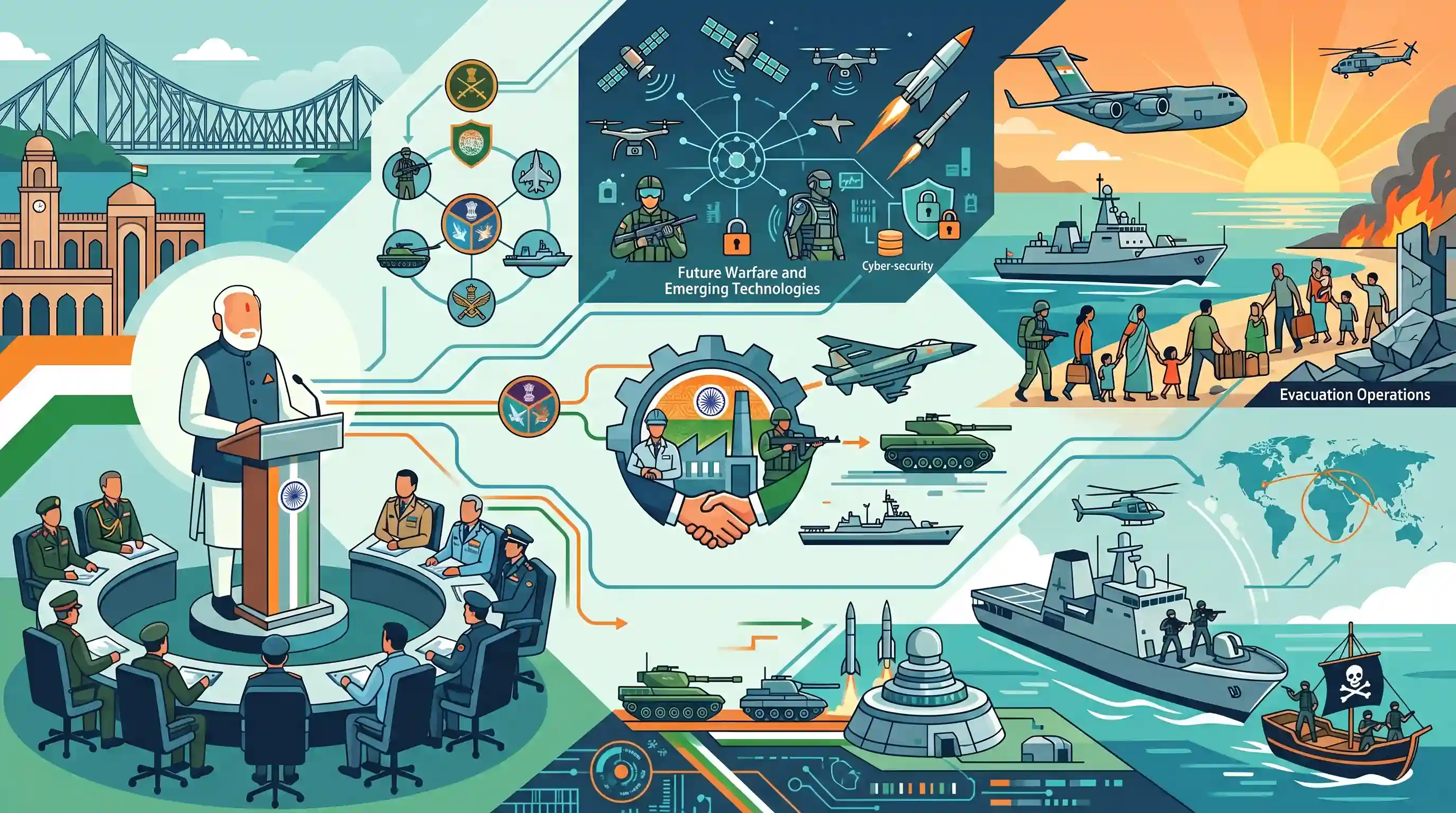
Prime Minister Narendra Modi inaugurated the 16th Combined Commanders' Conference in Kolkata, directing the Ministry of Defence and the Armed Forces to focus on 'atmanirbharta' (self-reliance), jointness, and multi-domain integration. Highlighting the changing nature of warfare and the new strategic realities following 'Operation Sindoor', the PM unveiled the 'Indian Armed Forces Vision 2047' to future-proof India's military capabilities. He also praised the forces for their expanding roles in nation-building, such as executing global anti-piracy operations and safely evacuating Indian citizens from conflict zones.
Key Points
- Prime Minister Narendra Modi inaugurated the 16th Combined Commanders' Conference (CCC) in Kolkata with the theme 'Year of Reforms - Transformation for the Future'.
- The PM urged the Ministry of Defence to implement rapid reforms focusing on jointness, multi-domain integration, and 'atmanirbharta' (self-reliance) to meet future challenges.
- Operational readiness was reviewed in light of emerging technologies, tactics, and the new strategic environment shaped by 'Operation Sindoor'.
- The 'Indian Armed Forces Vision 2047' document was unveiled to guide the long-term modernization and operational paradigm of the forces.
- The armed forces were commended for their broader nation-building roles, including international anti-piracy operations and the successful evacuation of Indian citizens from conflict zones.
Important Terms
Combined Commanders' Conference (CCC)

The apex biennial brainstorming forum for India's top military and political leadership to discuss strategic, operational, and institutional priorities for national security.
UPSC context
GS-III (Security); tests understanding of higher defense management and the civil-military decision-making framework in India.
Operation Sindoor
A 2025 Indian military campaign involving precision missile and drone strikes against terror infrastructure in Pakistan, establishing a doctrine of 'non-contact war' and punitive retaliation.
UPSC context
GS-III (Security); relevant to 'Security Challenges and their Management in Border Areas' and India's evolving counter-terrorism response.
Indian Armed Forces Vision 2047
A strategic roadmap unveiled in 2025 to transform India’s military into a technology-driven, all-domain integrated force by the centenary of independence (2047).
UPSC context
GS-III (Security); tests knowledge of long-term defense planning, modernization, and the 'Viksit Bharat' strategic component.
Multi-Domain Integration (MDI)
The seamless coordination of military activities across land, air, sea, cyber, and space domains using networked systems (C4ISR) to achieve cross-domain synergy.
UPSC context
GS-III (Security); key concept in modern warfare, testing knowledge of emerging technologies and future military doctrines.
Theaterisation
The administrative and operational integration of the three services (Army, Navy, IAF) under unified geographical commands to optimize resource utilization and command efficiency.
UPSC context
GS-III (Security); critical for questions on defense restructuring, the role of CDS, and inter-service synergy.
Atmanirbharta in Defence
A policy objective focused on achieving self-sufficiency in defense manufacturing and technology to reduce import dependency and ensure strategic autonomy.
UPSC context
GS-III (Security/Economy); linked to indigenization of technology and the growth of the domestic defense industrial base.
Prelims Trap
The Combined Commanders' Conference is a purely military forum chaired solely by the Chief of Defence Staff (CDS).
The CCC is a premier civil-military forum where top civilian leadership (PM, Defence Minister) brainstorms with military commanders, not a military-only body.
Static Concepts Connected
What is the 'Theaterisation' of India's Armed Forces?
- Unified Command: Integration of the Army, Navy, and Air Force into unified commands under a single theatre commander.
- Geographical Focus: Commands are structured around specific geographical boundaries or strategic domains (e.g., maritime, northern borders) rather than individual services.
- Resource Optimization: Aims to prevent duplication of military resources, reduce logistical costs, and enable cohesive, multi-domain operations.
What are the key policy levers for 'Atmanirbharta' in Defence?
- Import Bans: Notifying 'Positive Indigenisation Lists' that impose a phased ban on the import of specified defence items.
- FDI Limits: Increased to 74% under the automatic route, and up to 100% via the government route for modern tech.
- iDEX Scheme: The Innovations for Defence Excellence (iDEX) scheme fosters start-ups, innovators, and MSMEs in aerospace and defence tech.
Cross-Topic Patterns
Defence manufacturing as an MSME booster
Initiatives like iDEX and Defence Industrial Corridors directly link national security goals with MSME sector growth, driving job creation and regional development in states like UP and Tamil Nadu.
Evacuations bridging Security and IR
Operations like Ganga and Kaveri showcase the military's expanding role beyond combat, acting as a critical tool of diaspora diplomacy and humanitarian soft power in global crisis zones.

Expect a multi-statement Prelims question in 2026 merging 'Armed Forces Vision 2047' with FDI limits and Indigenisation Lists.
Linked PYQs · 2
Linked PYQs · 2
- 2023MainsGS3
The use of unmanned aerial vehicles (UAVs) by our adversaries across the borders to ferry arms/ammunitions, drugs, etc., is a serious threat to the internal security. Comment on the measures being taken to tackle this threat.
- 2016MainsGS3
The terms 'Hot Pursuit' and 'Surgical Strikes' are often used in connection with armed action against terrorist attacks. Discuss the strategic impact of such actions.
