Bharatiya Vayuyan Adhiniyam and Aviation Investment Push
Source:The Hindu ↗
Why It Matters
Understanding India's push towards improving the ease of doing business in civil aviation is key for GS3 Infrastructure topics. The replacement of the colonial-era Aircraft Act with the Bharatiya Vayuyan Adhiniyam reflects policy reforms to boost global integration and investment.
Summary
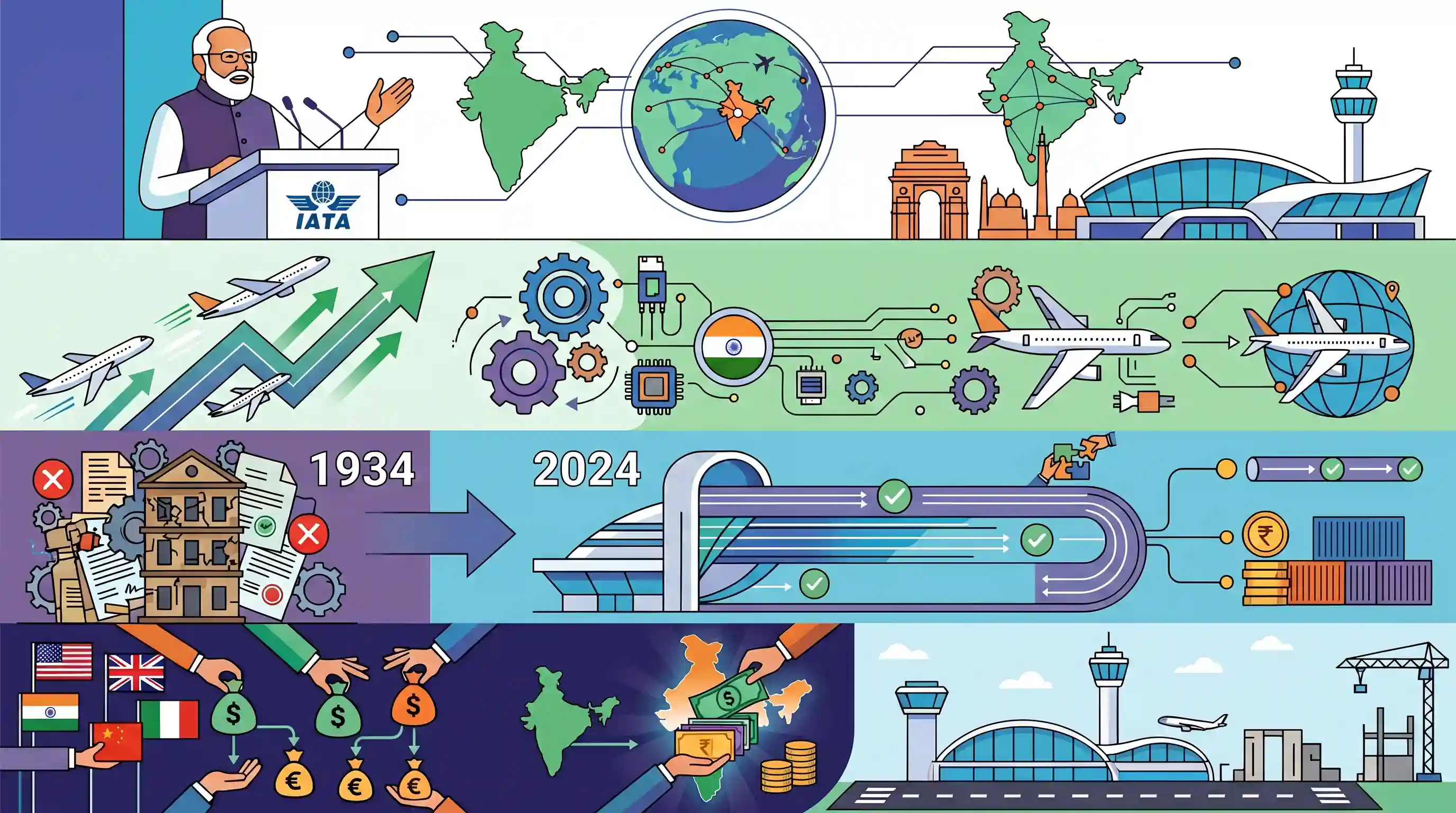
At the Annual General Meeting of the International Air Transport Association (IATA) in New Delhi, Prime Minister Narendra Modi highlighted the immense investment opportunities in India's fast-growing aviation sector. He emphasized that India is becoming a vital part of the global supply chain and seeks to be an aviation value-chain leader rather than just a massive market. He cited the recent passage of the Bharatiya Vayuyan Adhiniyam, 2024, which replaced the 1934 Aircraft Act. This legislation aims to streamline regulations, ensure ease of compliance, and simplify tax structures, signaling India's commitment to creating a favorable environment for international aviation companies and boosting foreign investment in infrastructure.
Key Points
- Prime Minister Narendra Modi, addressing the IATA AGM, projected India as a prime destination for global aviation investments.
- India aims to transition from merely being an aviation consumer market to a comprehensive value-chain leader and integral part of the global supply chain.
- The recently enacted Bharatiya Vayuyan Adhiniyam, 2024, replaces the outdated Aircraft Act of 1934 to align India's aviation regulations with global best practices.
- The new act provides a streamlined regulatory framework, eases compliance, and simplifies the tax structure to attract international aviation firms.
Important Terms
Bharatiya Vayuyan Adhiniyam, 2024

A 2024 legislation replacing the 1934 Aircraft Act to modernize India's aviation regulatory framework, streamline compliance, and promote indigenous manufacturing and global safety standards.
UPSC context
GS Paper 3: Infrastructure and Statutory Bodies; critical for understanding regulatory reforms in civil aviation and 'Ease of Doing Business'.
Aircraft Act of 1934
The primary colonial-era law that governed the manufacture, possession, use, and operation of aircraft in India for 90 years before its replacement in 2024.
UPSC context
Historical context for legislative evolution in GS Paper 2/3, highlighting the shift from colonial-era regulations to modern governance.
International Air Transport Association (IATA)
A global trade association representing approximately 330 airlines, responsible for setting industry standards for safety, security, efficiency, and sustainability in air transport.
UPSC context
GS Paper 2: International Organizations; relevant for global trade standards and India's position in the global aviation market.
Directorate General of Civil Aviation (DGCA)
India's principal regulatory body for civil aviation, responsible for safety oversight, licensing of personnel, and airworthiness standards under the Ministry of Civil Aviation.
UPSC context
GS Paper 3: Statutory Bodies; essential for understanding the executive and regulatory framework of India's aviation sector.
Bureau of Civil Aviation Security (BCAS)
The regulatory authority for civil aviation security in India, tasked with laying down standards and measures for the security of civil flights and airports.
UPSC context
GS Paper 3: Internal Security and Infrastructure; relevant for topics concerning aviation safety and security protocols.
Greenfield Airports
A new airport project developed on previously undeveloped land, characterized by modern infrastructure and often involving private investment through PPP models.
UPSC context
GS Paper 3: Investment Models and Infrastructure; critical for understanding urban planning and aviation sector growth.
Prelims Trap
IATA is a specialized agency of the United Nations responsible for setting international aviation safety regulations.
IATA is a private global trade association of airlines. It is ICAO (International Civil Aviation Organization) that is the UN specialized agency governing international air navigation and safety standards.
Static Concepts Connected
What is the difference between IATA and ICAO in global aviation?
- IATA: A global trade association for commercial airlines founded in 1945, focusing on industry operational standards, ticketing, and financial settlements.
- ICAO: A specialized agency of the United Nations that coordinates the principles and techniques of international air navigation and fosters safe global airspace.
What are the current FDI limits in India's civil aviation sector?
- Scheduled Airlines: 100% FDI is permitted, but only up to 49% is via the automatic route. Investments beyond 49% require government approval.
- NRI Investors: Non-Resident Indians (NRIs) are uniquely permitted 100% FDI under the automatic route for scheduled air transport services.
- Airport Infrastructure: 100% FDI is permitted under the automatic route for both greenfield and brownfield airport projects.
Cross-Topic Patterns
Decolonization of Indian Statutes
The Bharatiya Vayuyan Adhiniyam 2024 replacing the 1934 Aircraft Act mirrors the recent overhaul of colonial-era criminal codes (BNS, BNSS), showing a clear administrative trend in modernization.
Aviation MRO and Make in India
The push to become an aviation "value-chain leader" relies heavily on developing a domestic Maintenance, Repair, and Overhaul (MRO) sector, closely tying civil aviation policy to 'Make in India' and taxation reforms.

Expect a comparative Prelims statement on IATA vs ICAO alongside the nuanced FDI limits for scheduled airlines in India in 2026.
Linked PYQs · 4
Linked PYQs · 4
- 2024MainsGS3
What is the need for expanding the regional air connectivity in India? In this context, discuss the government's UDAN Scheme and its achievements.
- 2017MainsGS3
Examine the development of Airports in India through joint ventures under Public-Private Partnership (PPP) model. What are the challenges faced by the authorities in this regard?
- 2021MainsGS3
“Investment in infrastructure is essential for more rapid and inclusive economic growth.” Discuss in the light of India's experience.
- 2024PrelimsGS1
Consider the following materials : 1. Agricultural residues 2. Corn grain 3. Wastewater treatment sludge 4. Wood mill waste Which of the above can be used as feedstock for producing Sustainable Aviation Fuel?
