West Asia crisis impact on Indian diaspora and energy security
Source:The Hindu ↗
Why It Matters
The article bridges critical international geopolitical events (West Asia crisis) with their direct domestic implications for India (energy security and diaspora safety). It also touches upon essential social issues like integrating the youth of Jammu & Kashmir through sports (a 'hearts and minds' strategy for internal security) and preserving India's cultural heritage.
Summary
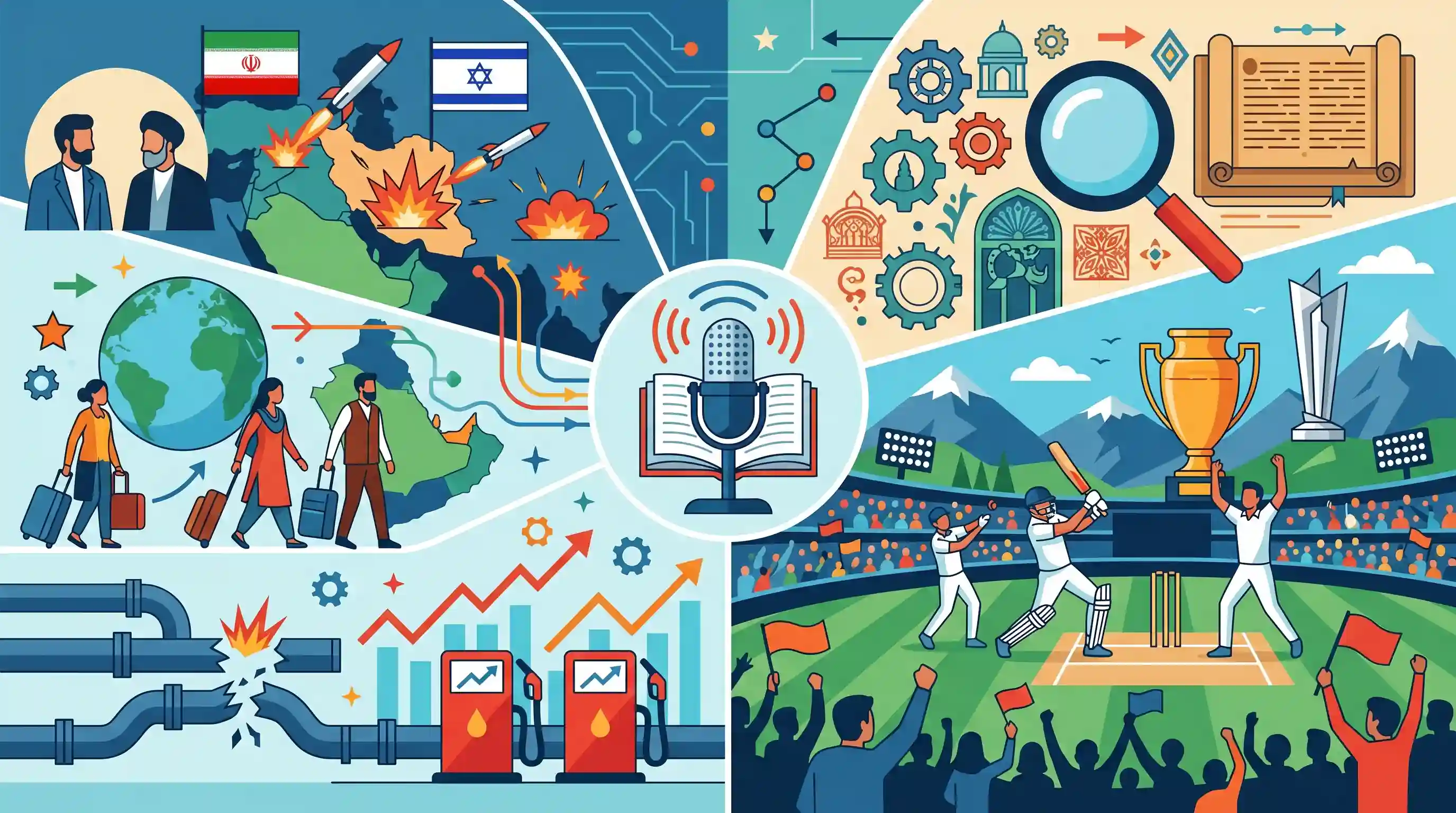
Prime Minister Narendra Modi used his 'Mann Ki Baat' broadcast to address multiple national and international issues, prominently the escalating Iran-Israel conflict in West Asia. He expressed concern for the millions of Indians living in the Gulf and the conflict's impact on global energy supplies, specifically petrol and diesel. Alongside geopolitical concerns, the PM highlighted domestic capacity-building and cultural preservation initiatives like the Gyan Bharatam Survey and the MY Bharat Budget Quest. He also celebrated India's T20 World Cup win and the Jammu and Kashmir cricket team's historic Ranji Trophy victory, noting that sports are playing a pivotal role in mainstreaming youth in J&K.
Key Points
- Prime Minister Narendra Modi, during his March 29, 2026 'Mann Ki Baat' address, addressed the ongoing West Asia crisis (Iran-Israel war), describing the period as 'challenging times'.
- He highlighted the vulnerability of over 1 crore Indians working in the Gulf and the conflict's potential impact on India's energy security, leading to potential petrol and diesel crises.
- He urged the public to rely on verified government information rather than rumours and warned against politicising the issue.
- PM Modi praised initiatives like the Gyan Bharatam Survey for manuscript preservation via crowdsourcing and the MY Bharat Budget Quest for engaging youth in the policymaking process.
- He lauded the historic maiden Ranji Trophy victory of the Jammu and Kashmir cricket team, emphasising J&K's transformation into a sporting hub as a positive step for youth engagement.
Important Terms
Mann Ki Baat

A monthly radio program initiated in 2014 where the Prime Minister communicates directly with citizens on various national and social issues.
UPSC context
GS Paper II (Governance); tests understanding of direct communication as a tool for "Jan Bhagidari" (public participation) and behavioral change.
Gyan Bharatam Survey
A nationwide initiative by the Ministry of Culture to map, document, and digitize India's vast manuscript heritage using a dedicated mobile application.
UPSC context
GS Paper I (Art and Culture); significant for the preservation of Indian Knowledge Systems (IKS) and preventing intellectual piracy of ancient texts.
Mera Yuva Bharat (MY Bharat)
An autonomous body under the Ministry of Youth Affairs and Sports providing a digital platform for youth-led development and nation-building opportunities.
UPSC context
GS Paper II (Social Justice/Education); focuses on empowering youth (15-29 years) as drivers for the "Viksit Bharat @2047" vision.
Khelo India Winter Games
A national-level multidisciplinary competition held in the Himalayan region to promote winter sports, talent identification, and regional tourism.
UPSC context
GS Paper II & III (Internal Security/Development); tests the role of sports in mainstreaming youth in sensitive areas like J&K.
Jammu and Kashmir cricket team
The regional sports body representing Jammu and Kashmir in domestic cricket, recently celebrated for its historic Ranji Trophy successes.
UPSC context
GS Paper III (Internal Security); illustrative of the "Winning Hearts and Minds" strategy to integrate youth in conflict-prone regions.
MY Bharat Budget Quest
A youth engagement program on the MY Bharat portal designed to simplify the Union Budget and involve young citizens in policy discourse.
UPSC context
GS Paper II (Governance); highlights youth participation in the democratic process and budgetary awareness.
West Asia Conflict
The geopolitical tension between Iran and Israel, impacting regional stability, global oil prices, and the Indian diaspora.
UPSC context
GS Paper II (International Relations); critical for assessing India's energy security and strategic interests in the Gulf region.
Prelims Trap
"The Gyan Bharatam Survey is an initiative by the Ministry of Education to assess foundational literacy."
It is actually a crowdsourcing initiative launched by the Ministry of Culture specifically to map, document, and digitise ancient Indian manuscripts.
Static Concepts Connected
How do West Asian maritime chokepoints impact India's energy security?
- Strait of Hormuz: Links the Persian Gulf to the Gulf of Oman; handles a massive share of global oil transit. Disruption directly spikes India's crude oil import bill.
- Bab-el-Mandeb: Connects the Red Sea to the Gulf of Aden. Vital for Suez Canal transit; disruptions force longer, costlier shipping routes via the Cape of Good Hope.
What are the institutional mechanisms protecting the Indian diaspora?
- ICWF: The Indian Community Welfare Fund (ICWF) provides contingency financial assistance, boarding, and legal aid to overseas Indian citizens in distress.
- Evacuation Operations: Rapid response strategies implemented during geopolitical crises, demonstrated in past missions like Operation Ajay (Israel) and Operation Rahat (Yemen).
Cross-Topic Patterns
Sports as Internal Security tool
Celebrating J&K's Ranji Trophy win highlights a soft-power internal security strategy: using sports to de-radicalise, build trust, and mainstream youth in conflict-affected regions.
Crowdsourcing Cultural Preservation
The Gyan Bharatam Survey reflects a shift towards citizen-led tech (mobile crowdsourcing) for heritage preservation, complementing the static National Mission for Manuscripts.

Expect a 2026 Prelims match-the-following on recent portals: Gyan Bharatam (Culture) vs MY Bharat Budget Quest (Youth Affairs).
Linked PYQs · 4
Linked PYQs · 4
- 2018MainsGS2
“India’s relations with Israel have, of late, acquired a depth and diversity, which cannot be rolled back.” Discuss.
- 2023MainsGS2
Indian diaspora has scaled new heights in the West. Describe its economic and political benefits for India.
- 2018MainsGS1
Safeguarding the Indian art heritage is the need of the moment. Discuss.
- 2023MainsGS3
Winning of 'Hearts and Minds' in terrorism-affected areas is an essential step in restoring the trust of the population. Discuss the measures adopted by the Government in this respect as part of the conflict resolution in Jammu and Kashmir.
