Karaikal fishing harbour modernisation project launched under PMMSY
Source:The Hindu ↗
Why It Matters
Modernising coastal infrastructure and upgrading fishing harbours are vital for minimising post-harvest losses, enhancing the export competitiveness of India's marine products, and doubling fishers' incomes under the broader ambitions of the Blue Economy and PMMSY.
Summary
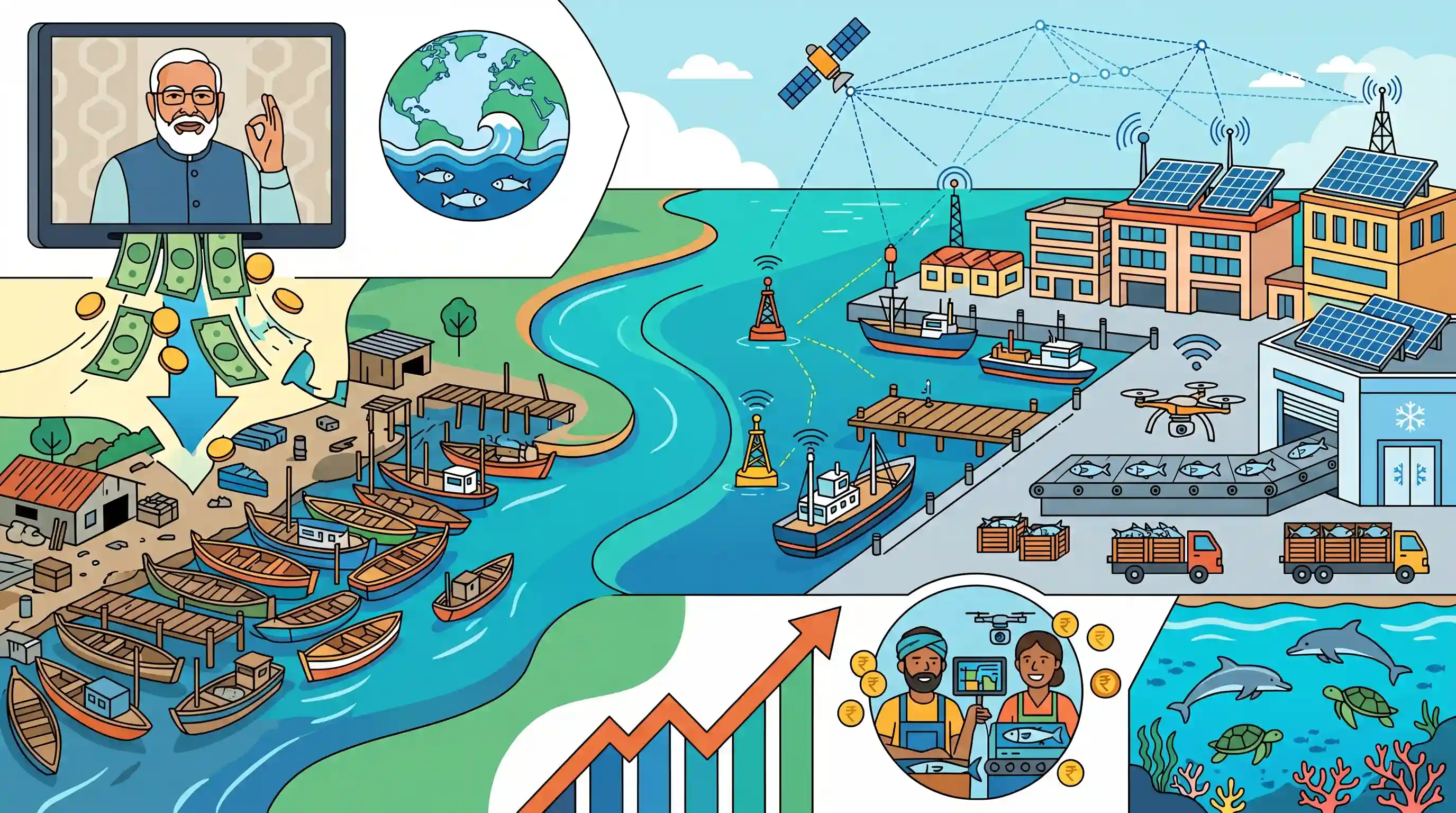
Prime Minister Narendra Modi virtually inaugurated the foundation for a ₹130-crore Smart and Integrated Fishing Harbour Development Project in Karaikal, Puducherry. Administered under the Pradhan Mantri Matsya Sampada Yojana (PMMSY), the initiative targets severe harbour congestion by expanding capacity along the Mullaiyar river and implementing state-of-the-art infrastructure. As a pilot location, Karaikal's harbour will feature IoT-based monitoring, satellite communication, modern fish handling, and solar power installations, aligning with India's broader Blue Revolution goals to ensure sustainable fisheries and empower local communities.
Key Points
- PM Narendra Modi laid the foundation for the ₹130-crore Smart and Integrated Fishing Harbour Development Project in Karaikal, Puducherry.
- The project is funded under the Pradhan Mantri Matsya Sampada Yojana (PMMSY) to promote sustainable fisheries development as part of the Blue Revolution.
- Karaikal is selected as a pilot location for this smart harbour initiative to address extreme vessel congestion.
- The modernised harbour will integrate IoT-based monitoring, satellite communications, cybersecurity measures, 100% solar power setups, and advanced effluent treatment systems.
- Upon completion, the expanded facility will accommodate 250 mechanised and 1,000 motorised vessels while spurring local employment.
Important Terms
Pradhan Mantri Matsya Sampada Yojana (PMMSY)

A flagship scheme launched in 2020 to ensure sustainable development of the fisheries sector through modernization, productivity enhancement, and infrastructure investment of over ₹20,000 crore.
UPSC context
GS Paper III (Economy/Agriculture); tests knowledge of government interventions in allied sectors and strategies for doubling farmers' income.
Blue Economy
The sustainable use of ocean resources for economic growth, improved livelihoods, and jobs while preserving the health of the marine ecosystem.
UPSC context
GS Paper III (Economy/Environment); essential for maritime security, resource management, and Sustainable Development Goal (SDG) 14.
Blue Revolution
A movement (Neel Kranti) focused on the rapid growth of fish and aquatic production through modern aquaculture practices and intensive fisheries management.
UPSC context
GS Paper III (Agriculture); focuses on the evolution of primary sector revolutions and current seafood export strategies.
Smart and Integrated Fishing Harbour
Modern maritime infrastructure featuring IoT, satellite communication, and renewable energy to optimize vessel docking, hygienic handling, and post-harvest management efficiency.
UPSC context
GS Paper III (Infrastructure); tests understanding of tech-driven infrastructure development in coastal regions and logistics optimization.
IoT in Fisheries
The use of connected sensors and data analytics to monitor catch volumes, water quality, and weather in real-time for improved traceability and safety.
UPSC context
GS Paper III (Science & Technology); focuses on the application of Industry 4.0 technologies in traditional economic sectors.
Prelims Trap
India's vast coastline ensures that marine fisheries contribute the absolute majority of the country's total fish production.
False. Despite a 7,500+ km coastline and a vast EEZ, inland fisheries actually dominate, accounting for over 70% of India's total fish production.
Static Concepts Connected
What are the core implementation features of the Pradhan Mantri Matsya Sampada Yojana (PMMSY)?
- Funding structure: Implemented as an umbrella scheme with two separate components: Central Sector Scheme (CS) and Centrally Sponsored Scheme (CSS).
- Cluster approach: Adopts a 'cluster or area-based approaches' with backward and forward linkages to create fisheries hubs and boost export competitiveness.
- Infrastructure push: Prioritises creating modern infrastructure, cold chains, and traceability systems to reduce post-harvest losses from the current 20-25% to about 10%.
How does international law define the Exclusive Economic Zone (EEZ)?
- UNCLOS baseline: Extends up to 200 nautical miles from the baseline, as defined by the UN Convention on the Law of the Sea (UNCLOS).
- Sovereign rights: The coastal state has sovereign rights for exploring, exploiting, conserving, and managing natural resources (like fisheries and minerals) within this zone.
- Freedom of navigation: Other states still enjoy freedoms of navigation, overflight, and laying submarine cables and pipelines within a coastal state's EEZ.
Cross-Topic Patterns
Smart Harbours & Coastal Security
Integrating IoT and satellite tracking in fishing vessels doubles as a coastal security mechanism, filling critical tracking gaps for non-merchant boats post-26/11 alongside the coastal radar chain.
Decarbonising Maritime Infrastructure
Solar-powered fishing harbours parallel the Harit Sagar Guidelines, expanding India's zero-carbon footprint and environmental compliance from major commercial ports to localized, community-level fishing hubs.

Expect a 2026 prelims statement mixing PMMSY funding mechanisms with production data (inland > marine) and IoT/satellite traceability.
Linked PYQs · 3
Linked PYQs · 3
- 2018MainsGS1
Defining blue revolution, explain the problems and strategies for pisciculture development in India.
- 2020MainsGS3
What are the challenges and opportunities of food processing sector in the country? How can income of the farmers be substantially increased by encouraging food processing?
- 2014MainsGS1
Critically evaluate the various resources of the oceans which can be harnessed to meet the resource crisis in the world.
