RSS Advocates Primary Education in Mother Tongue Amid Language Debates
Source:The Hindu ↗
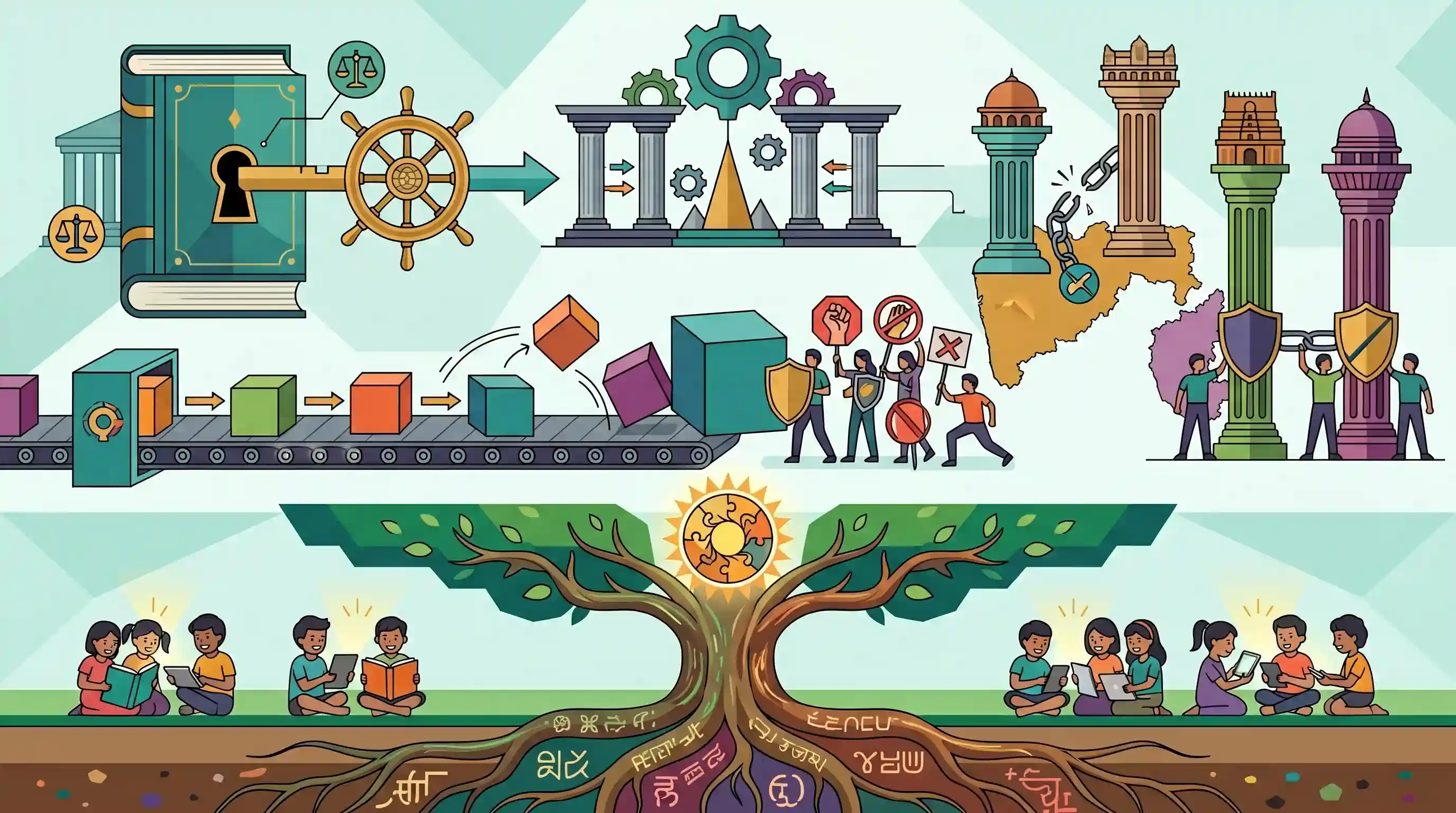
Why It Matters
Highlights the ongoing federal and socio-political tensions surrounding language policies in education. It is crucial for understanding the practical implementation of the National Education Policy (NEP) and Constitutional provisions like Article 350A, which mandates instruction in the mother tongue at the primary stage.
Summary
The Rashtriya Swayamsevak Sangh (RSS) has emphasized that primary education should be conducted in the mother tongue, declaring that all Indian languages hold the status of national languages. This stance follows ongoing protests and controversies in Maharashtra, Karnataka, and Tamil Nadu against the three-language formula, which critics interpret as an attempt to impose Hindi. Recently, Maharashtra rolled back orders that introduced a third language in primary schools. The National Education Policy (NEP) decentralizes this issue, granting individual states the prerogative to decide on implementing the three-language policy. The issue underscores the broader political and federal friction over linguistic identity and educational autonomy in India.
Key Points
- The RSS affirmed that primary education must be imparted in the mother tongue, asserting that all Indian languages are considered 'national languages.'
- The statement arrives amidst widespread controversies and protests over the three-language policy in states like Maharashtra, Karnataka, and Tamil Nadu.
- The Maharashtra government recently revoked two orders that introduced a third language in primary education, a move critics labeled as an imposition of Hindi.
- The Marathi Abhyas Kendra has urged the total withdrawal of the three-language policy in State Board schools.
- Under the National Education Policy (NEP), the implementation of the three-language formula is left to the discretion of individual States.
Important Terms
National Education Policy (NEP) 2020

A 2020 framework replacing the 1986 policy, aiming to overhaul Indian education through holistic learning, a 5+3+3+4 curricular structure, and vocational integration.
UPSC context
GS Paper II (Governance/Education); GS Paper I (Social Issues). Tests understanding of major policy shifts and human capital development.
Three-Language Formula
A 1968 policy reaffirmed by NEP 2020, prescribing three languages—mother tongue, English/Hindi, and another modern Indian language—to foster national integration and multilingualism.
UPSC context
GS Paper II (Polity/Federalism). Essential for discussing linguistic diversity, anti-Hindi imposition protests, and Union-State relations.
Rashtriya Swayamsevak Sangh (RSS)
An influential volunteer organization and ideological mentor of the BJP that advocates for "India-centric" education, emphasizing regional languages and ancient Indian values in national policy.
UPSC context
GS Paper II (Pressure Groups). Tests the role of extra-constitutional organizations in policy formulation and ideological shifts.
Mother Tongue Education
Pedagogical practice mandated by NEP 2020 for instruction until Grade 5, grounded in the belief that children learn best in their primary home language.
UPSC context
GS Paper II (Social Sector-Education). Relevant for arguments on cognitive development, inclusivity, and preserving linguistic heritage.
Marathi Abhyas Kendra
A Marathi linguistic advocacy group that organizes protests against the closure of Marathi-medium schools and promotes the preservation of regional language infrastructure.
UPSC context
GS Paper I (Regionalism). A case study of civil society action defending sub-national linguistic identity against administrative homogenization.
Federalism in Education
The constitutional distribution of power where Education lies in the Concurrent List, allowing both Centre and States to legislate, often leading to policy friction.
UPSC context
GS Paper II (Polity). Tests understanding of Seventh Schedule dynamics and state autonomy in implementing central guidelines.
Prelims Trap
"NEP 2020 mandates the use of mother tongue as the medium of instruction for all students up to Grade 5."
The NEP only *recommends* mother tongue instruction "wherever possible"; it is not legally binding. Additionally, beware of statements claiming Hindi is India's "National Language"—India only has Official Languages.
Static Concepts Connected
What are the Constitutional safeguards for linguistic minorities and mother-tongue education?
- Article 350A: Directs States to endeavor to provide adequate facilities for instruction in the mother tongue at the primary stage for children of linguistic minority groups.
- Article 350B: Provides for a Special Officer for Linguistic Minorities, appointed by the President, to investigate all matters relating to linguistic safeguards.
- Article 29: Grants any section of citizens residing in India the fundamental right to conserve their distinct language, script, or culture.
How did the Three-Language Formula evolve in India?
- Kothari Commission: First proposed the formula (1964-66) to promote national integration, balancing Hindi, English, and regional languages.
- NPE 1968: Formally adopted the formula, expecting non-Hindi states to teach Hindi/English/regional language, and Hindi states to teach Hindi/English/South Indian language.
- NEP 2020: Retains the formula but emphasizes flexibility, explicitly stating that no language will be imposed on any State.
Cross-Topic Patterns
Federal friction in the Concurrent List
Education's shift to the Concurrent List (42nd Amendment) means central frameworks like the NEP must constantly negotiate with State-level cultural and linguistic autonomy.
Legacy of linguistic reorganization
Current pushback in Tamil Nadu and Karnataka against the three-language formula directly links to post-independence linguistic reorganization and anxieties surrounding the Official Languages Act of 1963.

Expect a 2026 Prelims question mixing Article 350A, Eighth Schedule languages, and NEP 2020's specific mother-tongue recommendations.
Linked PYQs · 3
Linked PYQs · 3
- 2001PrelimsGS1
Which Article of the Constitution provides that it shall be the endeavour of every State to provide adequate facility for instruction in the mother tongue at the primary stage of education?
- 2020MainsGS2
National Education Policy 2020 is in conformity with the Sustainable Development Goal-4 (2030). It intends to restructure and reorient education system in India. Critically examine the statement.
- 2022MainsGS2
“While the national political parties in India favour centralisation, the regional parties are in favour of State autonomy.” Comment.
