Primary Agricultural Credit Societies Modernization Progress
Source:The Hindu ↗
Why It Matters
The transformation of PACS showcases the government's approach to revitalizing the cooperative sector and decentralizing rural service delivery. This directly addresses the GS3 focus on agricultural credit, rural infrastructure, and the cooperative model, as well as the GS2 emphasis on grassroots e-governance via CSC integration.
Summary
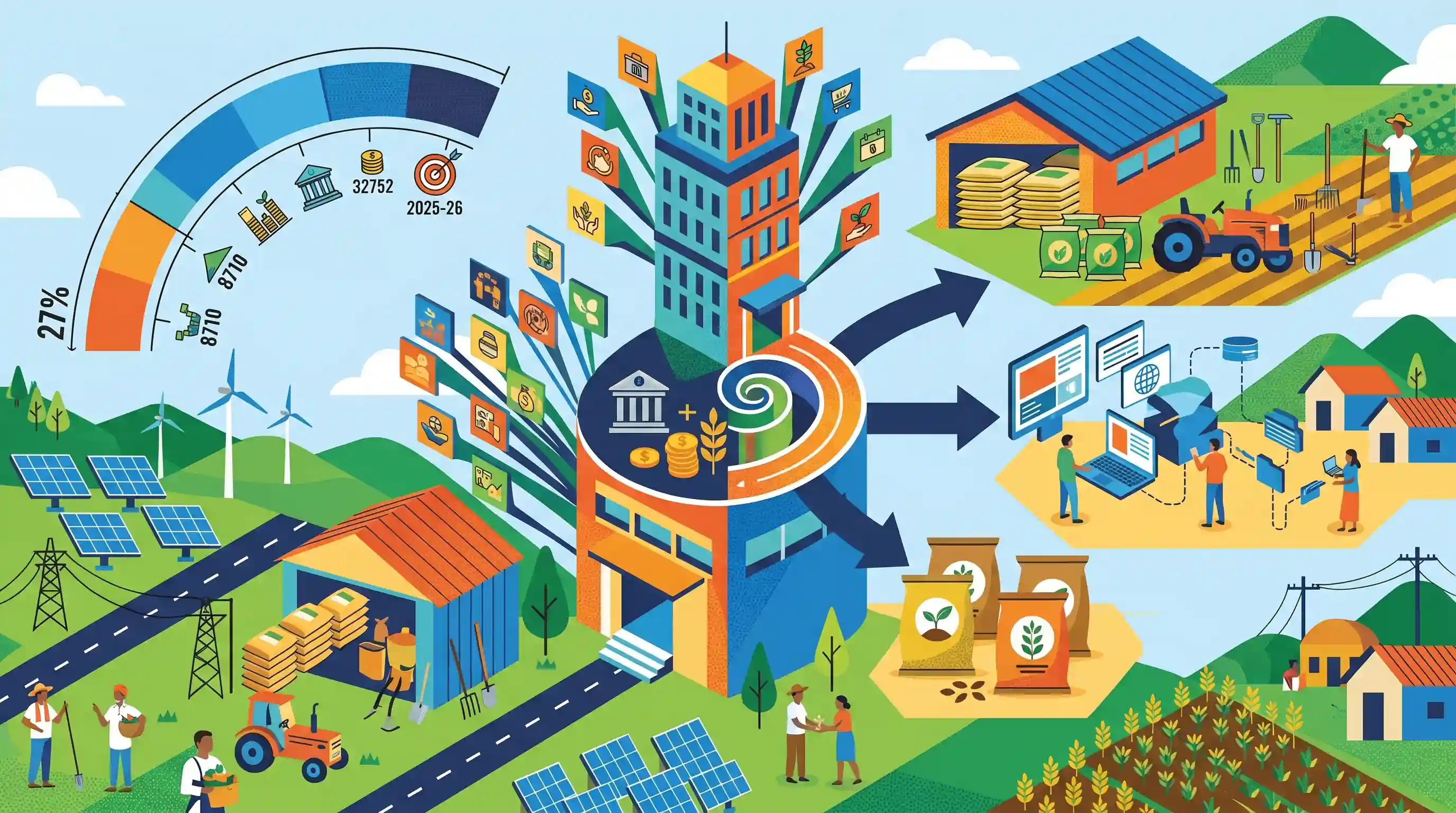
The Union Minister of Cooperation informed the Rajya Sabha that 8,710 Primary Agricultural Cooperative Societies (PACS) have been established, achieving 27% of the overall target to set up 32,752 PACS by 2025-26. A key focus is transforming these traditional agricultural credit societies into multipurpose economic hubs. Driven by the new Model Bye-laws, PACS are now expanding their scope to over 25 diversified activities. This includes serving as Pradhan Mantri Kisan Samriddhi Kendras (PMKSK) for fertilizer distribution, operating as Common Service Centres (CSCs) for e-governance, and facilitating seed distribution through the Bharatiya Beej Sahakari Samiti Limited.
Key Points
- 8,710 Primary Agricultural Cooperative Societies (PACS) have been established, reaching 27% of the government's target of 32,752 by 2025-26.
- Odisha leads among the states with the highest number of new PACS setups, followed by Rajasthan and Uttar Pradesh.
- New Model Bye-laws have enabled PACS to diversify into more than 25 business activities, shifting them from traditional credit institutions to multipurpose economic entities.
- PACS are integrating into various rural service delivery frameworks, serving as Common Service Centres (CSCs) providing over 300 e-services, and acting as PMKSKs for agricultural inputs.
Important Terms
Primary Agricultural Cooperative Societies (PACS)

Grassroots-level cooperative credit institutions providing short and medium-term agricultural loans to farmers. They serve as the final link in India's three-tier cooperative credit structure.
UPSC context
GS Paper 3 (Agriculture); vital for rural credit, financial inclusion, and the 'Sahakar se Samriddhi' vision.
Model Bye-laws for PACS
A standard legal framework provided by the Ministry of Cooperation enabling PACS to diversify into 25+ economic activities like dairy, fishery, and storage to ensure economic viability.
UPSC context
GS Paper 2 (Governance); relates to cooperative sector reforms and administrative modernization of rural institutions.
Bharatiya Beej Sahakari Samiti Limited (BBSSL)
An apex multi-state cooperative society established in 2023 to manage the production, procurement, certification, branding, and distribution of quality seeds across India through the cooperative network.
UPSC context
GS Paper 3 (Agriculture); relates to seed security, improving seed replacement rates, and cooperative-led growth.
Pradhan Mantri Kisan Samriddhi Kendras (PMKSK)
'One-stop shop' centers converted from fertilizer retail outlets to provide farmers with fertilizers, seeds, equipment, soil testing, and expert advisory services under a single roof.
UPSC context
GS Paper 3 (Agriculture); focuses on input supply chains, reducing cultivation costs, and modernizing extension services.
Common Service Centres (CSCs)
Digital access points providing e-governance, financial, and social welfare services to rural areas. They are being integrated into PACS to deliver over 300 e-services at panchayat levels.
UPSC context
GS Paper 2 (E-Governance); vital for bridging the digital divide and ensuring last-mile delivery of public services.
Bharat Beej brand
The unified brand name for high-quality, certified seeds produced and marketed by BBSSL, focusing on high-yield, traditional, and natural seed varieties.
UPSC context
GS Paper 3 (Agriculture); relevant for seed sovereignty, indigenous variety conservation, and branding in the agri-sector.
Prelims Trap
"PACS are exclusively short-term credit providers and fall under the direct administrative control of the Reserve Bank of India."
PACS are now multipurpose hubs (handling >25 activities like seeds and CSCs). Also, they are administratively controlled by State Governments, not directly by the RBI.
Static Concepts Connected
What is the 3-tier Short-Term Cooperative Credit Structure in India?
- State level: State Co-operative Banks (StCBs) act as the apex institution at the state level.
- District level: District Central Co-operative Banks (DCCBs) operate at the district level.
- Village level: Primary Agricultural Credit Societies (PACS) form the foundation, operating at the village or panchayat level.
What are the Constitutional provisions regarding Cooperative Societies?
- 97th Amendment: The 97th Constitutional Amendment Act of 2011 gave constitutional status and protection to cooperative societies.
- Fundamental Right: Article 19(1)(c) guarantees the right to form cooperative societies as a Fundamental Right.
- DPSP: Article 43B (a DPSP) directs the State to promote voluntary formation and democratic control of cooperatives.
- Part IXB: Part IXB (Articles 243ZH to 243ZT) details the incorporation, board terms, and audit of cooperative societies.
Cross-Topic Patterns
PACS as Digital India rural nodes
Utilizing PACS as Common Service Centres (CSCs) merges traditional agricultural credit networks with e-governance delivery, directly tackling GS2 rural digital divide and service delivery themes.
PMKSK & rural input security
PACS converting into Pradhan Mantri Kisan Samriddhi Kendras (PMKSKs) integrates grassroots credit societies with the broader GS3 themes of unified fertilizer availability and input-security for farmers.

Expect a 2026 multi-statement Prelims question merging PACS' new multipurpose roles (CSCs, PMKSKs) with their constitutional status.
Linked PYQs · 3
Linked PYQs · 3
- 2014MainsGS3
In the villages itself no form of credit organization will be suitable except the cooperative society. -All India Rural Credit Survey. Discuss this statement in the background of agricultural finance in India. What constraints and challenges do financial institutions supplying agricultural finance face? How can technology be used to better reach and serve rural clients?
- 2024MainsGS2
e-governance is not just about the routine application of digital technology in service delivery process. It is as much about multifarious interactions for ensuring transparency and accountability. In this context evaluate the role of the 'Interactive Service Model' of e-governance.
- 2025MainsGS2
e-governance projects have a built-in bias towards technology and back-end integration than user-centric designs. Examine.
