Consumer Price Index inflation trends and monetary policy challenges
Source:The Hindu ↗
Why It Matters
Understanding the distinction between supply-side and demand-side inflation is crucial for evaluating the effectiveness and limitations of the RBI's monetary policy. This article perfectly illustrates how geopolitical conflicts and climatic events (like El Niño) directly influence domestic inflation via fertilizer and energy prices, a recurring analytical theme in GS3 Mains and Prelims economy questions.
Summary
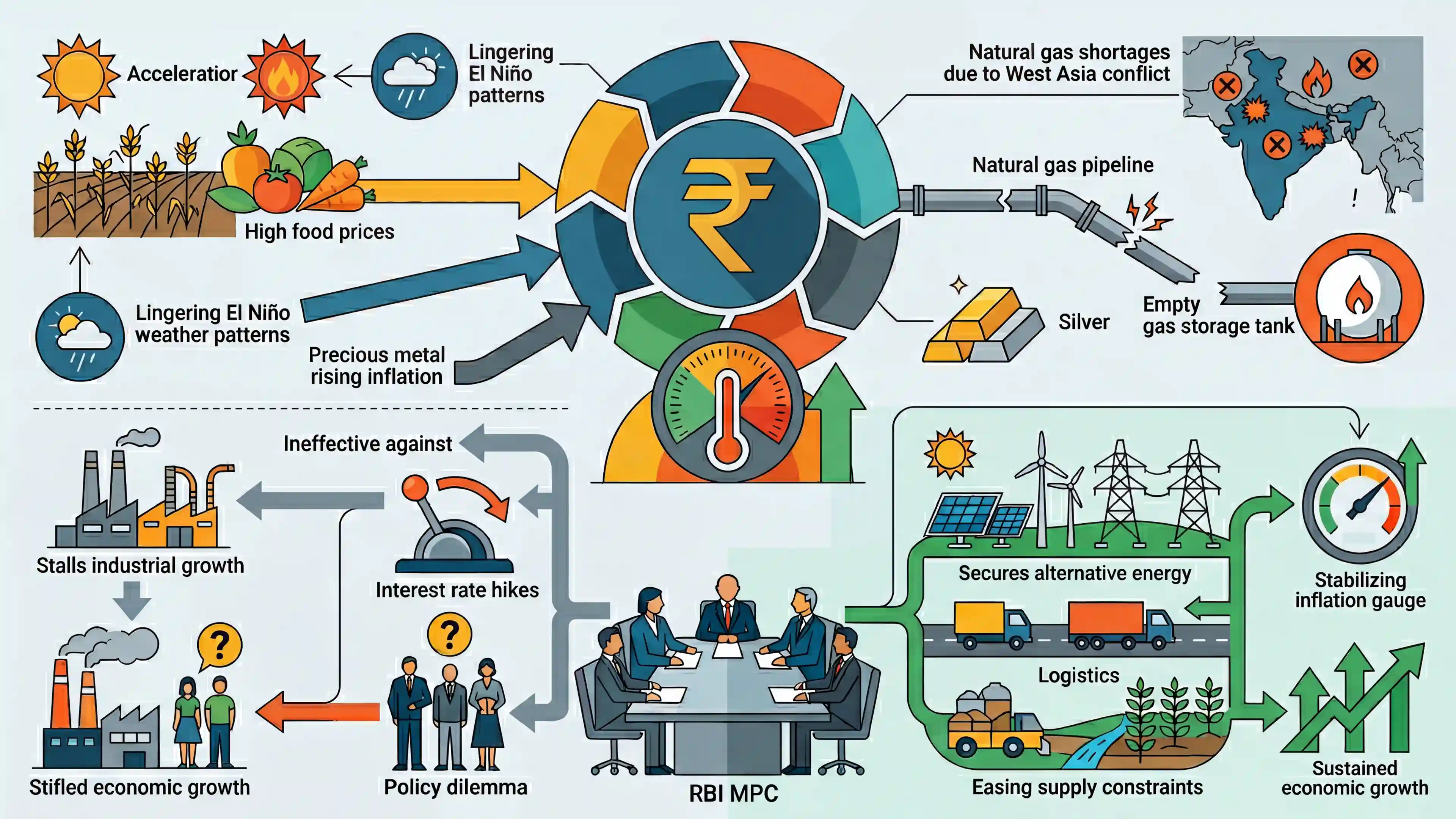
The editorial analyzes India's retail inflation, which accelerated to 3.2% in February 2026 under the new Consumer Price Index (CPI) series, driven by soaring food and precious metal prices. It highlights how structural supply-side issues, such as the lingering effects of El Niño on agriculture and natural gas shortages stemming from the West Asia conflict, are fueling this inflation. Consequently, the RBI's Monetary Policy Committee (MPC) faces a policy dilemma, as utilizing interest rate hikes to curb demand would be ineffective against supply-side shocks and could inadvertently stifle economic growth. The piece calls for government action to secure alternative energy sources and ease supply constraints.
Key Points
- India's retail inflation accelerated to 3.2% in February 2026, as measured by the new Consumer Price Index (CPI) series.
- The inflationary spike is heavily driven by the food basket (3.35%), particularly tomatoes (45%), meat, and oils, as well as surging precious metal prices (gold up 48.2%, silver up >160%).
- Agricultural output and food prices continue to face pressures from the lingering climatic effects of El Niño on the Indian monsoon.
- Geopolitical conflicts in West Asia have constrained natural gas supplies, leading to higher fertilizer costs and elevated input costs for food production.
- The RBI's Monetary Policy Committee (MPC) faces a dilemma, as hiking interest rates to suppress demand is largely ineffective against supply-side inflation and risks dampening economic growth.
- The government must proactively intervene to secure alternative fuel supplies (like LPG and LNG) and address structural supply-chain bottlenecks to effectively control inflation.
Important Terms
Consumer Price Index (CPI)

A statistical measure tracking retail price changes in a fixed basket of goods and services. It is India's primary indicator for measuring inflation and guiding monetary policy decisions.
UPSC context
GS-III: Indian Economy. Tests understanding of retail inflation metrics, base year updates, and their role in macroeconomic stability and policy formulation.
Monetary Policy Committee (MPC)
A six-member statutory body, chaired by the RBI Governor, mandated to fix the benchmark interest rate (repo rate) to maintain price stability within a 2-6% target.
UPSC context
GS-III: Indian Economy. Focuses on institutional frameworks for inflation targeting, statutory mandates, and central bank tools for economic management.
Reserve Bank of India (RBI)
India's central bank and regulatory authority established in 1935. It manages monetary policy, issues currency, supervises the banking sector, and ensures the country's financial stability.
UPSC context
GS-III: Indian Economy. Essential for understanding central banking functions, regulatory frameworks, and the relationship between finance and national growth.
El Niño
A climatic phenomenon marked by unusual warming of Pacific Ocean waters, which typically disrupts global weather patterns and often causes deficient monsoon rainfall in India.
UPSC context
GS-I: Physical Geography and GS-III: Agriculture. Tests impact of global climatic cycles on monsoons, crop yields, and rural economic stability.
Supply-side Inflation
A type of inflation caused by rising production costs, such as higher energy prices or raw material shortages, which decrease the overall supply of goods.
UPSC context
GS-III: Indian Economy. Evaluates ability to distinguish between demand and supply shocks and their unique implications for monetary policy.
Energy Security
The reliable and affordable availability of energy resources necessary to sustain economic growth. For India, this includes reducing import dependency and diversifying energy sources.
UPSC context
GS-III: Infrastructure and Energy. Assesses strategies for managing resource import dependence and ensuring sustainable power for industrial development.
Prelims Trap
"The new 2024 CPI series increases the weight of Food & Beverages to reflect surging retail food inflation."
Aspirants intuitively assume rising food prices mean food gets a higher weight. However, the new 2024 series actually reduced the Food & Beverages weight from 45.86% to 36.75%.
Static Concepts Connected
How does the RBI's Monetary Policy Committee target inflation?
- Headline CPI Target: The MPC targets 'Headline CPI' (including volatile food and fuel), aiming for 4% with a +/- 2% tolerance band.
- Demand-side Tools: The MPC primarily uses the repo rate to manage liquidity and aggregate demand, which is largely ineffective against supply-side (cost-push) shocks.
- Core Inflation: Inflation excluding volatile food and fuel components. While closely monitored to gauge underlying inflation trends, it is not the official statutory target.
What are the key changes in the new CPI series (Base 2024)?
- New Base Year: The base year has been updated to 2024, replacing the old 2012 base year to better reflect current consumption patterns.
- Weightage Shifts: Food & Beverages weight dropped to 36.75%, while Housing increased to 17.67%. The basket expanded from 299 to 358 items.
- Digital Economy Inclusion: Aligned with the UN's COICOP 2018, explicitly including digital streaming (OTT) and e-commerce for the first time.
Cross-Topic Patterns
West Asia gas & Fertilizer subsidies
Geopolitical shocks in West Asia restrict global natural gas supplies, raising urea production costs. This links imported inflation directly to the government's fiscal deficit via surging agricultural fertilizer subsidies.
El Niño, Monsoons & Macroeconomics
Geographical phenomena like El Niño directly dictate macroeconomic policy. Supply-side food inflation from erratic monsoons forces the RBI to maintain tighter monetary policy, demonstrating the Geography-Economy overlap.

Expect a 2026 Prelims question testing the new CPI (Base 2024) weightages, specifically targeting the trap of reduced food weightages.
Linked PYQs · 5
Linked PYQs · 5
- 2024MainsGS3
What are the causes of persistent high food inflation in India? Comment on the effectiveness of the monetary policy of the RBI to control this type of inflation.
- 2020PrelimsGS1
Consider the following statements: 1. The weightage of food in Consumer Price Index (CPI) is higher than that in Wholesale Price Index (WPI). 2. The WPI does not capture changes in the prices of services, which CPI does. 3. Reserve Bank of India has now adopted WPI as its key measure of inflation and to decide on changing the key policy rates. Which of the statements given above is/are correct?
- 2017PrelimsGS1
Which of the following statements is/are correct regarding the Monetary Policy Committee (MPC)? 1. It decides the RBI's benchmark interest rates. 2. It is a 12-member body including the Governor of RBI and is reconstituted every year. 3. It functions under the chairmanship of the Union Finance Minister. Select the correct answer using the code given below:
- 2014MainsGS1
Most of the unusual climatic happenings are explained as an outcome of the El-Nino effect. Do you agree?
- 2017MainsGS2
The question of India's Energy Security constitutes the most important part of India's economic progress. Analyze India's energy policy cooperation with West Asian countries.
