Constitutional Framework and Preventive Detention
Source:The Hindu ↗
हे का महत्त्वाचे आहे
Understanding preventive detention and constitutional rights (Article 22) is critical for polity, governance, and maintaining the delicate balance between civil liberties and national security/public order.
सारांश
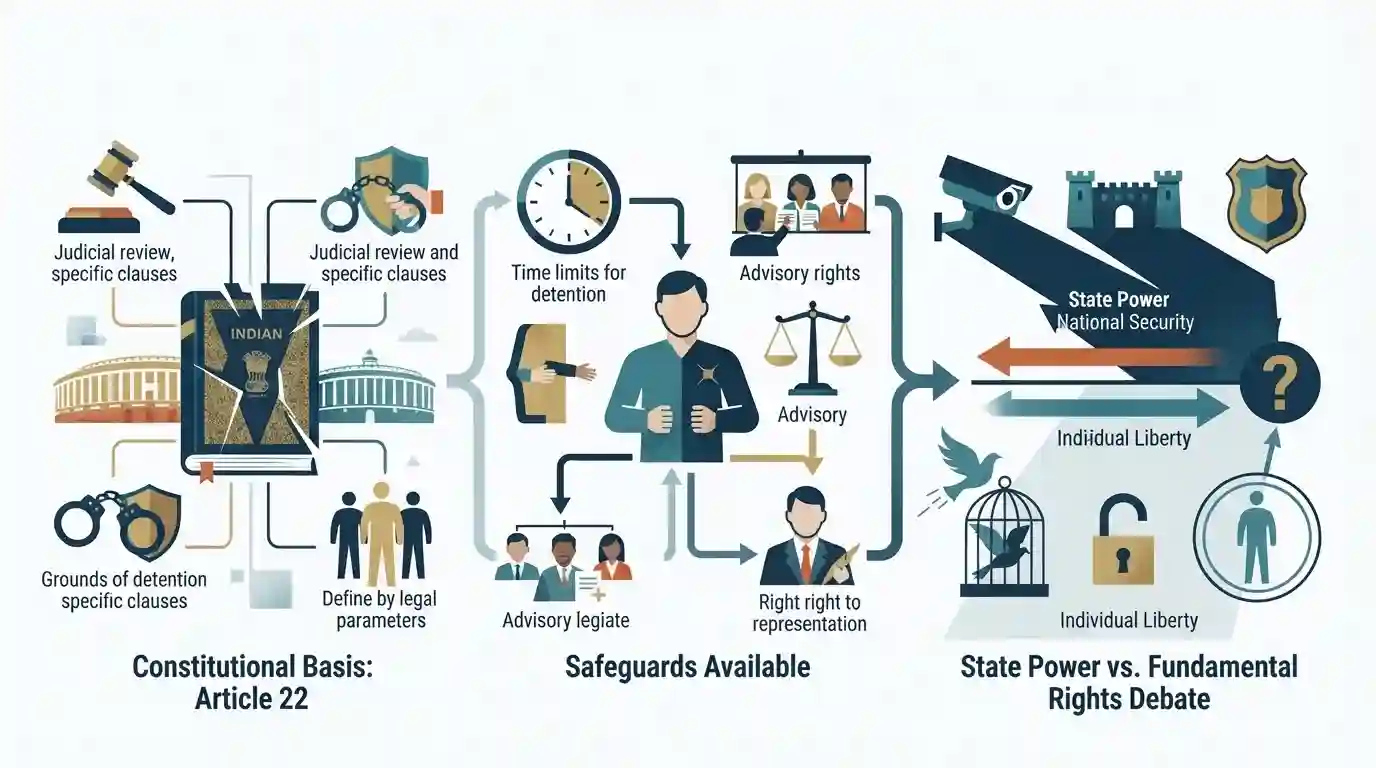
An analytical breakdown of preventive detention in India, exploring its constitutional basis under Article 22, the safeguards available to individuals, and the broader debate concerning state power versus individual fundamental rights.
मुख्य मुद्दे
- Preventive detention is a statutory and constitutional mechanism allowing the state to detain individuals without trial to prevent future offenses or threats to public order and security.
- Article 22 of the Indian Constitution provides specific safeguards and limits regarding preventive detention, though it exempts certain protections compared to punitive detention.
- The balance between individual liberty under Fundamental Rights and state security/public order remains a subject of ongoing legal debate and judicial scrutiny in India.
महत्त्वाच्या संज्ञा
Article 22

A constitutional provision that provides protection against arbitrary arrest and detention, detailing fundamental safeguards for arrested individuals and prescribing exceptions for preventive detention laws.
UPSC context
UPSC GS Paper II (Indian Constitution — Features, Articles, and Fundamental Rights). Tests understanding of due process vs. procedure established by law and state police powers.
Supreme Court of India
The supreme judicial authority in India tasked with interpreting the Constitution, safeguarding fundamental rights, and reviewing state executive actions like preventive detention orders.
UPSC context
UPSC GS Paper II (Judiciary, Constitutional Governance). Tests role of judicial review in balancing state security with personal liberty under Article 21 and 22.
Constitution of India
The supreme law of the land containing Fundamental Rights, Directive Principles, and structural frameworks that govern the delicate balance between state authority and citizen liberties.
UPSC context
UPSC GS Paper II (Indian Constitution - Historical Underpinnings, Evolution, Features, Amendments, Basic Structure).
Parliament
The bicameral national legislature empowered under Article 22(7) to enact laws regarding preventive detention, maximum detention periods, and advisory board procedures.
UPSC context
UPSC GS Paper II (Parliament and State Legislatures — Structure, Functioning, and Conduct of Business). Tests legislative competence over national security laws.
पूर्वपरीक्षा सापळा
All constitutional safeguards against arbitrary arrest under Article 22 apply equally to both punitive and preventive detention.
Aspirants often confuse Article 22 protections: preventive detainees do not enjoy the right to be produced before a magistrate within 24 hours or the right to consult a legal practitioner of choice in the same manner as punitive detainees.
संबंधित स्थिर संकल्पना
What are the constitutional safeguards and limitations under Article 22 regarding preventive detention in India?
- Article 22(3) Exclusion: Exemptions: Article 22(3) explicitly denies normal safeguards like production before a magistrate within 24 hours to preventive detainees and enemy aliens.
- Three-Month Limit: Advisory Board: Detention beyond three months requires approval from an Advisory Board comprising High Court judges or qualified persons under Article 22(4).
- Grounds & Representation: Representation: Grounds of detention must be communicated at the earliest, and the detenu must be given an opportunity to make a representation (Article 22(5)).
आंतर-विषय नमुने
Preventive Detention vs. Reasonable Restrictions (Art 19)
The tension between preventive detention laws and fundamental rights mirrors the balancing test applied under Article 19 reasonable restrictions and national security jurisprudence.
Executive Power and Historical Emergency Overreach
Executive preventive powers without trial parallel emergency provisions and Maintenance of Internal Security Act (MISA) historical debates in constitutional evolution.

Article 22 safeguards and the 3-month Advisory Board rule for preventive detention will feature in a multi-statement polity question.
संबंधित PYQ · 1
संबंधित PYQ · 1
- 2023PrelimsGS1
Consider the following statements: 1. According to the Constitution of India, the Central Government has a duty to protect States from internal disturbances. 2. The Constitution of India exempts the States from providing legal counsel to a person being held for preventive detention. 3. According to the Prevention of Terrorism Act, 2002, confession of the accused before the police cannot be used as evidence. How many of the above statements are correct?
