Supreme Court Rules on Career Bias Against Women in Armed Forces
Source:The Hindu ↗
Why It Matters
The judgment is a landmark constitutional enforcement of gender equality (Article 14, 15) and equal opportunity in public employment (Article 16). It serves as a vital case law for GS2 (Social Justice and Constitution) and GS1 (Role of Women) concerning the dismantling of institutional patriarchy and systemic discrimination in male-dominated institutions like the Armed Forces.
Summary
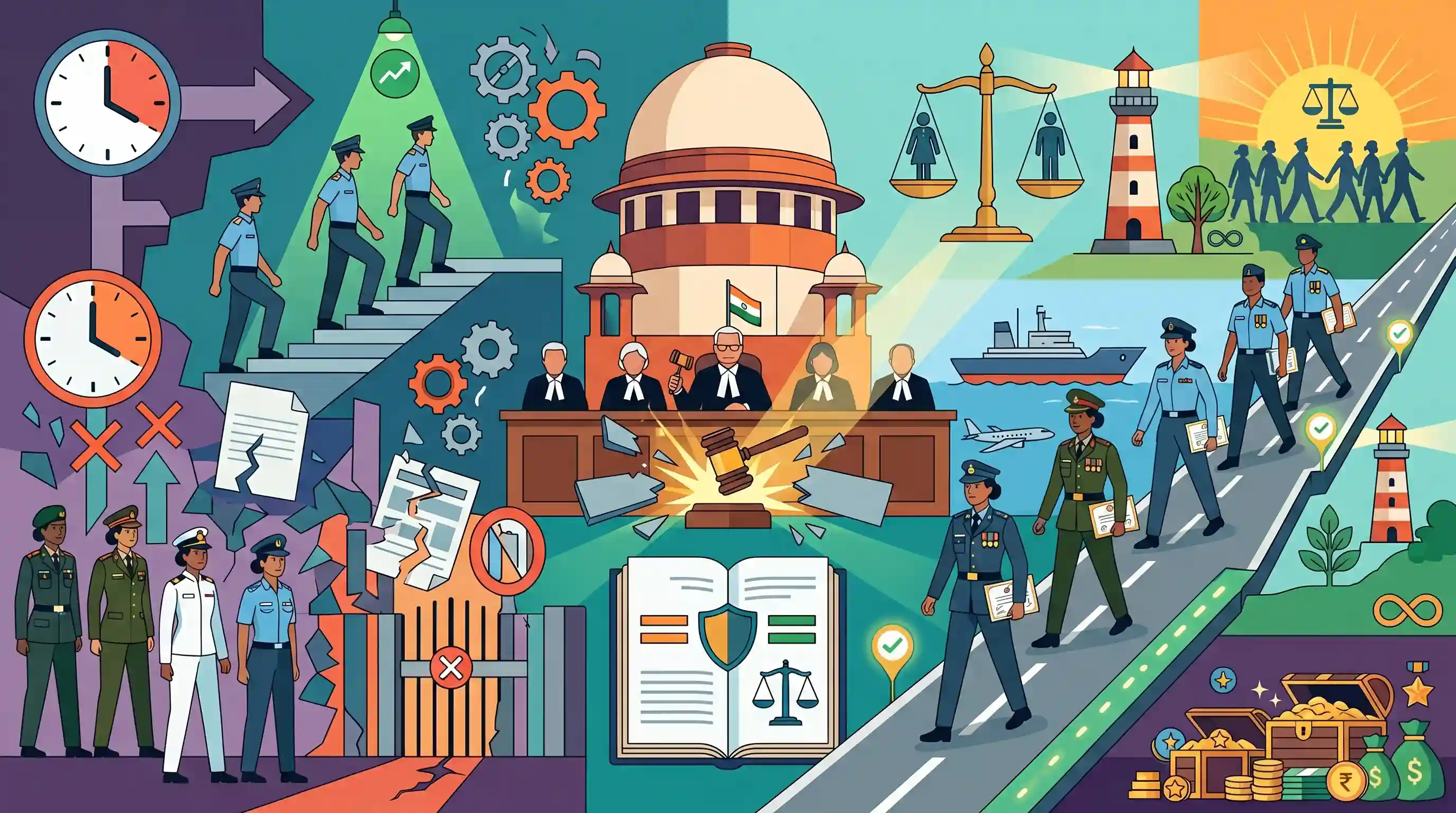
The Supreme Court of India upheld the permanent commission (PC) and consequent pensionary benefits for women officers in the Army, Air Force, and Navy. A Bench headed by Chief Justice Surya Kant observed that systemic biases and the presumption that women officers had no long-term career prospects led to casual grading of their Annual Confidential Reports (ACRs) and a denial of career-enhancing opportunities. The Court struck down government vacancy caps as a defense against remedial action and ruled that including Short Service Commission Women Officers (SSCWOs) for PC is a constitutional obligation, thereby ensuring an equal playing field and enforcing gender justice in the Armed Forces.
Key Points
- The Supreme Court upheld the permanent commission (PC) and pensionary benefits for women officers across the Army, Air Force, and Navy.
- A three-judge Bench headed by CJI Surya Kant ruled that the systemic presumption against women having long-term careers in the Armed Forces created an unequal playing field.
- Short Service Commission Women Officers (SSCWOs) suffered from casual and low grading of their Annual Confidential Reports (ACRs) due to the assumption that they lacked scope for career progression.
- The Court affirmed that the inclusion of SSCWOs for permanent commission is a constitutional obligation, dismissing objections from male officers.
- The Supreme Court rejected the Union government's plea on vacancy ceilings, stating that an annual cap on PC vacancies cannot be used as a shield against remedial action for gender justice.
Important Terms
Permanent Commission (PC)

A career path in the Indian Armed Forces that allows officers to serve until retirement (superannuation). It grants long-term stability and eligibility for full pensionary benefits after 20 years of service.
UPSC context
GS Paper 2 (Polity/Social Justice); GS Paper 3 (Security). Tests understanding of gender-neutral career progression and institutional reforms in defense.
Short Service Commission (SSC)
A limited tenure of service (initially 10 years, extendable to 14) in the armed forces. Historically, it was the only entry point for women, often denying them pensions.
UPSC context
GS Paper 2 (Governance/Social Justice). Tests knowledge of service conditions and the legal transition from temporary to permanent roles for women.
Annual Confidential Report (ACR)
An annual performance appraisal for military personnel. The Supreme Court identified 'casual' ACR grading as a tool of indirect discrimination that barred women from career-enhancing opportunities.
UPSC context
GS Paper 2 (Executive/Administrative Reforms). Relevant for discussing transparency, objectivity, and systemic bias within bureaucratic or military hierarchies.
Substantive Equality
A legal standard moving beyond 'formal equality' to address structural and systemic barriers. It requires the law to rectify historical disadvantages rather than just providing equal rules.
UPSC context
GS Paper 2 (Polity/Fundamental Rights). Tests the ability to distinguish between literal equality (Article 14) and transformative constitutionalism.
Article 142
Grants the Supreme Court extraordinary power to pass any decree or order necessary for doing "complete justice" in any cause or matter pending before it.
UPSC context
GS Paper 2 (Judiciary). Essential for understanding judicial activism and the Court's role in bypassing procedural delays to enforce fundamental rights.
Gender Justice
The fair treatment of all genders in legal and social systems. In the military context, it involves dismantling patriarchal notions of 'physiological limitations' and 'societal norms.'
UPSC context
GS Paper 1 (Social Issues); GS Paper 2 (Social Justice). Tests analysis of institutional sexism and constitutional protections for vulnerable groups.
Prelims Trap
"The Constitution guarantees unrestricted Article 15 and 16 rights to all military personnel without exception."
Article 33 specifically empowers Parliament to restrict or abrogate the Fundamental Rights of armed forces personnel to ensure discipline and proper discharge of duties.
Static Concepts Connected
How does Article 33 restrict Fundamental Rights for the Armed Forces?
- Parliamentary Authority: Only Parliament (not state legislatures) has the power to restrict or abrogate Fundamental Rights of armed forces, police, and intelligence agencies.
- Objective: The primary goal is to ensure the proper discharge of duties and the maintenance of strict discipline among the forces.
- Court-Martial Autonomy: Laws enacted under Article 33 (e.g., Army Act) can exclude the writ jurisdiction of civilian courts regarding court-martial decisions.
What is the difference between Formal and Substantive Equality?
- Formal Equality: Treats everyone exactly the same under the law, operating under the assumption that all individuals start from the same baseline, ignoring historical disadvantages.
- Substantive Equality: Focuses on equal outcomes by recognizing systemic barriers and indirect discrimination, thereby mandating affirmative actions to create a truly level playing field.
Cross-Topic Patterns
Substantive Equality & Public Employment
The transition to Permanent Commission parallels debates on vertical/horizontal reservations in public employment (Art 16), emphasizing that administrative caps cannot override structural gender justice.
Command vs. Active Combat Roles
While PC provides parity in command and promotions, full induction into active combat arms remains a phased, policy-driven domain frequently tested in Mains.

Expect a GS2 Mains question evaluating judicial interventions shifting women's military inclusion from 'formal' to 'substantive' equality.
Linked PYQs · 3
Linked PYQs · 3
- 2023MainsGS2
Explain the constitutional perspectives of Gender Justice with the help of relevant Constitutional Provisions and case laws.
- 2024MainsGS1
Distinguish between gender equality, gender equity and women's empowerment. Why is it important to take gender concerns into account in programme design and implementation?
- 2019MainsGS1
What are the continued challenges for women in India against time and space?
