US Venezuela Policy and the Geopolitics of Coercive Diplomacy
Source:The Hindu ↗
Why It Matters
The article provides critical insights into the modern use of coercive economic diplomacy and sanctions as tools of neocolonial control, which is essential for understanding contemporary international relations, energy security, and the geopolitical dynamics affecting the Global South.
Summary
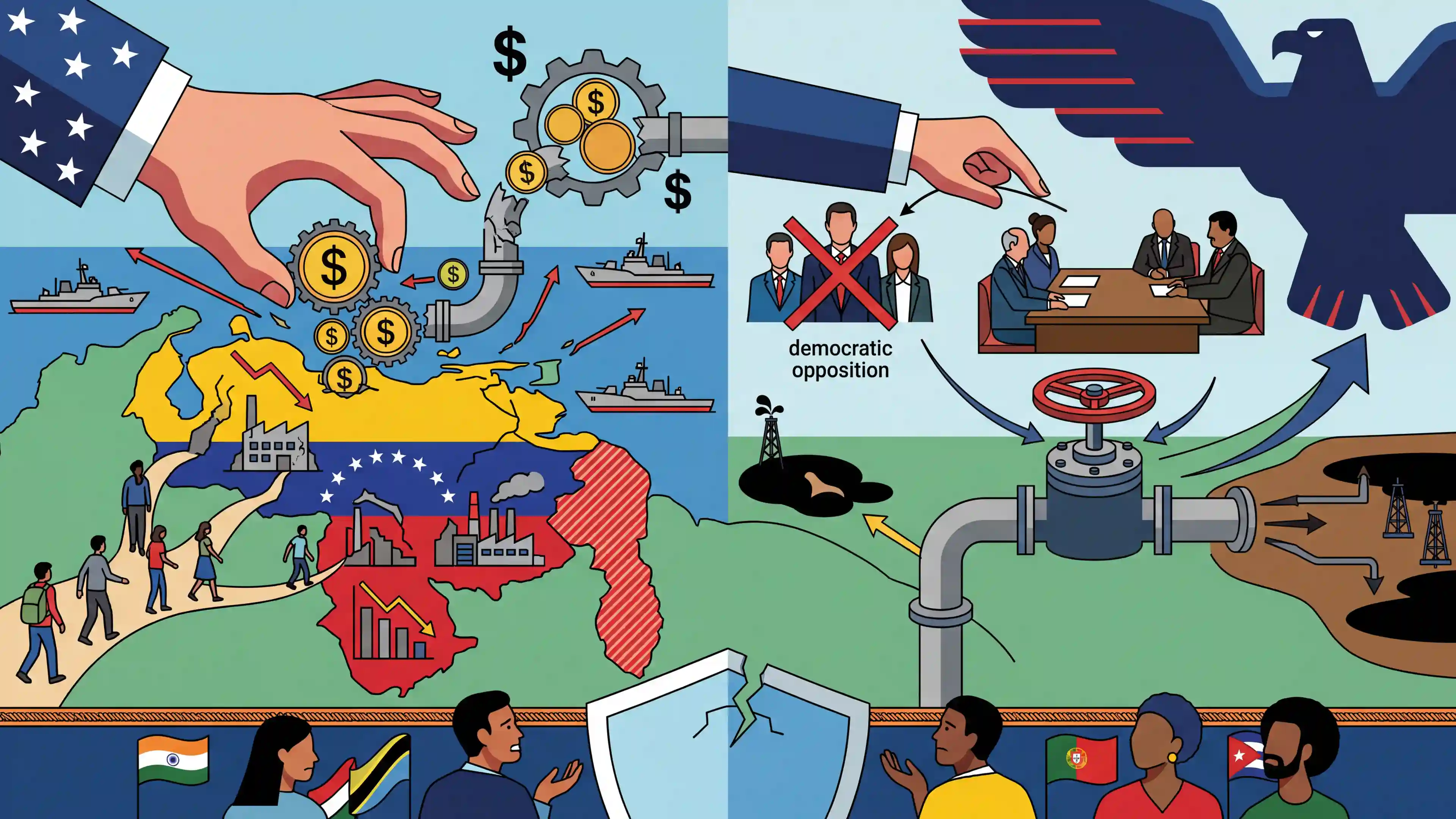
The editorial critically analyzes the US administration's aggressive posture towards Venezuela, characterizing it as a modern form of neocolonialism aimed at controlling the nation's vast oil wealth. Termed the 'Donroe Doctrine,' the strategy eschews costly military interventions and regime change in favor of crippling economic sanctions and naval blockades. By weaponizing Venezuela's resulting economic collapse and migration crisis, the US extorts control over energy resources, bypassing the democratic opposition to negotiate directly with the Bolivarian regime. The piece underscores the broader implications for the Global South, where economic vulnerability can be exploited by great powers to undermine sovereignty and the international order.
Key Points
- The US strategy towards Venezuela under the Trump administration focuses on gaining control of its oil reserves without incurring the costs of military occupation or regime change.
- By imposing crippling sanctions that led to a migration crisis and economic collapse, the US effectively used coercive economic diplomacy to extract concessions.
- The US willingness to negotiate with Acting President Delcy Rodriguez rather than supporting the opposition reveals a clear prioritization of energy access over democratic restoration.
- This aggressive approach, termed the 'Donroe Doctrine' (a modern, extortionist iteration of the Monroe Doctrine), highlights the vulnerability of the Global South to neocolonial exploitation.
- The weaponization of sanctions to compromise a nation's economic sovereignty poses a significant challenge to the contemporary international order.
Important Terms
Monroe Doctrine

An 1823 U.S. policy opposing European colonialism in the Americas, establishing the Western Hemisphere as a unique U.S. sphere of influence where foreign interference is viewed as a hostile act.
UPSC context
GS Paper II: Foundational concept in International Relations for understanding U.S. foreign policy and its historical influence on Latin American sovereignty.
Donroe Doctrine
A modern, transactional reinterpretation of the Monroe Doctrine under Donald Trump, emphasizing U.S. regional hegemony, direct control over natural resources (oil), and the exclusion of rival powers like China.
UPSC context
GS Paper II: Relevant for analyzing shifting U.S. foreign policy paradigms and their impact on global stability and rules-based order.
Neocolonialism
The indirect control or influence exerted by powerful nations over developing ones through economic pressure, financial dependencies, or strategic coercion rather than direct military or territorial rule.
UPSC context
GS Paper II: Core concept for discussing North-South relations, dependency theory, and the exploitation of vulnerable economies by great powers.
Bolivarian Regime
The socialist political movement in Venezuela, initiated by Hugo Chávez and continued by Nicolás Maduro, characterized by anti-imperialism, state-led oil nationalization, and opposition to U.S. hegemony.
UPSC context
GS Paper II: Key actor in Latin American geopolitics; tests knowledge of regional political movements and their impact on global energy security.
Economic Sanctions
Coercive economic measures, such as trade blockades or asset freezes, used by one state to compel another to change its policies or behavior without resorting to war.
UPSC context
GS Paper II: Critical tool of modern diplomacy and statecraft; assesses understanding of non-military methods of international pressure and their consequences.
Global South
A term for developing nations in Asia, Africa, and Latin America, often sharing a history of colonialism and advocating for a more equitable global political and economic order.
UPSC context
GS Paper II: Central to India's foreign policy as a leader of this grouping, seeking strategic autonomy and reform in international institutions.
Prelims Trap
Secondary sanctions imposed by the US on Venezuela's oil sector are mandated and enforced by the UN Security Council.
Only UN Security Council sanctions carry international legal weight. US secondary sanctions are unilateral tools that rely entirely on US financial hegemony, not international or UN mandates.
Static Concepts Connected
What is the historical Monroe Doctrine?
- 1823 Origin: An 1823 US policy declaring that European powers should no longer colonize or interfere with the affairs of nations in the Americas.
- Sphere of Influence: It gradually evolved from a defensive posture into a justification for US hegemony, interventionism, and political dominance across Latin America.
How do secondary sanctions differ from primary sanctions?
- Primary Sanctions: Bar the sanctioning country's own citizens and domestic corporations from conducting business with the targeted nation.
- Secondary Sanctions: Target third-country entities (e.g., Indian oil firms), threatening to cut them off from the US dollar and financial system if they trade with the sanctioned state.
Cross-Topic Patterns
Geopolitics of the Resource Curse
Venezuela holds the world's largest proven oil reserves (heavy crude in the Orinoco Belt), yet faces economic collapse, classically illustrating how immense resource wealth can invite predatory geopolitical coercion.
Sanctions and De-dollarization
The extraterritorial weaponization of the US dollar forces Global South economies to build alternative payment frameworks, linking US foreign policy moves directly to India's push for rupee-internationalization.

Expect a Mains question linking unilateral US sanctions (weaponized dollar) to the Global South's accelerated push for de-dollarization.
Linked PYQs · 2
Linked PYQs · 2
- 2025MainsGS2
"With the waning of globalization, post-Cold War world is becoming a site of sovereign nationalism.” Elucidate.
- 2025MainsGS2
"Energy security constitutes the dominant kingpin of India's foreign policy, and is linked with India's overarching influence in Middle Eastern countries.” How would you integrate energy security with India's foreign policy trajectories in the coming years?
