Swachh Bharat Mission Urban Progress Review in Madhya Pradesh
Source:PIB ↗
આ શા માટે મહત્વનું છે
This development highlights the structural progress of MP in waste management, CBG production, and sanitation, offering crucial details on specific MP districts (Indore, Gwalior, Dewas, Ratlam, Morena, Burhanpur, Khandwa) and the upcoming Simhasth 2028, which are highly relevant for MPPSC Prelims.
સારાંશ
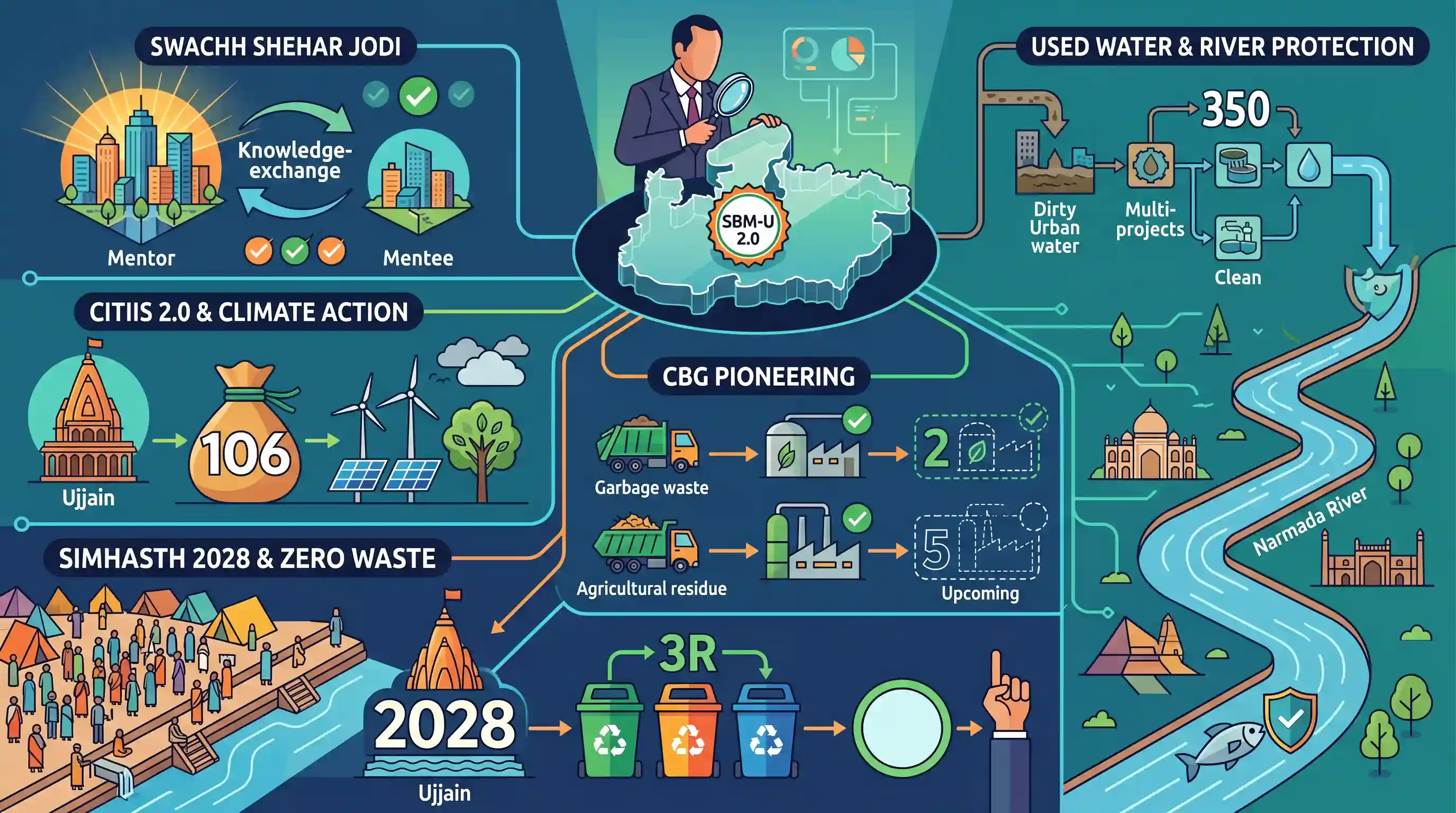
A high-level review of Swachh Bharat Mission-Urban 2.0 progress in Madhya Pradesh was conducted by MoHUA Minister Manohar Lal in Ujjain. The state is pioneering in Compressed Bio-Gas (CBG) with two active and five upcoming plants, executing 350 used water management projects to protect the Narmada River, and establishing mentor-mentee city pairings under the Swachh Shehar Jodi initiative. Furthermore, a ₹106 crore climate action project was approved under CITIIS 2.0 for Ujjain, and special focus is directed towards hosting a 'Zero Waste' Simhasth 2028 in Ujjain.
મુખ્ય મુદ્દા
- Union Minister Manohar Lal reviewed the Swachh Bharat Mission-Urban (SBM-U) 2.0 progress in Madhya Pradesh at a meeting in Ujjain.
- SBM-U 2.0 has approved projects worth ₹3,680 crore in MP, with a Central share of ₹2,036 crore, covering legacy waste remediation, toilets, and used water management.
- Madhya Pradesh has processed over 48 lakh metric tonnes of legacy waste across 109 Urban Local Bodies (ULBs), reclaiming 509 acres of land (with plantation on 100 acres).
- Operational CBG (Compressed Bio-Gas) plants are running in Indore and Gwalior, with five upcoming plants in Dewas, Ratlam, Morena, Burhanpur, and Khandwa.
- Around 350 projects are being executed for treated used water management by ULBs to curb pollution in the Narmada River and other water bodies.
- The 'Swachh Shehar Jodi' initiative pairing 7 mentor and mentee cities is being implemented in Madhya Pradesh to uplift low-performing ULBs.
- Under the CITIIS 2.0 scheme, a project worth ₹106 crore (80% Central funding) is approved for Ujjain Municipal Corporation's Climate Change Action Plan.
- The upcoming Simhasth 2028 in Ujjain is being planned on a 'Zero Waste' concept, necessitating a major boost to regional waste management.
મહત્વપૂર્ણ શબ્દો
Swachh Bharat Mission-Urban 2.0

Launched in 2021, SBM-U 2.0 targets "Garbage Free" status for Indian cities by 2026 through 100% waste processing, sustained open-defecation-free status, and safe wastewater management in towns under one lakh population.
UPSC context
GS Paper II (Governance) & Paper III (Infrastructure); tests understanding of national urban sanitation policies and sustainable waste management.
CITIIS 2.0 (City Investments to Innovate, Integrate and Sustain 2.0)
City Investments to Innovate, Integrate and Sustain 2.0 (2023–2027) is a program funding innovative circular economy projects, integrated waste management, and climate-resilient infrastructure through global collaboration.
UPSC context
GS Paper II (Schemes) & Paper III (Urban Planning); tests knowledge of climate governance and international funding in smart cities.
Swachh Shehar Jodi Initiative
Launched in September 2025 under SBM-U, this structured 100-day program pairs top-performing "mentor" cities with lower-ranked "mentee" cities to share and replicate best practices in urban sanitation and waste management.
UPSC context
GS Paper II (Urban Governance/Cooperative Federalism); tests understanding of peer-learning models and institutional capacity building.
Swachh Survekshan
The world's largest annual urban sanitation survey conducted by MoHUA, which evaluates and ranks Indian cities on waste management, sanitation infrastructure, and citizen participation to foster competitive cleanliness.
UPSC context
GS Paper II (Governance & Public Policy); tests awareness of competitive federalism and performance tracking in urban local bodies.
Simhasth 2028
The upcoming massive Kumbh Mela in Ujjain, planned as a "Zero Waste" event using permanent eco-friendly township planning, advanced underground drainage, and river conservation systems to manage millions of pilgrims.
UPSC context
GS Paper I (Culture) & Paper III (Mass Gathering Management); tests sustainable planning for massive temporary-to-permanent urban events.
પ્રિલિમ્સ ટ્રેપ
Under SBM-U 2.0, wastewater and faecal sludge management targets are exclusively mandated for metropolitan cities with populations exceeding 10 lakh.
SBM-U 2.0 explicitly addresses a major gap of SBM 1.0 by introducing mandatory wastewater and faecal sludge management for all smaller ULBs with a population under 1 lakh.
સંલગ્ન સ્થિર ખ્યાલો
What are the objectives and funding structures of the CITIIS 2.0 program?
- Core Objective: A sub-component of the Smart Cities Mission (2023-2027) focused on driving a circular economy and climate-resilient waste management in Indian cities.
- Key Partners: Jointly supported by MoHUA, French Development Agency (AFD), Germany's KfW, the European Union (EU), and the National Institute of Urban Affairs (NIUA).
- Funding Model: Provides up to 80% grant funding (90% for North-Eastern and hill states) directly to selected municipal projects to encourage innovative urban planning.
What is the geographical course of the Kshipra River and its link to the Narmada?
- River Course: Originates from the Kakri-Tekdi hill in the Vindhya Range near Indore and flows north to join the Chambal River, a major tributary of the Yamuna.
- Narmada-Kshipra Link: It is an inter-basin transfer project that pumps water from the west-flowing Narmada River to the source of the Kshipra to prevent seasonal drying.
આંતર-વિષય પેટર્ન
Urban Sanitation & Municipal Finance
Indore's model of waste-to-CBG demonstrates how urban sanitation projects can generate carbon credits and municipal green bonds, enhancing the fiscal autonomy of urban local bodies.
River Rejuvenation & Engineering Infrastructure
The Narmada-Kshipra link shows that river rejuvenation via inter-basin transfers is unsustainable without SBM-U 2.0 wastewater treatment to control point-source urban pollution.

SBM-U 2.0 wastewater mandates for <1L ULBs and CITIIS 2.0 international funding partners will likely feature in a 2026 scheme comparison.
સંલગ્ન PYQ · 1
સંલગ્ન PYQ · 1
- 2025MPPSC_PRELIMSGS1
Match List-I with List-II and select the correct answer using the codes given below the lists: | List-I (River) | List-II (Place/Town) | |---------------------|----------------------| | (i) Betwa | 1. Balaghat | | (ii) Tapti (Tapi) | 2. Ujjain | | (iii) Kshipra | 3. Multai | | (iv) Wainganga | 4. Orchha | Codes: (i) (ii) (iii) (iv)
