PIB Dehradun Organizes Media Workshop on Central Schemes
Source:PIB ↗
हे का महत्त्वाचे आहे
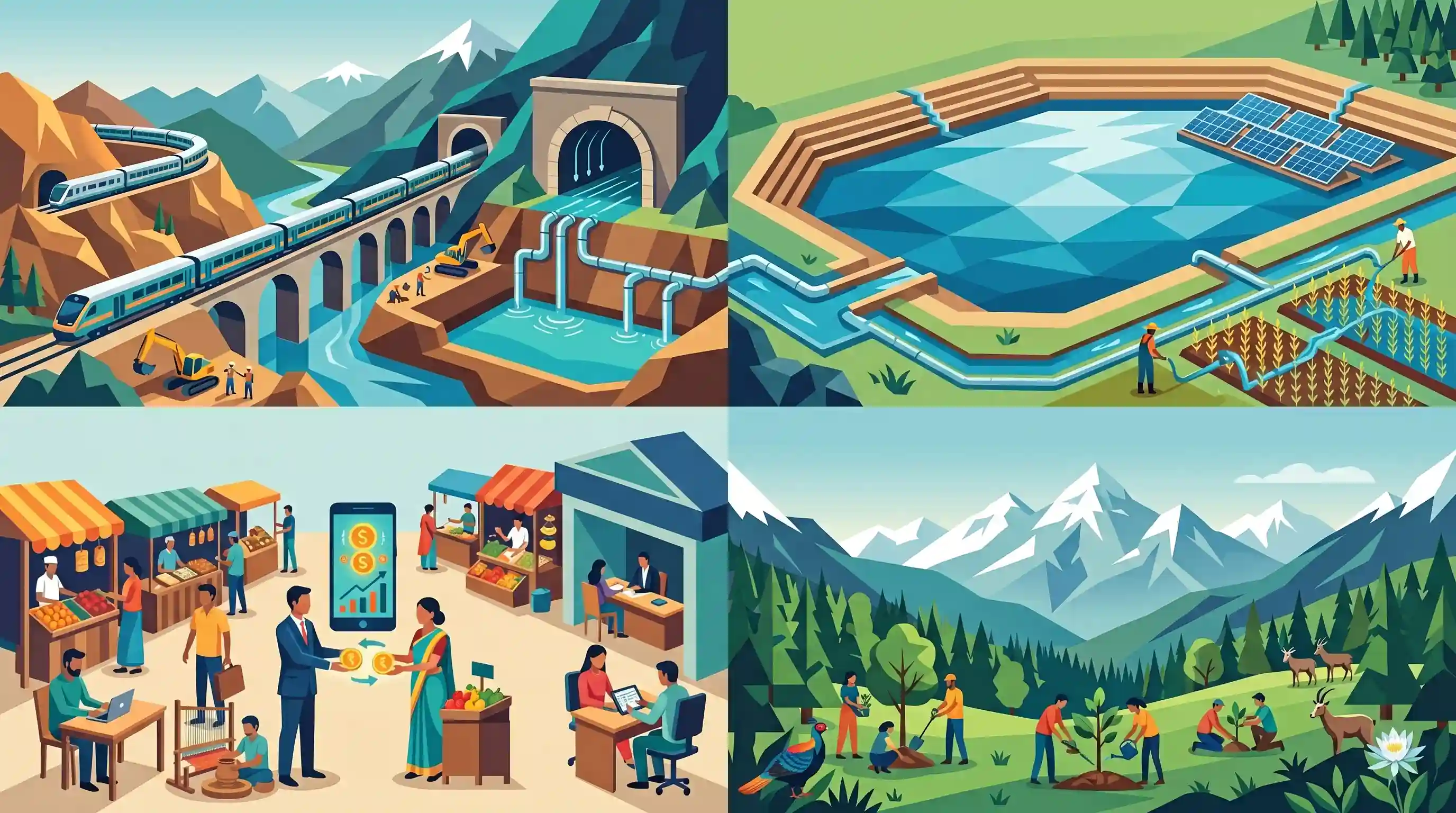
This article highlights how mega infrastructure projects in the ecological hotspot of the Himalayas (such as the Rishikesh-Karnaprayag rail link) are integrated with conservation programs (like the Amrit Sarovar Project for tunnel water discharge). It also illustrates the regional delivery of flagship financial inclusion schemes in Uttarakhand, which is highly tested in UKPSC Prelims.
सारांश
On June 16, 2026, PIB Dehradun organized a one-day media workshop called 'Varta' in Rishikesh to highlight the developmental, infrastructural, and financial accomplishments in Uttarakhand. The workshop emphasized key regional projects, such as the eco-friendly Rishikesh-Karnaprayag Rail Line—incorporating water conservation from tunnels into the Amrit Sarovar Project—and the localized implementation of micro-credit schemes like PM SVANidhi.
मुख्य मुद्दे
- Press Information Bureau (PIB) Dehradun hosted a one-day regional media workshop called 'Varta' in Rishikesh on June 16, 2026, focused on the theme 'Lok Seva hi Sankalp - 12 Saal'.
- Five key progress booklets were launched, highlighting central government schemes like Lakhpati Didi, PM SVANidhi, and Char Dham All-Weather Road in Uttarakhand.
- The Rishikesh-Karnaprayag Rail Line project features 16 tunnels passing through 5 districts of Uttarakhand. The project is designed with digital mapping to safeguard high Himalayan biodiversity.
- An innovative ecological measure is being implemented under which water flowing out of the railway tunnels during excavation will be conserved and managed under the Amrit Sarovar Project to mitigate water stress.
- Financial inclusion details for PM SVANidhi and Mudra schemes in Uttarakhand were highlighted, indicating a 7% interest subsidy for street vendors in urban areas and 35% subsidy in rural areas.
महत्त्वाच्या संज्ञा
PM SVANidhi

A Central Sector micro-credit scheme launched in June 2020 to provide collateral-free working capital loans of up to ₹50,000 to urban and peri-urban street vendors, promoting formalization and digital payments.
UPSC context
GS Paper II (Welfare Schemes) & GS III (Financial Inclusion); tests knowledge of informal sector recovery, micro-credit access, and digital onboarding.
Amrit Sarovar Project
A water conservation initiative launched in April 2022 aiming to construct or rejuvenate at least 75 waterbodies (minimum 1 acre each) per district to enhance groundwater recharge and support rural livelihoods.
UPSC context
GS Paper III (Environment and Water Conservation); tests knowledge of decentralized watershed management, water security, and rural ecological rejuvenation.
Lakhpati Didi Scheme
A livelihood empowerment scheme under DAY-NRLM aiming to enable three crore rural women in Self-Help Groups (SHGs) to earn a sustainable annual household income of ₹1 lakh or more through diversified skills.
UPSC context
GS Paper II (Social Justice/Women Empowerment); tests knowledge of SHG-driven poverty alleviation, financial literacy, and rural micro-entrepreneurship models.
Char Dham All-Weather Road Project
A massive highway expansion project upgrading over 800 km of national highways in Uttarakhand to provide all-weather connectivity to major Himalayan shrines, while also facilitating strategic troop movement to borders.
UPSC context
GS Paper III (Infrastructure and Environmental Ecology); tests balance between national security, infrastructure development, and fragile mountain ecosystem conservation.
PM Mudra Yojana
Launched in April 2015, this flagship scheme provides collateral-free institutional credit up to ₹20 lakh (under Tarun Plus) to non-corporate, non-farm micro and small enterprises to boost grassroots entrepreneurship.
UPSC context
GS Paper III (Economic Development/Financial Inclusion); tests knowledge of MSME credit facilitation, micro-finance tiers, and last-mile financial inclusion.
Ayushman Bharat
The world's largest government-funded health assurance scheme, providing cashless secondary and tertiary hospitalization coverage of up to ₹5 lakh per family annually to over 50 crore economically vulnerable citizens.
UPSC context
GS Paper II (Social Sector/Health); tests knowledge of universal health coverage models, public health infrastructure, and socioeconomic welfare interventions.
पूर्वपरीक्षा सापळा
The Rishikesh-Karnaprayag Rail Line project directly connects the high-altitude districts of Uttarkashi and Pithoragarh to the plains.
It passes through Dehradun, Tehri Garhwal, Pauri Garhwal, Rudraprayag, and Chamoli. It does not touch Uttarkashi or Pithoragarh, which are common geographic trap options.
संबंधित स्थिर संकल्पना
What are the geological vulnerabilities associated with mega-tunnelling in the Himalayas?
- Fault Line Intersections: Tunnels cross active shear zones (like Main Boundary Thrust), causing rock bursts and high squeezing pressure.
- Aquifer Disruption: Subterranean excavation punctures perched aquifers, leading to severe water ingress and drying of local natural springs.
- Seismic Hazards: High seismicity (Zones IV and V) demands specialized dynamic support systems like the New Austrian Tunnelling Method.
How is PM SVANidhi structured to promote urban financial inclusion?
- Nodal Ministry: Administered by the Ministry of Housing and Urban Affairs (MoHUA) with SIDBI acting as the implementation coordinator.
- Graduated Credit: Provides collateral-free working capital in progressive tranches of ₹15,000, ₹25,000, and ₹50,000 to urban vendors.
- Fiscal Incentives: Offers a 7% interest subsidy per annum on timely repayment, paired with cashbacks for adopting digital transactions.
आंतर-विषय नमुने
Infrastructure vs. Himalayan Eco-fragility
Linear infrastructure in Zone V seismic regions triggers landslides. Linking tunnel water drainage with Amrit Sarovars showcases eco-sensitive engineering to counter spring drying.
Border Infrastructure as Strategic Deterrence
The Rishikesh-Karnaprayag project serves as a dual-use civilian-military feeder route to the LAC, highlighting India's proactive strategic border infrastructure development.

Mains 2026: Balancing strategic Himalayan rail transit with eco-mitigation (aquifer preservation) as a crucial GS-3 long-answer.
संबंधित PYQ · 2
संबंधित PYQ · 2
- 2025UKPSC_PRELIMSGS1
Which of the following pairs is not correctly matched ? Name of Airport District
- 2025UKPSC_PRELIMSGS1
Consider the following statements and select the correct answer from the options given below : Statement 1 : Uttarakhand is highly vulnerable to climate change. Statement 2 : Climate change is causing water stress and depleting biodiversity in Uttarakhand.
