IMA Dehradun Passing Out Parade and Gender Integration Milestone
Source:PIB ↗
Why It Matters
This article highlights a significant milestone in the gender integration of India's elite defense academies (specifically IMA Dehradun) and connects to the constitutional powers of the President as the Supreme Commander of the Armed Forces. It is highly relevant for UKPSC candidates due to the focus on Uttarakhand-based institutions and current developments in defense.
Summary
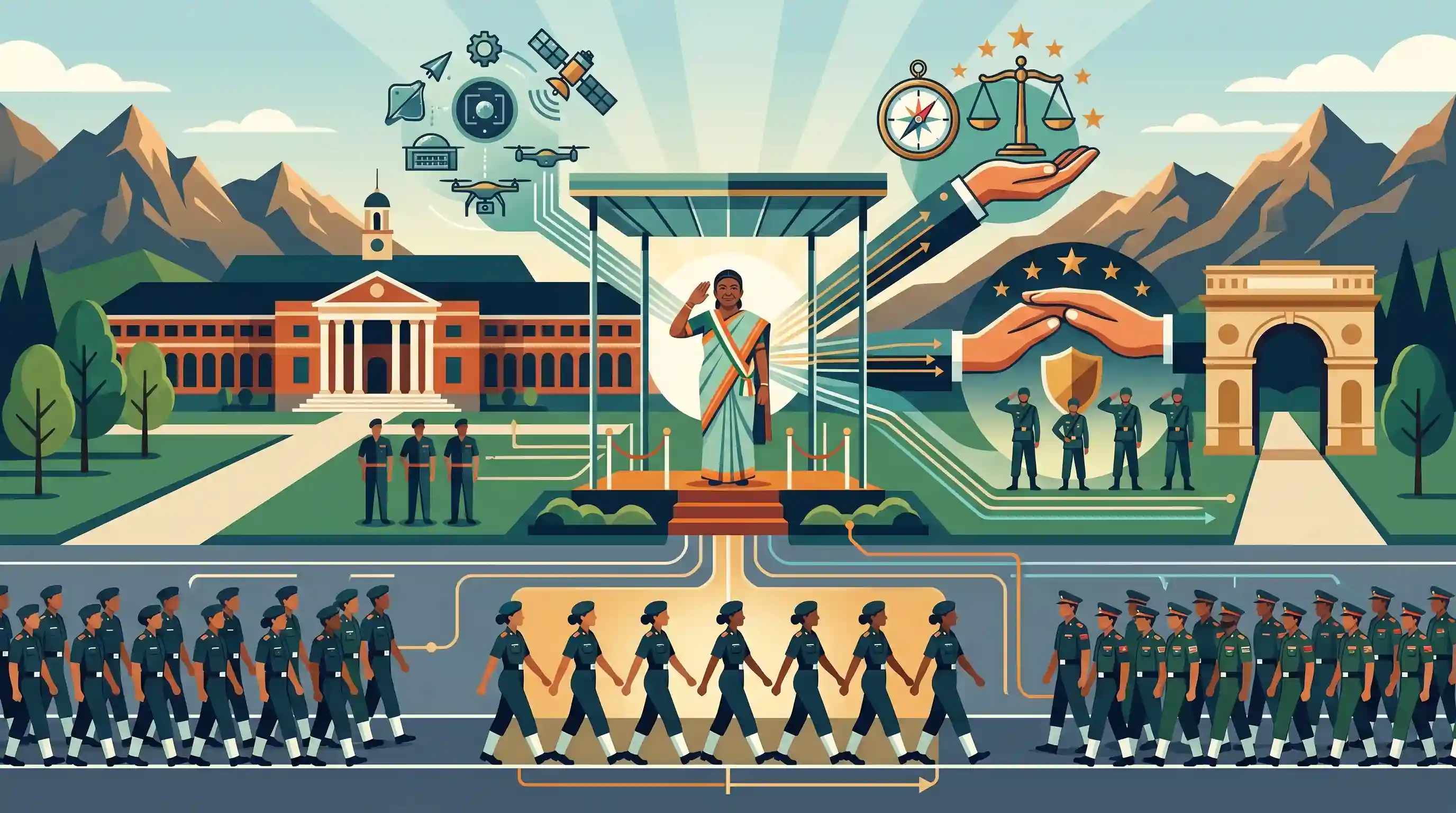
On June 13, 2026, President Droupadi Murmu reviewed the historic passing out parade of the 158th Regular Course and 141st Technical Graduate Course at the Indian Military Academy (IMA) in Dehradun. The event marked a monumental step for gender integration in the Indian Armed Forces, as nine women cadets graduated from the academy. Highlighting the presence of international cadets, the President underscored India's commitment to global cooperation, while urging the newly commissioned officers to be future-ready, ethical leaders who prioritize their soldiers' welfare.
Key Points
- President Droupadi Murmu reviewed the passing out parade of the 158th Regular Course and the 141st Technical Graduate Course at the Indian Military Academy (IMA) in Dehradun on June 13, 2026.
- A historic milestone was achieved with the graduation of nine women cadets, representing a watershed moment in the history of the IMA and a significant step toward women-led development in the defense forces.
- The parade also featured cadets from friendly foreign countries, highlighting India's commitment to strengthening global defense cooperation and fostering peaceful relations.
- The President, as the Supreme Commander of the Armed Forces, urged the young officers to lead by example, remain future-ready in the face of rapid technological advances, and prioritize the well-being of their soldiers.
Important Terms
Indian Military Academy

Established in 1932 in Dehradun, it is the premier officer-training academy of the Indian Army, preparing Gentleman and Lady Cadets for permanent commission as Lieutenants.
UPSC context
GS Paper III (Security) — tests knowledge of military training institutions and defense leadership frameworks.
Supreme Commander of the Armed Forces
Under Article 53(2) of the Indian Constitution, the President is vested with the supreme command of the defense forces, a ceremonial authority exercised on Cabinet advice.
UPSC context
GS Paper II (Executive/Polity) — tests understanding of constitutional provisions, executive military powers, and civil-military balance.
Gender Integration in Armed Forces
The ongoing transition to include women in combat, combat-support, and administrative roles within the defense services, supported by recent judicial and institutional shifts.
UPSC context
GS Paper I (Social Empowerment) & GS III (Security) — tests gender parity, policy reform, and inclusivity in defense.
Permanent Commission
An option in the Indian Armed Forces allowing officers to serve until retirement, extended to female officers after the landmark Babita Puniya (2020) judgment.
UPSC context
GS Paper I (Women Empowerment) & GS III (Security) — tests gender-equal career structures and legal battles in armed forces.
Prelims Trap
The President's authority as Supreme Commander of the Defence Forces is an executive prerogative independent of parliamentary legislative control.
Article 53(2) explicitly mandates that the exercise of the Supreme Command shall be regulated by law, meaning Parliament holds ultimate legislative control over it.
Static Concepts Connected
What constitutional limits apply to the President's role as Supreme Commander?
- Article 53(2): Vests the supreme command of the Defence Forces in the President of India.
- Legislative control: Explicitly states that the exercise of this command shall be regulated by parliamentary law.
- Article 74 bound: The President must exercise this command on the aid and advice of the Council of Ministers.
What was the historical significance of the 1932 Chetwode Committee?
- Indianisation of Officers: Formed to establish a training academy (IMA) to transition officer-cadre recruitment from Sandhurst to India.
- Nationalist demands: Directly responded to the Indian nationalist pressure during the Round Table Conferences for military self-reliance.
- The Chetwode Creed: Enunciated the core military ethos prioritizing the country and troops over self.
Cross-Topic Patterns
Judicial mandate to executive reform
The transition from the Kush Kalra (2021) ruling to active IMA female graduates demonstrates how judicial interventions reshape traditional, conservative executive institutions.
Defense diplomacy and Act East
Training friendly foreign cadets at the IMA acts as a strategic soft-power tool, cementing bilateral security ties and military interoperability across the Indo-Pacific.

Historical Indianisation committees (Chetwode) and modern gender-integration rulings (Kush Kalra) are prime for multi-statement 2026 MCQs.
Linked PYQs · 3
Linked PYQs · 3
- 2025UKPSC_PRELIMSGS1
Which of the following is incorrectly matched about Central Government Institutes located in Uttarakhand?
- 2024UKPSC_PRELIMSGS1
According to the Constitution of India, who among the following is the Head of the State ?
- 2021UKPSC_PRELIMSGS1
Which of the following organizations is not located in Uttarakhand?
