Yuva Sangam Phase VI Karnataka Delegation Rajasthan Visit
Source:PIB ↗
Why It Matters
The article directly mentions the current Governor of Rajasthan, Shri Haribhau Kisanrao Bagde (appointed in 2024), a key figure tested in RPSC RAS Prelims state polity. It also highlights the 'Ek Bharat Shreshtha Bharat' and 'Yuva Sangam' central schemes, which are important for government schemes and policy implementation.
Summary
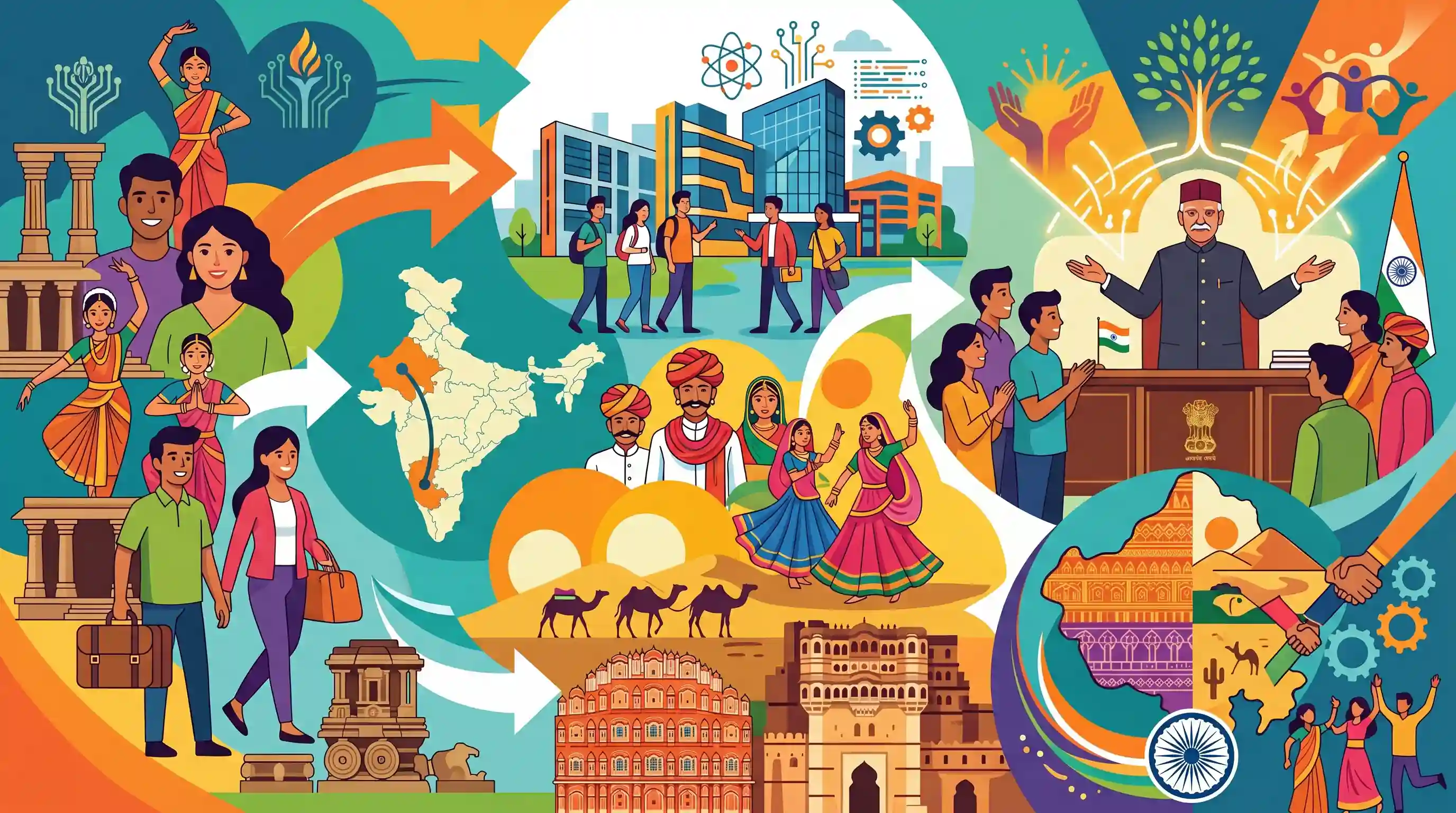
Under Phase VI of the 'Yuva Sangam' initiative of 'Ek Bharat Shreshtha Bharat', a youth delegation from Karnataka (led by IIIT Dharwad) visited Rajasthan (hosted by MNIT Jaipur) in June 2026. The exchange program aimed to strengthen national integration and cultural appreciation. The delegation participated in educational tours at MNIT Jaipur, explored Rajasthan's heritage, and met the Governor of Rajasthan, Shri Haribhau Kisanrao Bagde, who emphasized the youth's role in promoting national unity.
Key Points
- Yuva Sangam Phase VI is a youth exchange initiative under the Central Government's 'Ek Bharat Shreshtha Bharat' programme, implemented by the Department of Higher Education, Ministry of Education.
- The initiative pairs 22 States and Union Territories to encourage young people to explore India's diverse culture, academic environments, tourism, and developmental models.
- A delegation from Karnataka, led by IIIT Dharwad, visited Rajasthan from June 9 to June 12, 2026, hosted by MNIT Jaipur.
- The delegation interacted with the Governor of Rajasthan, Shri Haribhau Kisanrao Bagde, at Lok Bhavan in Jaipur on June 9, 2026, focusing on leadership, diversity, and nation-building.
- The visit combined cultural heritage immersion (folk arts, traditional crafts) with educational interaction (research, entrepreneurship facilities at MNIT Jaipur) and infrastructure tours.
Important Terms
Ek Bharat Shreshtha Bharat

A flagship central government initiative launched in 2015 to foster national integration, cultural bonding, and mutual understanding by systematically pairing different States and Union Territories for cultural and educational exchange.
UPSC context
GS Paper II (Governance) & GS Paper I (Indian Society); tests federalism, national integration, and government schemes.
Yuva Sangam
A flagship youth exchange programme under the ‘Ek Bharat Shreshtha Bharat’ initiative that organizes structured, multidimensional exposure tours for youth aged 18–30 to promote national unity and experiential learning.
UPSC context
GS Paper II (Welfare Schemes & Social Sector); tests government initiatives for youth, cultural integration, and human resource development.
Ministry of Education
The Union Ministry of India responsible for national education policies, overseeing school education, literacy, higher education, and technical education to enhance human resource development across the country.
UPSC context
GS Paper II (Governance & Education Policy); tests issues relating to development and management of Social Sector/Services relating to Education.
Department of Higher Education
A department within India's Ministry of Education that regulates university education, technical institutes, and coordinates flagship youth initiatives like the Yuva Sangam exchange programme.
UPSC context
GS Paper II (Education & Governance); tests institutional machinery and policy implementation in the social sector.
Malaviya National Institute of Technology (MNIT) Jaipur
A premier public technical university in Rajasthan established in 1963, recognized as an Institute of National Importance, and acting as a nodal center for national programs like Yuva Sangam.
UPSC context
GS Paper II (Social Sector/Education); tests technical education infrastructure and roles of Institutes of National Importance in national policies.
Indian Institute of Information Technology (IIIT) Dharwad
An autonomous technical institute in Karnataka, established in 2015 under a public-private partnership (PPP) model, and designated as an Institute of National Importance.
UPSC context
GS Paper II (Education) & GS Paper III (Infrastructure); tests public-private partnership models and technical education development.
Prelims Trap
The oath of office of a State Governor is prescribed under the Third Schedule of the Constitution.
Article 159 explicitly contains the Governor's oath; it is not listed in the Third Schedule, which covers Union/State Ministers, MPs, MLAs, and Judges.
Static Concepts Connected
What constitutional and ex-officio roles define a State Governor’s position?
- Oath source: Article 159 prescribes the exact oath; it is not part of the Third Schedule.
- Oath administrator: Sworn in by the Chief Justice of the state High Court, or the senior-most judge available.
- University Chancellorship: Acts as ex-officio Chancellor of state-run universities, whereas the President of India is Visitor to Central Universities.
What is the structural framework of the Ek Bharat Shreshtha Bharat (EBSB) initiative?
- Nodal Ministry: Coordinated by the Ministry of Education alongside 16 other partner ministries.
- Pillars of Yuva Sangam: Focuses on 5 Ps: Paryatan (Tourism), Parampara (Traditions), Pragati (Development), Paraspar Sampark (People-to-People), and Prodyogiki (Technology).
Cross-Topic Patterns
Cultural Integration as Soft Federalism
Beyond institutional relations (inter-state councils), schemes like EBSB foster grassroots-level integration, reinforcing emotional and cultural federalism across linguistically diverse states.
Experiential Learning under NEP 2020
Integrating youth exchange programs (Yuva Sangam) with higher education aligns with NEP's push for experiential, cross-cultural learning outside traditional classroom settings.

Governor's oath (Art 159 vs Third Schedule) paired with EBSB's nodal ministry and 5-P pillars likely to form a 2026 MCQ.
Linked PYQs · 1
Linked PYQs · 1
- 2025RPSC_PRELIMSGS1
Which of the following statements regarding the Governor of Rajasthan is not correct?
