Presidents Rule Revoked in Manipur Ahead of Government Formation
Source:Indian Express ↗
Why It Matters
The imposition and revocation of Article 356 are critical components of India's federal structure and Centre-State relations. Additionally, the underlying cause of the political crisis—the persistent ethnic conflict in Manipur—highlights significant internal security challenges and the complexities of governance in North-East India.
Summary
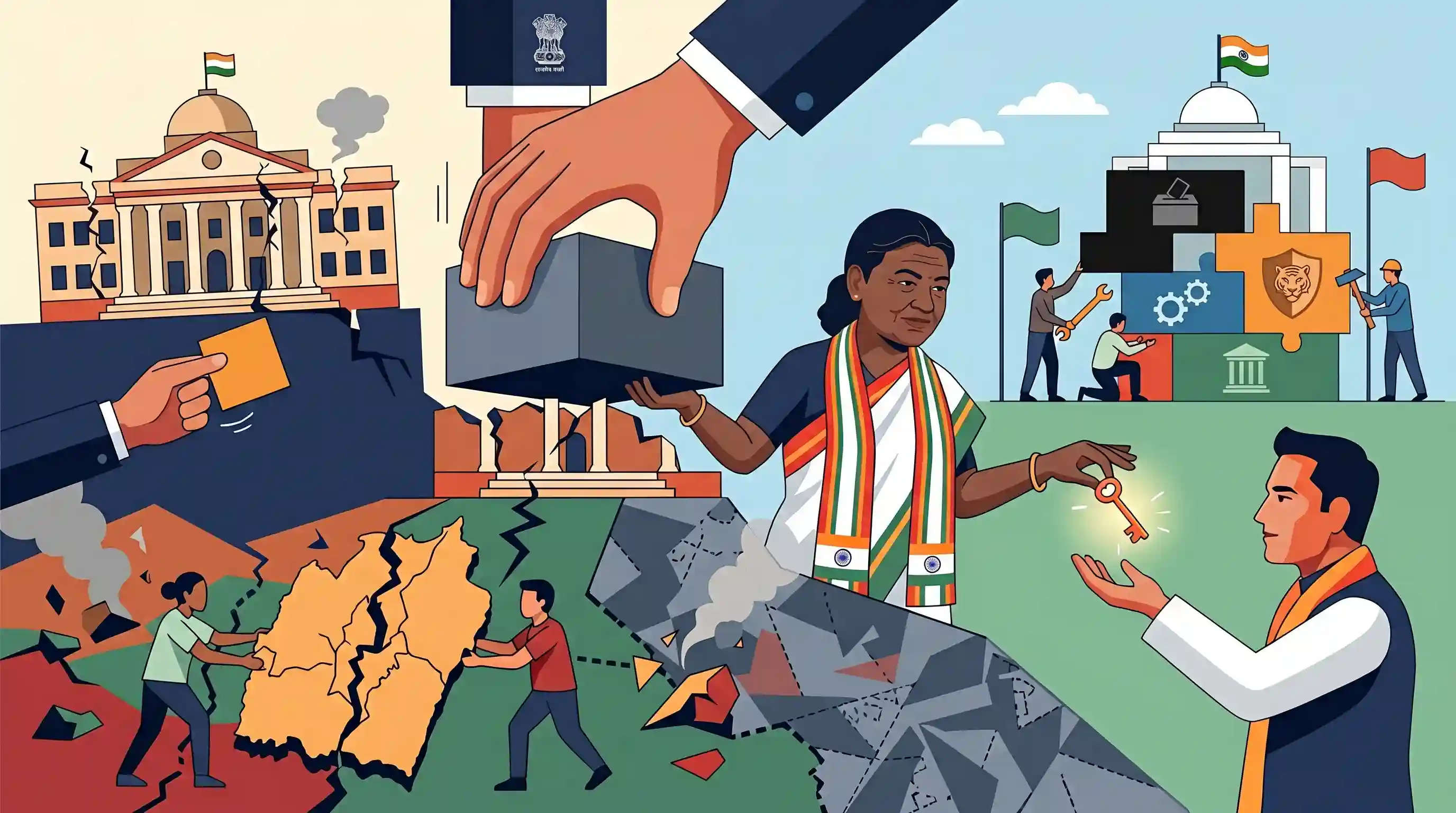
President Droupadi Murmu has revoked President's Rule in Manipur, ending nearly a year of central administration imposed under Article 356. The central rule was triggered by the collapse of N Biren Singh's government in February 2025 following the withdrawal of support by the National People's Party (NPP) over the state's handling of the prolonged Meitei and Kuki-Zo ethnic conflict. With the constitutional machinery restored, the BJP is poised to form a new state government, likely under the leadership of Yumnam Khemchand Singh, aiming to restore democratic governance amidst ongoing internal security challenges.
Key Points
- President Droupadi Murmu has officially revoked President's Rule in Manipur, which was initially imposed on February 13, 2025.
- The revocation paves the way for the formation of a new elected government, with the BJP's Yumnam Khemchand Singh likely to take over as Chief Minister.
- The previous government led by N Biren Singh collapsed after the NPP, led by Conrad Sangma, withdrew its support, citing the state's failure to resolve the ongoing ethnic violence.
- Manipur has faced severe internal security challenges and ethnic conflict between the Meitei and Kuki-Zo communities since May 2023.
Important Terms
Article 356

Constitutional provision empowering the President to impose central rule in a state if its 'constitutional machinery' fails, leading to the dismissal of the state government.
UPSC context
GS Paper II: Essential for understanding Federalism, Centre-State relations, and Emergency Provisions; frequently tested via landmark cases like S.R. Bommai.
President's Rule
Direct administration of a state by the Central government via the Governor; involves suspending or dissolving the state legislature and the executive council of ministers.
UPSC context
GS Paper II: Tests knowledge of Indian polity, parliamentary approval timelines, and the impact on the federal structure.
National People's Party (NPP)
The first political party from Northeast India to gain 'National Party' status (2019); focuses on tribal interests and is a key member of the NEDA alliance.
UPSC context
GS Paper II: Relevant for regionalism, political party classification criteria by ECI, and coalition dynamics in the Northeast.
Suspended Animation
A state of temporary cessation where a Legislative Assembly is neither dissolved nor active; often imposed during President's Rule to allow for future government formation.
UPSC context
GS Paper II: A technical aspect of Article 356 that tests understanding of the Governor's powers and legislative procedures.
Article 355
Constitutional mandate requiring the Union to protect states against external aggression and 'internal disturbance,' ensuring state governance follows constitutional provisions.
UPSC context
GS Paper II/III: Crucial for discussing internal security challenges (e.g., Manipur conflict) and the legal justification for central intervention.
Prelims Trap
"Revocation of President's Rule requires the approval of Parliament."
A proclamation of President's Rule can be revoked by the President at any time. Unlike its imposition, revocation explicitly does not require parliamentary approval.
Static Concepts Connected
How is President's Rule approved and revoked by Parliament?
- Initial Approval: Must be approved by both Houses of Parliament within two months of its issue by a simple majority.
- Maximum Duration: Can be extended every six months up to three years, subject to specific conditions and Election Commission certification after one year.
- Revocation Process: Can be revoked by the President via a subsequent proclamation at any time without requiring parliamentary approval.
What safeguards against Article 356 misuse were established by S.R. Bommai (1994)?
- Judicial Review: The President's proclamation is not absolute and remains subject to judicial review to check mala fide intent.
- Floor Test: The majority enjoyed by the Council of Ministers must be tested on the floor of the House, not by the Governor's subjective assessment.
- Assembly Dissolution: The state assembly cannot be dissolved until Parliament formally approves the President's Rule proclamation.
Cross-Topic Patterns
Article 356 and Internal Security
The Manipur crisis bridges GS-3 internal security with GS-2 constitutional provisions, illustrating how prolonged ethnic insurgency directly forces the use of emergency federal interventions.
Article 371C and Hill Areas
The Kuki-Meitei conflict highlights Article 371C (special provision for Hill Areas of Manipur), contrasting sharply with the 6th Schedule autonomous councils in other Northeast states.

2026 Prelims will likely feature a multi-statement question on Article 356 revocation mechanics mixed with S.R. Bommai guidelines.
Linked PYQs · 3
Linked PYQs · 3
- 2018PrelimsGS1
If the President of India exercises his power as provided under Article 356 of the Constitution in respect of a particular State, then
- 2023MainsGS2
Account for the legal and political factors responsible for the reduced frequency of using Article 356 by the Union Governments since mid 1990s.
- 2017MainsGS3
The North-East region of India has been infested with insurgency for a very long time. Analyze the major reasons for the survival of armed insurgency in this region.
