Federal Implications of Presidential Reference on State Bills
Source:The Hindu ↗
Why It Matters
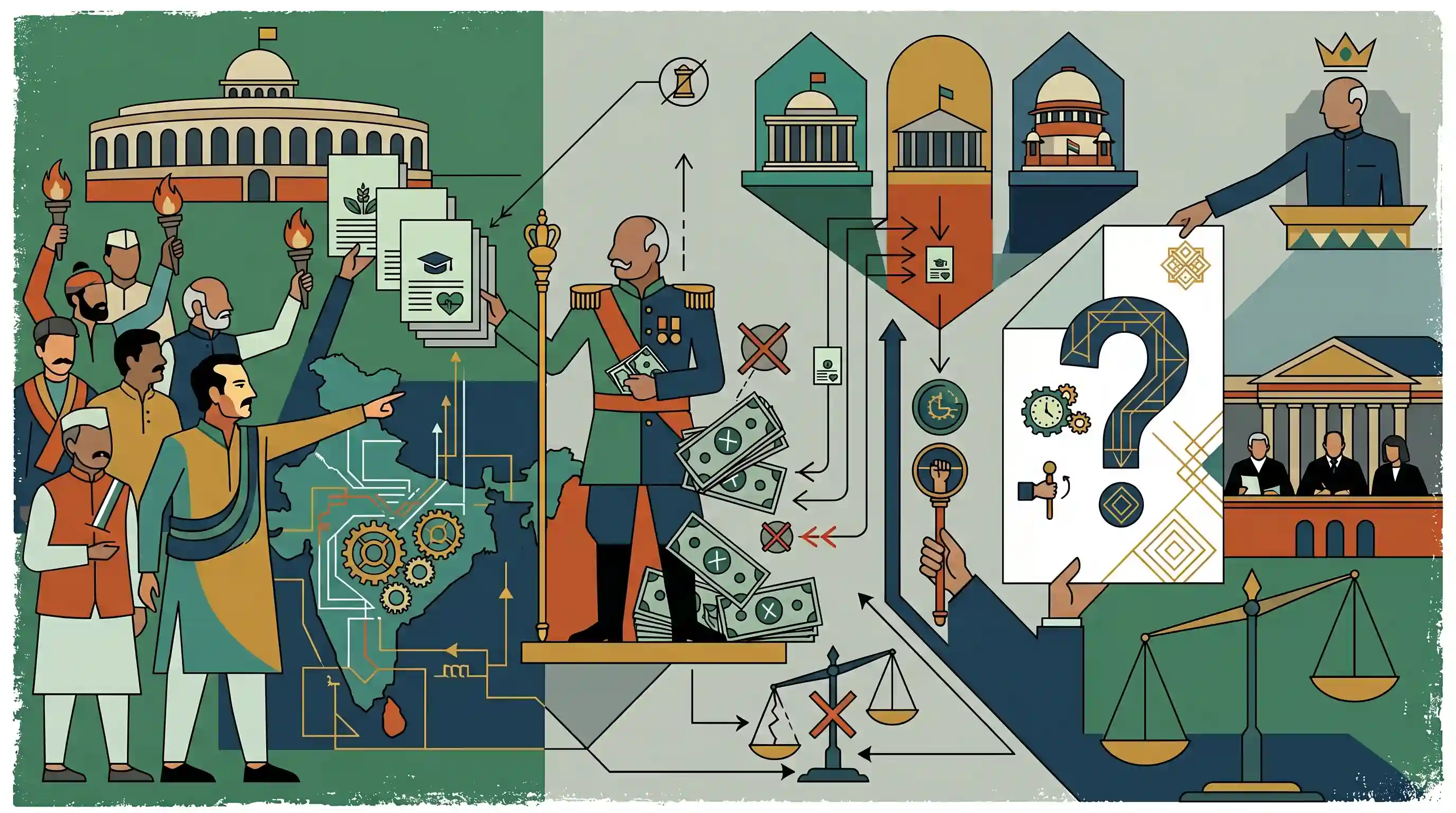
Highlights the ongoing friction between elected state governments and appointed Governors, emphasizing the need for clarity on the discretionary powers of the Governor and the constitutional vacuum regarding time limits for granting assent to bills. It acts as a major case study for Centre-State relations and the Advisory Jurisdiction of the Supreme Court.
Summary
Tamil Nadu Chief Minister M.K. Stalin is initiating discussions with other Chief Ministers to formulate a joint legal and political strategy regarding the recent Presidential Reference to the Supreme Court under Article 143. The reference seeks judicial clarity on whether the Supreme Court can prescribe time limits or dictate the manner in which Governors exercise their powers to grant assent to State Bills under Articles 200 and 201 of the Constitution. This development follows a Supreme Court judgment that declared Tamil Nadu Governor R.N. Ravi's actions of withholding assent and subsequently reserving re-enacted Bills for the President as illegal, raising significant federalism and Centre-State relations concerns.
Key Points
- Tamil Nadu CM M.K. Stalin is coordinating with Chief Ministers of other states to formulate a united strategy concerning the recent Presidential Reference to the Supreme Court.
- The Presidential Reference under Article 143 seeks clarity on whether the Supreme Court can prescribe time limits for Governors to grant assent to State Bills under Article 200.
- It also questions the manner in which Governors exercise their powers, particularly regarding withholding assent and reserving re-passed bills for the President under Article 201.
- The reference follows a Supreme Court ruling that found Tamil Nadu Governor R.N. Ravi's action of delaying and reserving re-passed bills for the President to be illegal.
Important Terms
Article 143 of the Constitution

Constitutional provision empowering the President to seek the Supreme Court’s advisory opinion on significant questions of law or public importance. Though non-binding, these opinions provide authoritative clarity on complex legal disputes.
UPSC context
GS Paper-II (Judiciary); tests knowledge of the President's advisory powers and the Supreme Court’s role in resolving constitutional ambiguities.
Article 200 of the Constitution
Defines the Governor’s options upon receiving a State Bill: granting assent, withholding it, returning it for reconsideration, or reserving it for the President’s consideration. It is a focal point of recent Centre-State friction.
UPSC context
GS Paper-II (Governor); critical for understanding legislative procedures and judicial limits on a Governor’s discretionary power to delay Bills.
Article 201 of the Constitution
Prescribes the procedure for Bills reserved by the Governor for the President. The President may then grant or withhold assent, or direct the Bill’s return to the State Legislature for reconsideration.
UPSC context
GS Paper-II (Federal Structure); highlights Union executive oversight over State legislation and the absence of constitutional timelines for such actions.
Presidential Reference
A formal request by the President to the Supreme Court under Article 143. It seeks judicial clarity on matters of public importance, such as gubernatorial discretion and the justiciability of constitutional timelines.
UPSC context
GS Paper-II (Executive-Judiciary Interface); examines the use of advisory jurisdiction to settle conflicts between constitutional functionaries and elected governments.
Federalism
A governance model where power is shared between the Union and States. This case highlights challenges to this structure when Union-appointed Governors clash with elected State Governments over legislative autonomy.
UPSC context
GS Paper-II (Federal Structure); foundational for analyzing Centre-State relations, legislative independence, and the constitutional balance of power in India.
Separation of Powers
A constitutional principle dividing governance into legislative, executive, and judicial branches. The Supreme Court cited this doctrine to rule that courts cannot impose fixed timelines on constitutional functionaries like Governors.
UPSC context
GS Paper-II (Constitutional Framework); tests understanding of the boundaries between the judiciary and executive in matters of constitutional discretion.
Prelims Trap
The Supreme Court's opinion under Article 143 is binding on the President.
Under Article 143, the Supreme Court's advisory opinion is consultative, not a judicial pronouncement. Therefore, the President is not constitutionally bound to accept or implement it.
Static Concepts Connected
What are the Governor's options under Article 200?
- Grant or Withhold: The Governor can assent to the Bill or withhold assent, which effectively ends the Bill's progress (except for Money Bills where withholding is rare).
- Return for Reconsideration: Can return a non-Money Bill. If the State Legislature repasses it (with or without amendments), the Governor is constitutionally bound to grant assent.
- Reserve for President: Can reserve the Bill for the President. This is mandatory if the Bill endangers the constitutional position of the State High Court.
How does the Supreme Court's Advisory Jurisdiction work?
- Article 143(1): Under Article 143(1), the President may refer a question of law or fact of public importance. The Supreme Court may or may not choose to provide an opinion.
- Non-binding Nature: The opinion expressed by the Supreme Court is strictly advisory. It is not a judicial decree and does not bind the President or the Union Government.
Cross-Topic Patterns
Punchhi Commission on Article 200
This judicial reference directly intersects with the Punchhi Commission's longstanding recommendation to impose a strict six-month deadline for Governors to decide on State Bills under Article 200.
Judicialization of Constitutional Silences
The case highlights a broader GS2 theme: whether the Supreme Court can interpret 'constitutional silences' (lack of explicit time limits) to enforce federal principles against Union appointees.

Expect a 2026 GS2 question linking 'constitutional silences' in Article 200/201 to the Punchhi Commission's 6-month time limit.
Linked PYQs · 4
Linked PYQs · 4
- 2024MainsGS2
What changes has the Union Government recently introduced in the domain of Centre-State relations ? Suggest measures to be adopted to build the trust between the Centre and the States and for strengthening federalism.
- 2022MainsGS2
Discuss the essential conditions for exercise of the legislative powers by the Governor. Discuss the legality of re-promulgation of ordinances by the Governor without placing them before the Legislature.
- 2025PrelimsGS1
Consider the following statements : I. The Constitution of India explicitly mentions that in certain spheres the Governor of a State acts in his/her own discretion. II. The President of India can, of his/her own, reserve a bill passed by a State Legislature for his/her consideration without it being forwarded by the Governor of the State concerned. Which of the statements given above is/are correct?
- 2023PrelimsGS1
Consider the following statements: 1. If the election of the President of India is declared void by the Supreme Court of India, all acts done by him/her in the performance of duties of his/her office of President before the date of decision become invalid. 2. Election for the post of the President of India can be postponed on the ground that some Legislative Assemblies have been dissolved and elections are yet to take place. 3. When a Bill is presented to the President of India, the Constitution prescribes time limits within which he/she has to declare his/her assent. How many of the above statements are correct?
