Legal Arguments in Supreme Court on Governor Assent Powers
Source:Indian Express ↗
Why It Matters
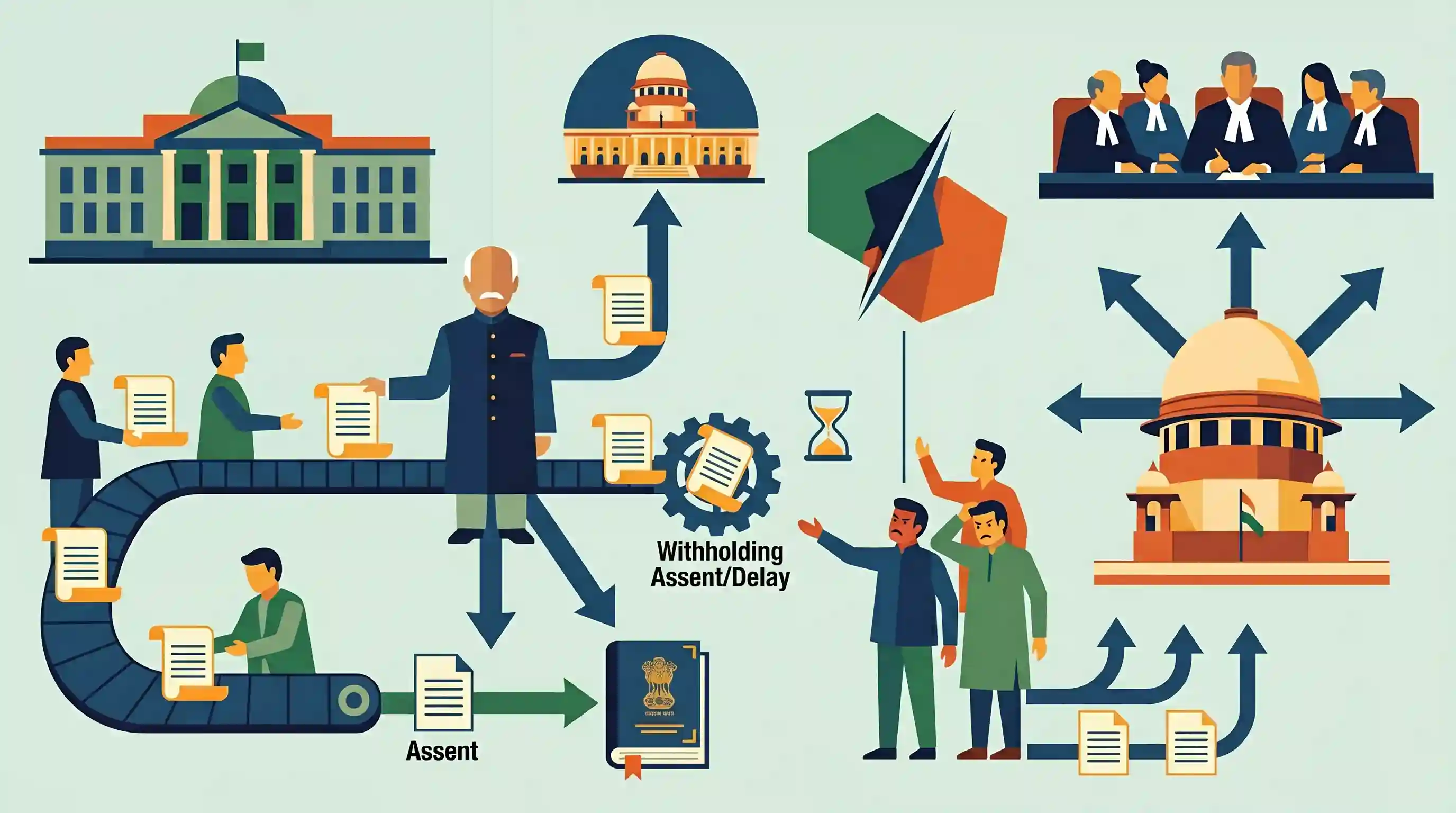
The discretionary powers of the Governor regarding state bills directly impact the functioning of state legislatures and the principles of federalism. Supreme Court judgements on Articles 200 and 201 are essential for UPSC aspirants to understand the checks and balances within the Indian constitutional framework.
Summary
The article discusses the arguments presented before the Supreme Court regarding the constitutional powers of Governors in relation to state legislation, particularly focusing on the reservation of bills for the President. States like Kerala have filed petitions challenging the actions of their Governors, who have either indefinitely withheld assent to bills passed by state legislatures or referred them to the President under Articles 200 and 201. The legal discourse centers on whether Governors possess absolute discretion in these matters and whether indefinite delays subvert the democratic process. The Supreme Court's impending rulings are expected to clarify the constitutional boundaries of gubernatorial powers and safeguard the federal structure.
Key Points
- States have approached the Supreme Court to challenge the indefinite withholding of assent to bills by Governors.
- The central legal debate revolves around the interpretation of Article 200 and Article 201 of the Constitution, which govern the Governor's power to give assent, withhold assent, or reserve state bills for the President's consideration.
- Arguments in court emphasize that the Governor's discretionary powers must not be used to undermine the legislative mandate of democratically elected state governments.
- The cases raise crucial questions about the timeline for a Governor to act on a bill and the legality of reserving bills for the President after an unreasonable delay.
- The outcome will significantly impact the dynamics of cooperative federalism and clarify the limits of the Governor's constitutional role.
Important Terms
Article 200

Outlines a Governor's options for bills passed by State Legislatures: grant assent, withhold assent, return for reconsideration (except Money Bills), or reserve for the President's consideration.
UPSC context
GS Paper II (Executive & Legislature); tests knowledge of state law-making and gubernatorial veto powers.
Article 201
Specifies the President's powers over bills reserved by a Governor. The President can grant assent, withhold it, or direct the bill's return to the State Legislature for reconsideration.
UPSC context
GS Paper II (Centre-State Relations); crucial for understanding federal oversight in state legislative matters.
Discretionary Powers of the Governor
Powers the Governor exercises independently of the Council of Ministers' advice, such as reserving bills for the President or reporting on the breakdown of constitutional machinery.
UPSC context
GS Paper II (Polity); tests the constitutional balance between the Governor's dual roles.
Federal Structure
The division of powers between the Union and States. India’s structure is often termed "quasi-federal," balancing state autonomy with a strong central oversight mechanism via the Governor.
UPSC context
GS Paper II (Federalism); evaluates challenges like gubernatorial delays that impact state autonomy.
Presidential Reference
A procedure under Article 143 where the President consults the Supreme Court on significant legal questions, such as the constitutional timelines for deciding on state bills.
UPSC context
GS Paper II (Judiciary); focuses on the advisory jurisdiction of the Supreme Court in resolving constitutional deadlocks.
Assent to Bills
The formal executive approval required for a bill passed by the legislature to become an enforceable law (Act). Controversies arise when this process is indefinitely delayed.
UPSC context
GS Paper II (Legislative Process); concerns the efficiency of democratic law-making and executive-legislative relations.
Prelims Trap
If a state legislature re-passes a bill returned by the President, the President is constitutionally bound to give assent.
False. While a Governor is bound to give assent if a State assembly re-passes a returned bill (Art 200), the President has no such binding obligation under Article 201.
Static Concepts Connected
What are the Governor's choices for state bills under Article 200?
- Grant or Withhold: The Governor can explicitly give assent or withhold assent to the passed state legislation.
- Return for Reconsideration: Can return non-Money bills for reconsideration. If the legislature re-passes the bill, the Governor's assent is mandatory.
- Reserve for President: Can reserve the bill for the President. This is mandatory if the bill derogates the constitutional powers of the State High Court.
How does Article 201 govern state bills reserved for the President?
- Grant or Withhold: The President may declare assent or explicitly withhold assent to the reserved state bill.
- Direct to Return: The President can direct the Governor to return a non-Money bill to the state legislature, which must reconsider it within six months.
- No Binding Assent: Unlike the Governor, if the state legislature re-passes the returned bill, the President is NOT constitutionally bound to give assent.
Cross-Topic Patterns
Judicial Review of Governor's Inaction
The Supreme Court ruling that prolonged inaction attracts a writ of mandamus connects executive immunity (Article 361) to the broader limits of judicial review in India.
Cooperative Federalism vs Separation of Powers
The SC balancing act—refusing fixed deadlines to respect separation of powers while striking down indefinite withholding to protect federalism—is a prime GS2 analytical theme.

Expect a multi-statement Prelims question testing the exact differences in assent-binding rules for re-passed bills between President and Governor.
Linked PYQs · 4
Linked PYQs · 4
- 2025PrelimsGS1
Consider the following statements : I. The Constitution of India explicitly mentions that in certain spheres the Governor of a State acts in his/her own discretion. II. The President of India can, of his/her own, reserve a bill passed by a State Legislature for his/her consideration without it being forwarded by the Governor of the State concerned. Which of the statements given above is/are correct?
- 2023PrelimsGS1
Consider the following statements: 1. If the election of the President of India is declared void by the Supreme Court of India, all acts done by him/her in the performance of duties of his/her office of President before the date of decision become invalid. 2. Election for the post of the President of India can be postponed on the ground that some Legislative Assemblies have been dissolved and elections are yet to take place. 3. When a Bill is presented to the President of India, the Constitution prescribes time limits within which he/she has to declare his/her assent. How many of the above statements are correct?
- 2003PrelimsGS1
Under which Article of the Indian Constitution did the President make a reference to the Supreme Court to seek the Court’s opinion on the Constitutional validity of the Election Commission’s decision on deferring the Gujarat Assembly elections (in the year 2002)?
- 2022MainsGS2
Discuss the essential conditions for exercise of the legislative powers by the Governor. Discuss the legality of re-promulgation of ordinances by the Governor without placing them before the Legislature.
