Ladakh Hill Council Regulation for District Level Elections
Source:The Hindu ↗
ఇది ఎందుకు ముఖ్యం
The extension of the LAHDC Regulation to all districts of Ladakh is a critical governance update in a sensitive border Union Territory, directly touching upon issues of local self-government, grassroots democracy, and regional autonomy demands.
సారాంశం
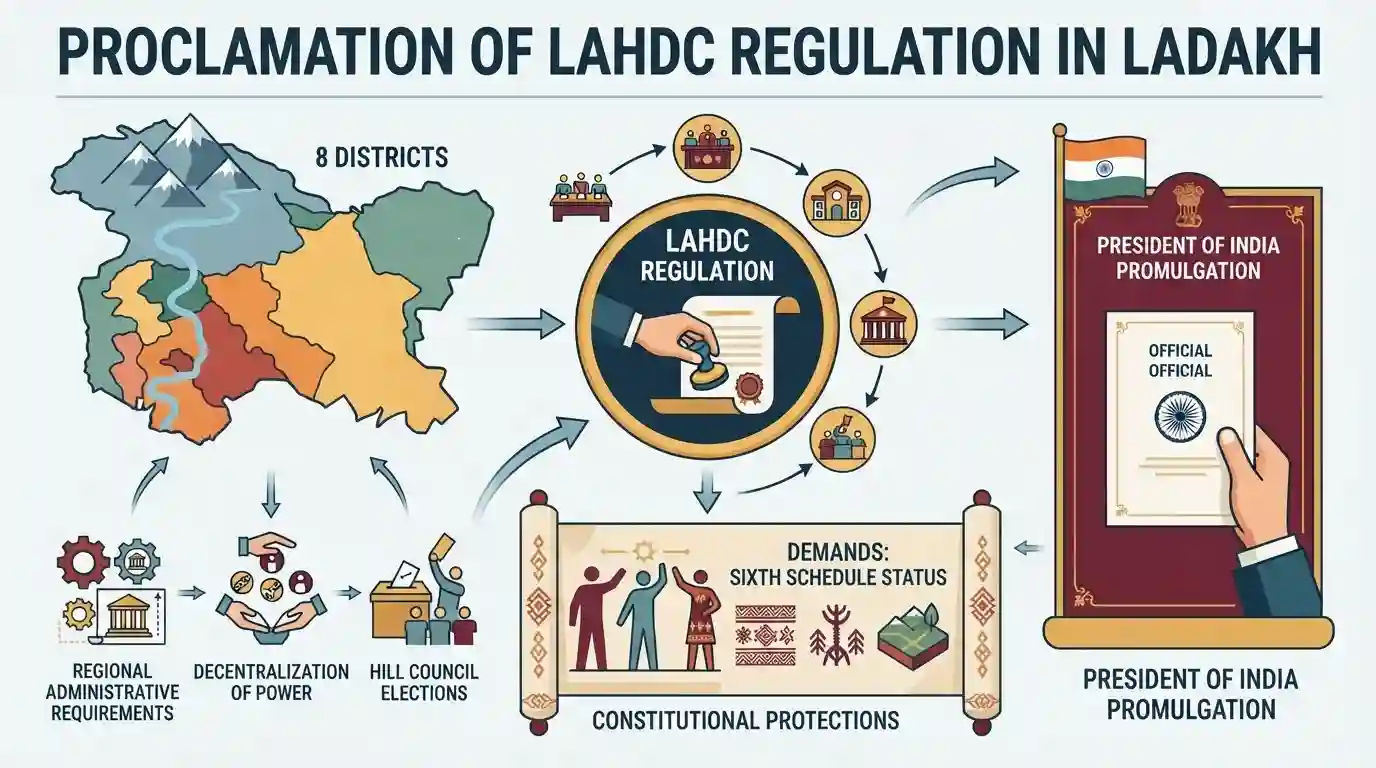
The President of India has promulgated the Ladakh Autonomous Hill Development Council (LAHDC) Regulation, paving the way for hill council elections across all eight districts of Ladakh. This development addresses regional administrative requirements and decentralization of power in the Union Territory, amidst ongoing demands from local bodies for comprehensive constitutional protections under the Sixth Schedule.
ముఖ్య అంశాలు
- The President of India promulgated the Ladakh Autonomous Hill Development Council (LAHDC) Regulation, extending and restructuring hill council provisions across all eight districts of Ladakh.
- This move paves the way for democratic decentralization and grass-roots elections across districts like Leh, Kargil, and newly created districts, addressing local aspirations for regional autonomy.
- Ladakh has witnessed continuous local demands for constitutional safeguards, such as inclusion under the Sixth Schedule of the Constitution or statehood, to protect land, employment, and cultural identity.
- The regulation strengthens local self-government structures in the Union Territory, filling the administrative vacuum post-reorganization of Jammu and Kashmir in 2019.
ముఖ్యమైన పదాలు
Ladakh Autonomous Hill Development Council (LAHDC) Regulation

A legislative framework promulgated by the President of India to establish and govern autonomous hill councils across all districts of Ladakh, facilitating decentralized local self-government.
UPSC context
UPSC Prelims/Mains (Polity & Governance): Tests understanding of decentralized administration, presidential ordinances/regulations in Union Territories, and regional governance structures.
Sixth Schedule of the Constitution
A constitutional provision under Article 244(2) providing for Autonomous District Councils (ADCs) with legislative, judicial, and executive powers to protect tribal populations in Assam, Meghalaya, Tripura, and Mizoram.
UPSC context
UPSC Prelims/Mains (Indian Polity): Tests knowledge of constitutional safeguards, tribal rights, federalism, and regional autonomy demands in frontier regions like Ladakh.
Ladakh Autonomous Hill Development Council (LAHDC)
Statutory bodies established to provide local self-government, decentralized planning, and executive development functions for specific districts in Ladakh.
UPSC context
UPSC Prelims/Mains (Local Self-Government): Tests the mechanics of grassroots democracy, devolution of powers, and administrative arrangements in Union Territories.
ప్రిలిమ్స్ ఉచ్చు
Ladakh Autonomous Hill Development Councils are constituted under the Sixth Schedule of the Constitution of India.
LAHDCs in Ladakh are established under statutory regulations/acts, NOT by inclusion under the Sixth Schedule of the Indian Constitution, which currently applies only to Assam, Meghalaya, Tripura, and Mizoram.
అనుసంధానమైన స్థిర భావనలు
What are the key constitutional provisions and differences regarding the Sixth Schedule of the Indian Constitution?
- Applicable States: Applies only to tribal areas in the four North-Eastern states of Assam, Meghalaya, Tripura, and Mizoram (Article 244(2) and 275(1)).
- Legislative Powers: Autonomous District Councils (ADCs) and Regional Councils have powers to make laws on land, forest, shifting cultivation, marriage, and social customs.
- Judicial Powers: ADCs are also empowered to constitute village councils or courts for trial of suits and disputes between local tribals.
- Central/State Laws: Parliamentary or state laws do not automatically apply to these autonomous areas unless the Governor/President directs so with modifications.
అంతర-అంశ నమూనాలు
LAHDCs vs. Sixth Schedule ADCs
While LAHDCs provide statutory administrative autonomy under acts of Parliament/regulations, the Sixth Schedule offers constitutional decentralization with legislative powers. Aspirants must distinguish administrative councils from constitutional autonomous districts.
Tribal Demographics vs. Constitutional Safeguards
Ladakh's 97% tribal population seeking Sixth Schedule status intersects with the Fifth and Sixth Schedule debate across tribal belts like Central India and North-East.

Sixth Schedule extension criteria + LAHDC statutory origin (Leh/Kargil Acts) likely to be tested in a statement-based prelims question.
అనుసంధాన PYQలు · 3
అనుసంధాన PYQలు · 3
- 2024MainsGS2
Analyse the role of local bodies in providing good governance at local level and bring out the pros and cons merging the rural local bodies with the urban local bodies.
- 2017MainsGS2
The local self-government system in India has not proved to be effective instrument of governance." Critically examine the statement and give your views to improve the situation.
- 2015PrelimsGS1
The provisions in Fifth Schedule and Sixth Schedule in the Constitution of India are made in order to
