India leadership in global artificial intelligence governance
Source:Indian Express ↗
Why It Matters
Highlights the intersection of technology and diplomacy (tech-diplomacy). It is highly relevant for GS2 (India's role as a leader of the Global South and bilateral relations) and GS3 (challenges and governance of emerging technologies like AI).
Summary
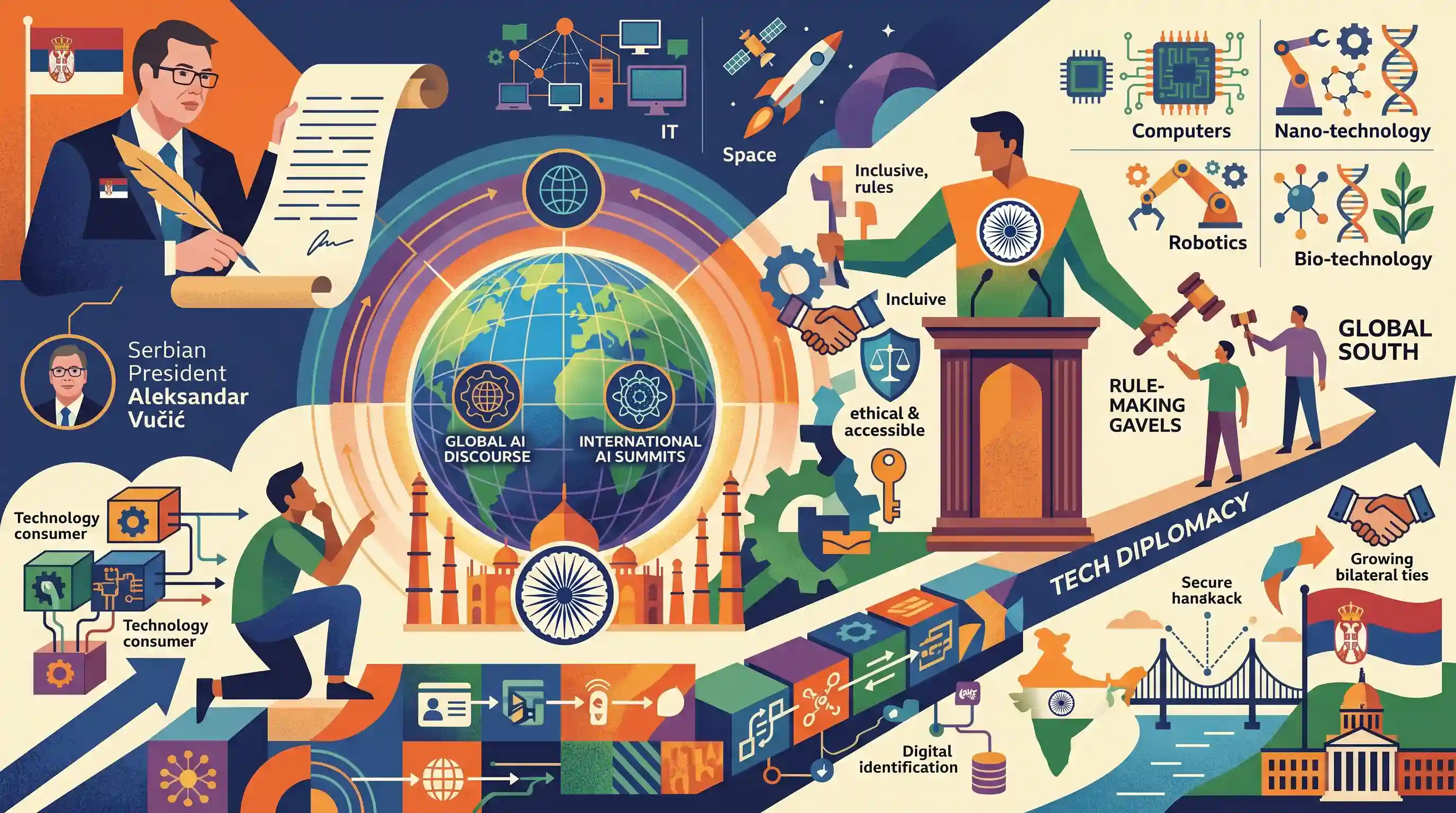
In an opinion piece, Serbian President Aleksandar Vučić highlights India's pivotal role in global AI discourse, driven by its leadership in international AI summits. The article underscores how India has evolved from a technology consumer to a rule-maker and advocate for the Global South, championing inclusive, ethical, and accessible AI governance. India's success with Digital Public Infrastructure (DPI) serves as a foundational model for this global outreach, strengthening its tech diplomacy and expanding bilateral ties with nations like Serbia.
Key Points
- India's hosting of global AI summits cements its position as a central figure in shaping international frameworks for AI governance and ethics.
- The piece by the Serbian President illustrates India's expanding tech diplomacy, showcasing its ability to forge strategic technological partnerships with European nations.
- India is leveraging its success in Digital Public Infrastructure (DPI) to advocate for inclusive AI solutions that benefit the Global South, countering digital divides.
- The focus is shifting from pure technological development to democratic, safe, and accessible AI, making India a crucial bridge between developed and developing economies in multilateral tech forums.
Important Terms
Global Partnership on Artificial Intelligence (GPAI)

An international multi-stakeholder initiative (29 members) launched in 2020 to bridge the gap between AI theory and practice, promoting human-centric and responsible development based on OECD principles.
UPSC context
GS Paper 2 (International Groupings/Agreements); GS Paper 3 (Science & Tech). Tests India’s leadership in global digital governance.
Digital Public Infrastructure (DPI)
Interoperable, open-standard digital platforms (e.g., Aadhaar, UPI) that provide foundational identity and payment layers, enabling equitable and scalable delivery of public and private services.
UPSC context
GS Paper 3 (IT/Economy); GS Paper 2 (Governance). Focuses on India's tech-led developmental model and its export as a Global Public Good.
Global South
Developing and less-developed nations in Asia, Africa, and Latin America with shared colonial histories. India positions itself as their "voice" to ensure inclusive and fair global governance.
UPSC context
GS Paper 2 (International Relations). Tests understanding of India’s strategic role in bridging the gap between developed and developing nations.
Tech Diplomacy
The integration of technology and scientific collaboration into foreign policy to achieve strategic goals, strengthen bilateral ties, and address trans-border challenges like cybersecurity and climate change.
UPSC context
GS Paper 2 (International Relations). Crucial for understanding India's evolving soft power and strategic autonomy in the digital era.
Non-Aligned Movement (NAM)
A group of states not formally aligned with any major power bloc, co-founded by India and Yugoslavia (Serbia's predecessor) to promote sovereignty, anti-colonialism, and strategic autonomy.
UPSC context
GS Paper 2 (International Relations/Historical Context). Explains the deep-rooted historical foundation of India-Serbia bilateral ties.
AI Governance
The legal and ethical frameworks, regulations, and guardrails designed to ensure that artificial intelligence systems are trustworthy, inclusive, and respect human rights and democratic values.
UPSC context
GS Paper 3 (IT/Robotics) & GS Paper 4 (Ethics). Evaluates the balance between technological innovation and societal safety.
Prelims Trap
GPAI is a specialized agency of the United Nations regulating global Artificial Intelligence development.
GPAI is not a UN agency or treaty; it is an OECD-supported initiative. Furthermore, major AI players like China are not members, as GPAI focuses on democratic values.
Static Concepts Connected
What is the Global Partnership on Artificial Intelligence (GPAI)?
- Origin: Launched in June 2020 as a multi-stakeholder initiative, with its secretariat hosted by the OECD.
- Membership: India is a founding member. The group currently has 29 members, notably excluding China, to promote democratic AI values.
- Objective: Aims to bridge the gap between theory and practice on AI by supporting cutting-edge research and applied activities.
What constitutes India's Digital Public Infrastructure (DPI) model?
- Core Pillars: Rests on three foundational layers: Identity (Aadhaar), Payments (UPI), and Data Empowerment (Account Aggregator framework).
- Open Architecture: Built on open-source, interoperable APIs, allowing both government and private entities to build consumer-facing applications.
- AI Integration: Initiatives like BHASHINI (an AI-driven translation tool) integrate DPI to break language barriers and ensure inclusive digital access.
Cross-Topic Patterns
From NAM to Tech-Diplomacy
Historical ties with nations like Serbia (NAM co-founders) are being revitalized through AI and DPI exports, marking a shift from ideological non-alignment to multi-aligned technological statecraft.
Sovereign AI + DPDP Act
India's push for "Sovereign AI" inherently relies on data governance frameworks established by the DPDP Act, ensuring domestic control over the foundational datasets needed to train AI models.
G20 DPI consensus cascading to GPAI
India is systematically leveraging its G20 presidency successes (consensus on the DPI definition) to steer outcomes in other forums like GPAI, setting the tech agenda for the Global South.

Expect a 2026 Prelims question mapping global AI declarations (GPAI New Delhi vs. Bletchley Park vs. UN resolutions) to their exact mandates.
Linked PYQs · 3
Linked PYQs · 3
- 2023MainsGS3
Introduce the concept of Artificial Intelligence (AI). How does Al help clinical diagnosis? Do you perceive any threat to privacy of the individual in the use of Al in healthcare?
- 2020PrelimsGS1
With the present state of development, Artificial Intelligence can effectively do which of the following? 1. Bring down electricity consumption in industrial units 2. Create meaningful short stories and songs 3. Disease diagnosis 4. Text-to-Speech Conversion 5. Wireless transmission of electrical energy Select the correct answer using the code given below:
- 2025MainsGS2
India-Africa digital partnership is achieving mutual respect, co-development and long-term institutional partnerships. Elaborate.
