President Murmu Inspects Dehradun Retreat and IMA Passing Out Parade
Source:newsonair ↗
Why It Matters
UKPSC PCS Prelims frequently tests candidates on historical landmarks, central government institutes based in Dehradun (such as the IMA, Survey of India, and FRI), and state-specific governance/historical visits. Understanding the history of the IMA (est. 1932) and the Rashtrapati Ashiana is vital for state-level general studies.
Summary
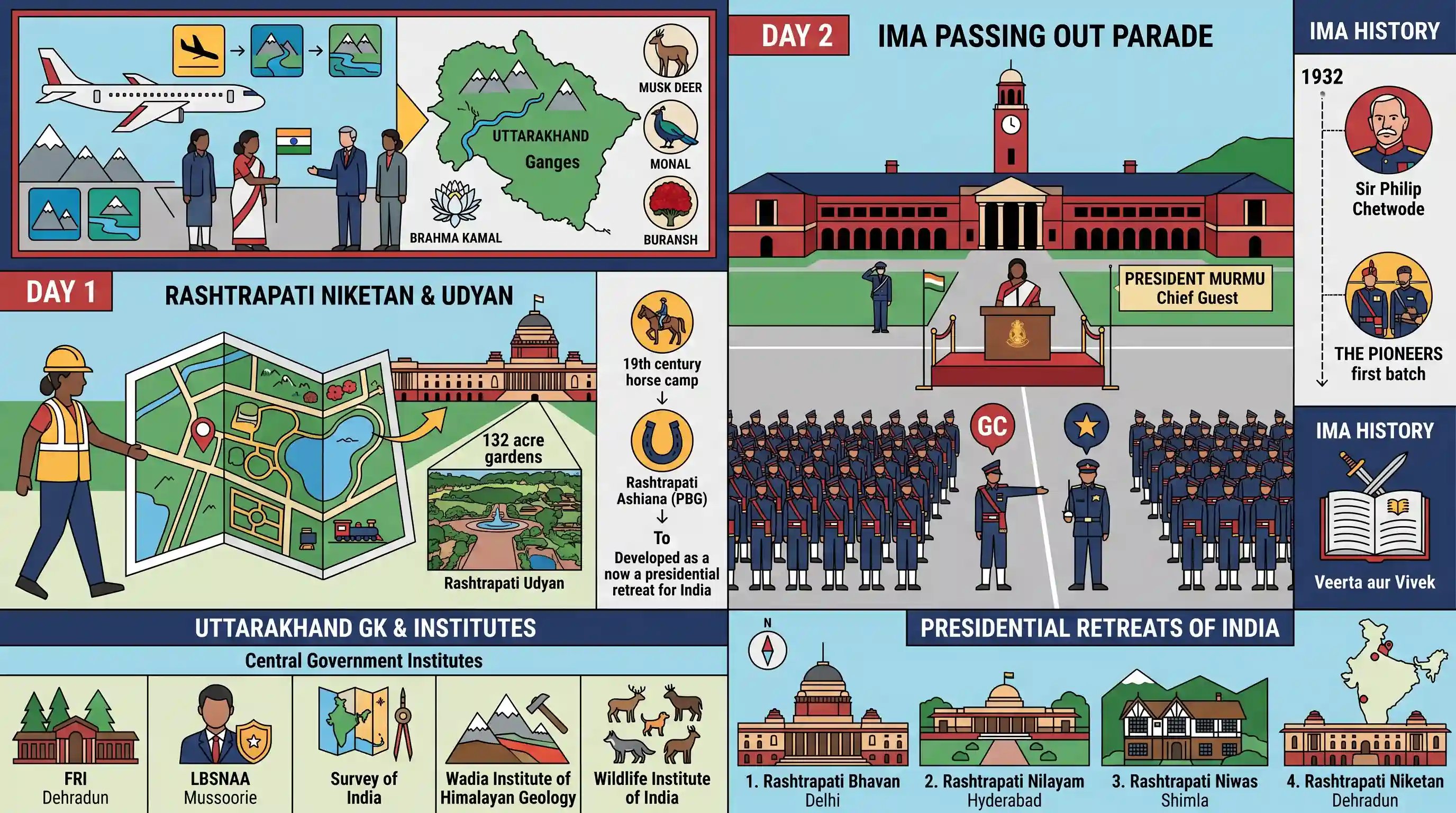
President Droupadi Murmu visited Dehradun, Uttarakhand, for a two-day tour on June 12, 2026. During her visit, she inspected the development of the 132-acre Rashtrapati Udyan at Rashtrapati Niketan (Rashtrapati Ashiana) and attended the Passing Out Parade as the Chief Guest at the Indian Military Academy (IMA) in Dehradun.
Key Points
- President Droupadi Murmu embarked on a two-day official visit to Uttarakhand starting June 12, 2026.
- The President visited the Rashtrapati Niketan (historically known as Rashtrapati Ashiana) in Dehradun to inspect the ongoing development of the 132-acre Rashtrapati Udyan.
- The Rashtrapati Ashiana was originally built in 1920 as the summer camp/bungalow for the Viceroy's Bodyguard and now serves as one of India's presidential retreats.
- As the Chief Guest, the President attended the Passing Out Parade (POP) at the historic Indian Military Academy (IMA) in Dehradun.
- The IMA was established on October 1, 1932, under the recommendation of the Indian Military College Committee chaired by Field Marshal Sir Philip Chetwode. The main building of the academy is named Chetwode Hall.
Important Terms
Indian Military Academy (IMA)

The premier officer-training academy of the Indian Army, established in 1932 in Dehradun, Uttarakhand, following the recommendations of the Chetwode Committee, to train and commission future military leaders of India.
UPSC context
GS Paper III: Security forces and their mandate; tests historical security architecture and elite military institutions of India.
Rashtrapati Niketan
Formerly known as Rashtrapati Ashiana, it is an official presidential retreat in Dehradun, Uttarakhand. Spread over 237 acres, it was originally built in 1920 and previously served the President's Bodyguard as a summer camp.
UPSC context
GS Paper II: Executive of India; tests knowledge of official presidential residences, historical landmarks, and constitutional conventions.
President's Bodyguard (PBG)
The oldest and senior-most cavalry regiment of the Indian Army, raised in 1773 by Warren Hastings. Stationed at Rashtrapati Bhavan, its primary role is to provide ceremonial escorts and protection to the President of India.
UPSC context
GS Paper III: Defence forces; tests the lineage, organizational structure, and operational history of India’s elite military regiments.
Presidential Retreats of India
Official residences outside New Delhi where the President of India stays annually to conduct business, symbolizing national integration. These include Rashtrapati Niwas (Shimla), Rashtrapati Nilayam (Hyderabad), and Rashtrapati Niketan (Dehradun).
UPSC context
GS Paper II: Executive; tests understanding of the presidency, federal architecture, and institutions that promote national unity.
Prelims Trap
The President of India has only two official presidential retreats outside New Delhi, located in Shimla and Secunderabad.
There are actually three official retreats outside Delhi. The third is Rashtrapati Niketan (Rashtrapati Ashiana) in Dehradun, Uttarakhand, designated in 1975–76.
Static Concepts Connected
What was the role of the Chetwode Committee in the Indianisation of the military?
- Historical catalyst: Formed in 1931 following intense demands for the Indianisation of the officer cadre at the First Round Table Conference.
- Key recommendation: Chaired by Field Marshal Philip Chetwode; recommended establishing a dedicated military training academy for Indian cadets.
- Direct outcome: Led to the establishment of the Indian Military Academy (IMA) in Dehradun on October 1, 1932, training pioneers like Sam Manekshaw.
What are the official Presidential Retreats of India?
- Rashtrapati Niwas: Located in Mashobra, Shimla (Himachal Pradesh); a historic wooden building where the President stays at least once a year.
- Rashtrapati Nilayam: Located in Bollarum, Secunderabad (Telangana); built in 1860, it symbolizes national integration between the North and South.
- Rashtrapati Niketan: Located in Dehradun (Uttarakhand); originally built in 1920 as a summer camp for the Viceroy's Bodyguard, designated a retreat in 1975-76.
Cross-Topic Patterns
Colonial architecture to Republic symbols
The transition of Viceregal retreats into Presidential assets illustrates how independent India repurposed imperial architecture to project sovereign, democratic, and geographically representative authority.
Constitutional devolution & military reform
The 1930s Round Table Conferences connected administrative devolution to military reform, showing that Indian political autonomy was structurally linked to the Indianisation of the officer cadre.

Chetwode Committee's role in military Indianisation and the three official Presidential Retreats are high-value targets for GS-1/Polity.
Linked PYQs · 3
Linked PYQs · 3
- 2025UKPSC_PRELIMSGS1
Which of the following is incorrectly matched about Central Government Institutes located in Uttarakhand?
- 2024UKPSC_PRELIMSGS1
Headquarters of which of the following is located in Dehradun, the Capital of Uttarakhand ?
- 2025UKPSC_PRELIMSGS1
Where was the first Asian Mayors' Conference held in Uttarakhand in 2006?
