Santhali Constitution Translation and Eighth Schedule Significance
Source:The Hindu ↗
Why It Matters
The inclusion and promotion of tribal languages (like Santhali and its Ol Chiki script) align with constitutional mandates for linguistic inclusivity and cultural preservation. Questions on the Eighth Schedule and Constitutional Amendments are recurring in UPSC Prelims, while tribal empowerment and knowledge systems are important for Mains.
Summary
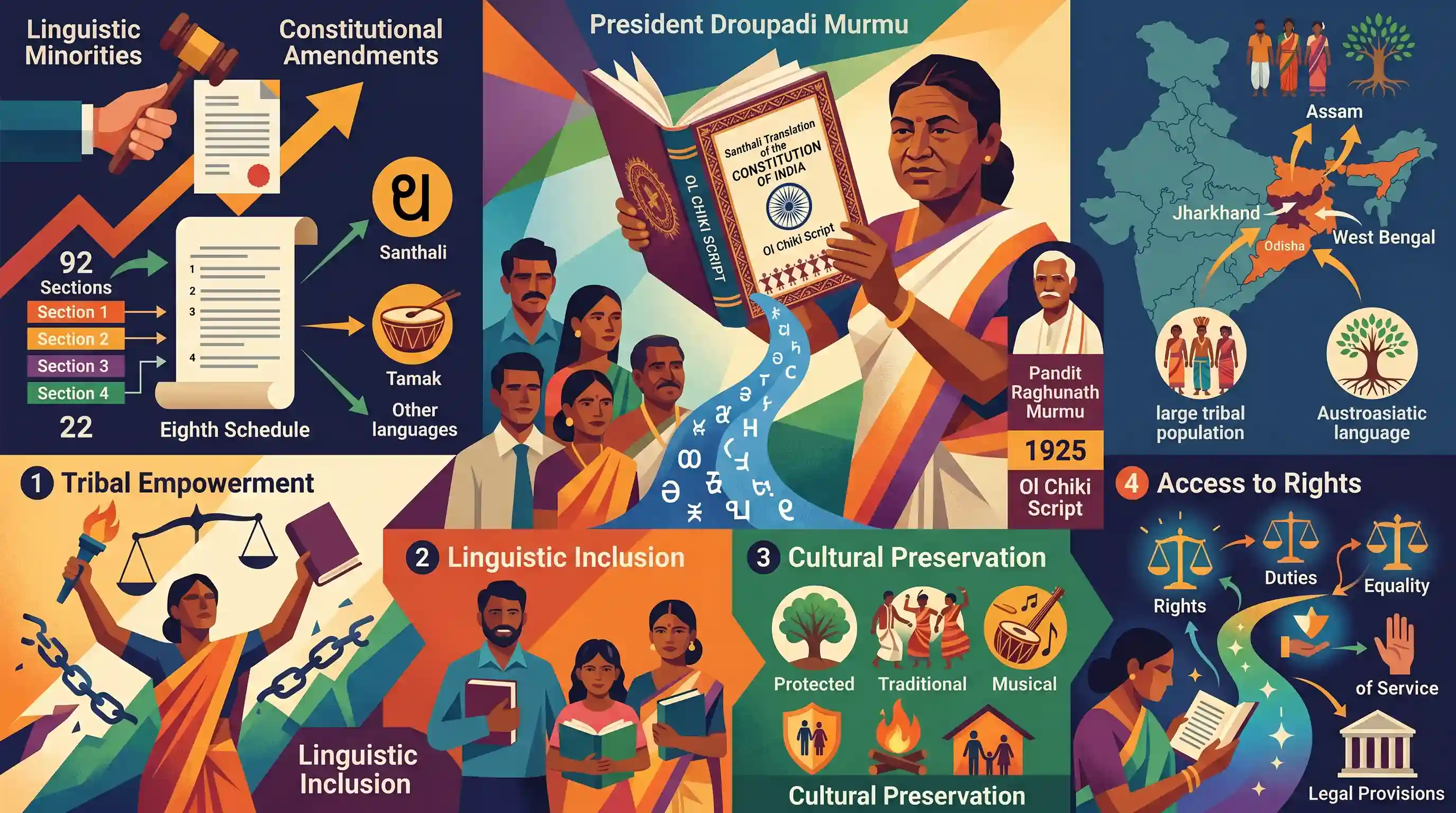
President Droupadi Murmu released the first-ever translation of the Constitution of India into the Santhali language, utilizing the Ol Chiki script. Santhali, an Austroasiatic language spoken by a large tribal population across states like Jharkhand, Odisha, and West Bengal, was recognized under the Eighth Schedule following the 92nd Amendment Act of 2003. This landmark translation initiative represents a major step toward tribal empowerment, linguistic inclusion, and cultural preservation, ensuring that constitutional rights, duties, and legal provisions are accessible to the Santhal community in their native tongue.
Key Points
- President Droupadi Murmu released the Constitution of India translated into the Santhali language.
- The Santhali language is written in the Ol Chiki script, which was created by Pandit Raghunath Murmu in 1925.
- Santhali was added to the Eighth Schedule of the Constitution through the 92nd Amendment Act in 2003, along with Bodo, Dogri, and Maithili.
- The initiative aims to enhance constitutional awareness, legal literacy, and awareness of fundamental rights among the Santhal tribal community in their mother tongue.
Important Terms
Eighth Schedule

A constitutional list (Articles 344(1) and 351) recognizing 22 official languages. Inclusion ensures government support for the language's development and its use in official competitive examinations like the UPSC.
UPSC context
GS Paper II (Polity) and GS Paper I (Social Issues). Tests knowledge of constitutional provisions for linguistic diversity and official status.
92nd Amendment Act, 2003
Enacted in 2003, this amendment added four languages—Bodo, Dogri, Maithili, and Santhali—to the Eighth Schedule of the Indian Constitution, raising the total number of recognized languages to 22.
UPSC context
GS Paper II (Polity). Tests understanding of the evolution of the Constitution and specific amendments related to federalism and culture.
Ol Chiki script
The indigenous, phonetic, and scientific writing system for the Santhali language. Invented in 1925, it uses 30 letters based on natural shapes to accurately represent the unique phonetics of the Austroasiatic language.
UPSC context
GS Paper I (Art and Culture). Tests awareness of tribal heritage, scripts, and indigenous cultural preservation initiatives.
Santhali language
A major Austroasiatic (Munda branch) tribal language spoken by over 7 million people, primarily in Jharkhand, West Bengal, and Odisha. It is the most spoken tribal language in India.
UPSC context
GS Paper I (Society/Culture). Important for topics on tribal demographics, linguistic identity, and constitutional recognition of minority groups.
Pandit Raghunath Murmu
A revered Santhali scholar and philosopher, known as 'Guru Gomke,' who invented the Ol Chiki script in 1925 to give the Santhali language its own written identity.
UPSC context
GS Paper I (History/Culture). Relevant for questions on tribal movements, personalities, and cultural icons of indigenous communities.
Prelims Trap
Santhali belongs to the Sino-Tibetan language family and is written in the Devanagari script.
Santhali belongs to the Austroasiatic (Munda) language family, not Dravidian or Sino-Tibetan. Furthermore, it is natively written in the Ol Chiki script, not Devanagari.
Static Concepts Connected
How did the 8th Schedule of the Constitution expand from 14 to 22 languages?
- 21st Amendment (1967): Added Sindhi to the Eighth Schedule.
- 71st Amendment (1992): Added Konkani, Manipuri, and Nepali.
- 92nd Amendment (2003): Added Bodo, Dogri, Maithili, and Santhali, bringing the total to 22 languages.
What are the four primary language families found in India?
- Indo-Aryan: Spoken by ~78% of the population (e.g., Hindi, Gujarati, Bengali).
- Dravidian: Spoken by ~20% of the population, mostly in Southern India (e.g., Tamil, Telugu).
- Austroasiatic: Includes the Munda branch spoken by central/eastern tribes (e.g., Santhali, Ho, Mundari).
- Sino-Tibetan: Spoken by communities in the North-East and Himalayan regions (e.g., Bodo, Meitei, Lepcha).
Cross-Topic Patterns
Indigenous Scripts & Tribal Autonomy
The evolution of the Ol Chiki script parallels other tribal linguistic identity movements, connecting to broader UPSC themes on cultural preservation and the Fifth/Sixth Schedule protections for tribal autonomy.
8th Schedule Benefits & Part XVII
Linking Eighth Schedule inclusion to Article 351 (Directive for development of Hindi) and Article 344 (Commission on Official Languages), showcasing how linguistic rights operationalize minority protection in India.

Match-the-following pairs of tribal languages, their unique scripts (Ol Chiki), and language families are highly probable in 2026.
Linked PYQs · 3
Linked PYQs · 3
- 2024PrelimsGS1
The Constitution (71st Amendment) Act, 1992 amends the Eighth Schedule to the Constitution to include which of the following languages? 1. Konkani 2. Manipuri 3. Nepali 4. Maithili Select the correct answer using the code given below:
- 2008PrelimsGS1
Under which one of the following Constitution Amendment Acts, four languages were added to the languages under the Eighth Schedule of the Constitution of India, thereby raising their number to 22?
- 2021MainsGS1
Examine the uniqueness of tribal knowledge system when compared with mainstream knowledge and cultural systems.
