President mercy plea rejection under Article 72 for heinous crimes
Source:The Hindu ↗
Why It Matters
Understanding the application of the President's pardoning power (mercy petitions) and the judicial doctrine surrounding the death penalty (especially in heinous crimes against children) is crucial for GS Paper 2 (Polity and Governance). It highlights the practical checks, balances, and executive-judicial processes involved in capital punishment.
Summary
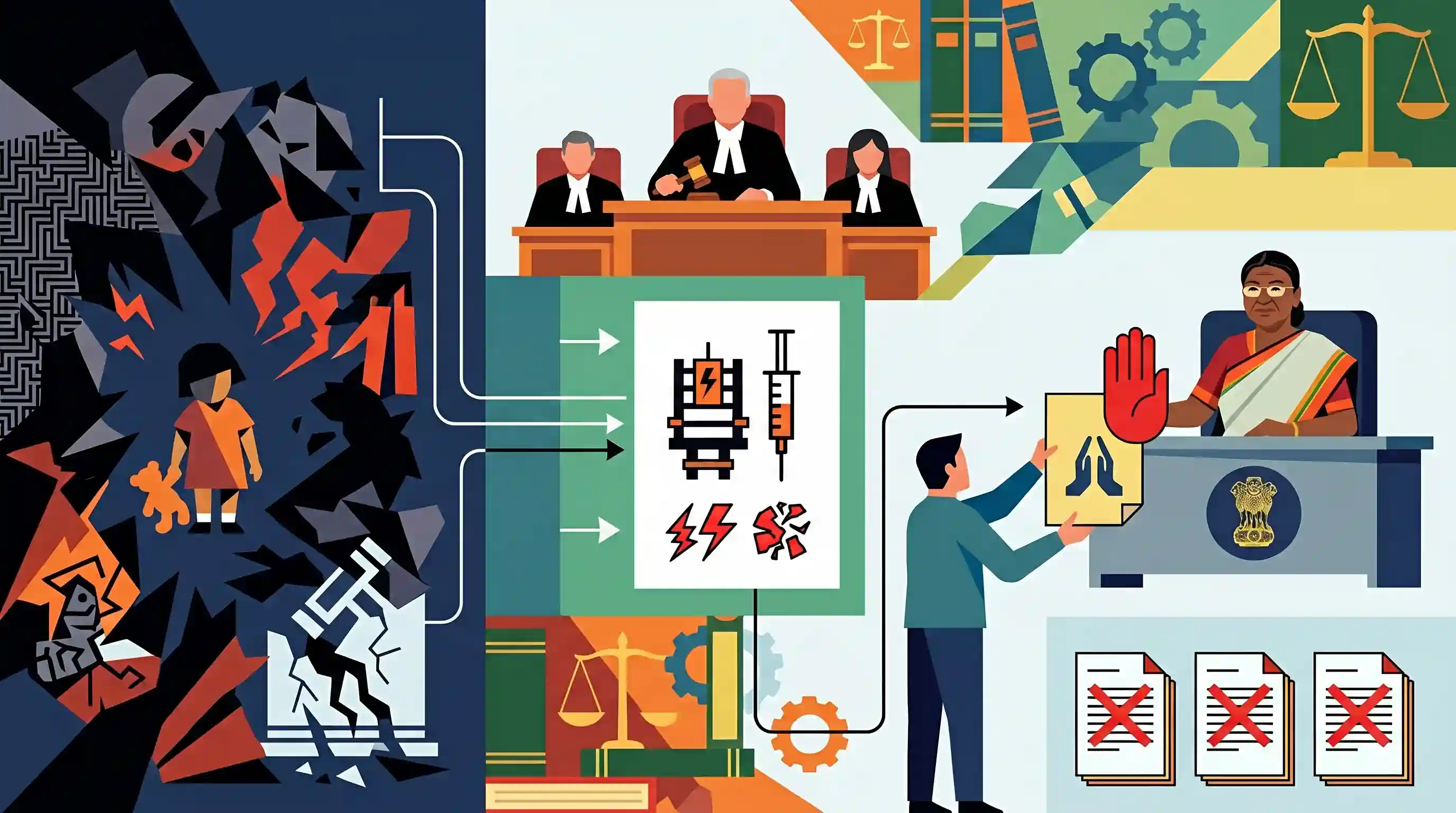
President Droupadi Murmu has rejected the mercy petition of a man sentenced to death for the 2012 rape and murder of a two-year-old girl in Maharashtra. This is the third such mercy plea rejected by the President since taking office. The Supreme Court had previously upheld the convict's death sentence, citing the extreme brutality and perversity of the crime, which justified capital punishment.
Key Points
- President Droupadi Murmu rejected the mercy petition of Ravi Ashok Ghumare, convicted of kidnapping, raping, and murdering a two-year-old in Maharashtra.
- This is the third mercy plea rejected by President Murmu since assuming office in July 2022.
- The Supreme Court upheld the death penalty in a 2019 verdict, describing the act as showcasing a 'horrifying tale of brutality' and an impairment of social values.
- The case highlights the intersection of judicial decisions on capital punishment for heinous crimes and the executive's pardoning powers under the Constitution.
Important Terms
Article 72

Constitutional provision empowering the President to grant pardons, reprieves, respites, remissions, or commutations. It applies to Union law violations, court-martial cases, and all death sentences, exercised on Cabinet advice.
UPSC context
GS Paper II: Executive powers and Constitutional provisions. Tests understanding of the President's role and Cabinet-dependence.
Capital Punishment
The highest legal penalty in India, awarded only in the 'rarest of rare' cases involving extreme brutality. It can be commuted by the President or Governor through clemency powers.
UPSC context
GS Paper II: Criminal Justice System and Judiciary. Tests knowledge of legal doctrines and human rights.
Mercy Petition
The final constitutional resort for a convict to seek clemency from the President (Article 72) or Governor (Article 161) after exhausting all judicial remedies, including review and curative petitions.
UPSC context
GS Paper II: Constitutional remedies and executive-judiciary relations. Tests procedural knowledge of the clemency process.
Judicial Review
The judiciary's power to scrutinize the President’s or Governor’s decision on mercy petitions. It ensures decisions are not arbitrary, mala fide, or based on extraneous considerations.
UPSC context
GS Paper II: Separation of Powers. Tests the limits of executive discretion and judicial oversight.
Article 161
Constitutional provision granting State Governors power to pardon or commute sentences for offenses against state laws. Unlike the President, Governors cannot pardon a death sentence.
UPSC context
GS Paper II: Federalism and State Executive. Tests comparison between Presidential and Gubernatorial powers.
Rarest of Rare Doctrine
A judicial principle established in the Bachan Singh case (1980), stating that the death penalty should only be imposed for crimes of exceptional depravity and brutality.
UPSC context
GS Paper II: Judiciary and landmark judgments. Tests understanding of sentencing guidelines in Indian law.
Prelims Trap
"The President's pardoning power under Article 72 is completely immune from judicial review."
The Supreme Court (Epuru Sudhakar case, 2006) established that clemency decisions are not absolute and remain subject to limited judicial review on grounds of arbitrariness or mala fide intent.
Static Concepts Connected
What are the key differences between Presidential and Gubernatorial pardoning powers?
- Death Sentences: The President can grant a full pardon for a death sentence, whereas a Governor can only suspend, remit, or commute it.
- Military Courts: Only the President has the power to pardon sentences handed down by Court Martials.
- Union vs State: The President's power applies to offenses against Union laws, while the Governor's applies to State laws.
What are the specific clemency terms defined under Article 72?
- Commutation & Remission: Commutation substitutes a harsher punishment with a lighter form. Remission reduces the sentence's duration without changing its fundamental character.
- Respite & Reprieve: Respite awards a lesser sentence due to special circumstances (e.g., physical disability). Reprieve temporarily stays execution to allow time for a mercy plea.
Cross-Topic Patterns
Rarest of Rare & Statutory Minimums
Judicial upholding of death penalties under the 'rarest of rare' doctrine (Bachan Singh case) frequently clashes with debates on mandatory death sentences in laws like POCSO.
Polity meets Ethics: Justice Models
Clemency decisions force aspirants to evaluate the tension between retributive justice (punishing heinous crimes) and reformative justice (human rights and rehabilitation).

A comparative multi-statement Prelims question testing Art 72 vs 161, specifically focusing on death penalty pardons, is highly likely.
Linked PYQs · 2
Linked PYQs · 2
- 2025MainsGS2
Compare and contrast the President's power to pardon in India and in the USA. Are there any limits to it in both the countries? What are 'preemptive pardons'?
- 2025PrelimsGS1
Consider the following statements with regard to pardoning power of the President of India : I. The exercise of this power by the President can be subjected to limited judicial review. II. The President can exercise this power without the advice of the Central Government. Which of the statements given above is/are correct?
