President Murmu Portugal and Slovakia Tour and European Diplomacy
Source:Indian Express ↗
Why It Matters
High-level state visits are essential instruments of India's soft power and diplomatic signaling. For UPSC aspirants, such visits highlight emerging focal points in India's foreign policy (deepening ties with Central and Southern Europe) and bring related geography (Slovakia's borders, EU/NATO memberships) into the Prelims spotlight.
Summary
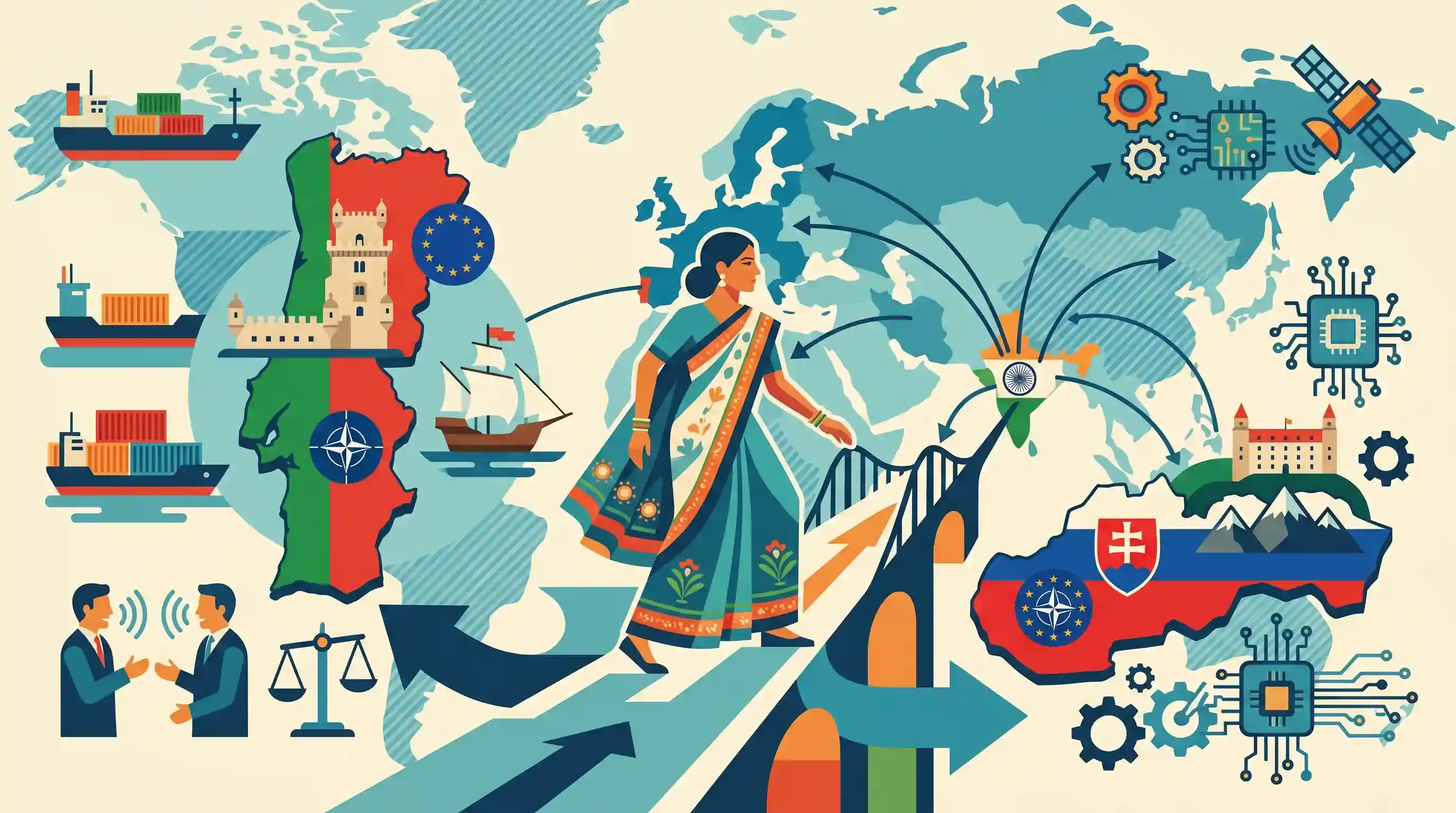
President Droupadi Murmu is set to visit Portugal and Slovakia, marking the first Indian Presidential tour to these European countries in nearly three decades. This diplomatic outreach aims to reinvigorate bilateral relations, enhance political dialogue, and expand cooperation in areas such as trade and technology. The visit underscores India's strategic approach to deepening its footprint across the European continent, recognizing the growing importance of engaging with individual EU and NATO member states amidst changing global geopolitics.
Key Points
- President Droupadi Murmu is undertaking the first Indian Presidential visit to Portugal and Slovakia in almost three decades.
- The tour signals India's intent to broaden its diplomatic outreach in Europe, looking beyond traditional major powers to strengthen ties with Western and Central European states.
- Geopolitically, the visits are strategic: Portugal is a key maritime partner in the EU, while Slovakia is a Central European nation that shares a border with Ukraine.
- The visits are expected to boost bilateral dialogue on trade, technology, diaspora relations, and global strategic issues.
Important Terms
European Union (EU)

An economic and political union of 27 European countries. It operates as a single market and is a critical partner for India regarding the Broad-based Trade and Investment Agreement (BTIA).
UPSC context
GS-II: Bilateral and regional groupings; crucial for trade negotiations and India-EU strategic cooperation.
NATO (North Atlantic Treaty Organization)
A collective defense alliance of 32 North American and European countries. Engaging its members like Portugal and Slovakia allows India to navigate European security dynamics and the Ukraine conflict.
UPSC context
GS-II: International relations and global security architecture; impacts of developed country policies on India's interests.
Visegrád Group (V4)
A cultural and political alliance of four Central European states: Czech Republic, Hungary, Poland, and Slovakia. It serves as a vital sub-regional platform for India's "Strategy for Europe."
UPSC context
GS-II: Regional groupings involving India; tests knowledge of sub-regional blocs and India's diversified European outreach.
Strategic Partnership
A high-level diplomatic framework for long-term cooperation in defense, technology, and trade. India utilizes these to upgrade relationships with key partners like those in the V4.
UPSC context
GS-II: Bilateral relations and agreements involving India and/or affecting India's interests.
Indian Diaspora
The global community of people of Indian origin. In Portugal, the 1.25-lakh-strong diaspora acts as a 'living bridge,' enhancing soft power and bilateral economic ties.
UPSC context
GS-II: Importance of the diaspora in Indian foreign policy and its role in strengthening bilateral bonds.
Operation Vijay (1961)
The 1961 military operation that liberated Goa from 450 years of Portuguese rule. It caused a diplomatic freeze that only ended after Portugal's 1974 Carnation Revolution.
UPSC context
GS-I: Post-Independence History - Integration of colonial enclaves and evolution of India-Portugal diplomatic history.
Prelims Trap
"India and Portugal normalized diplomatic relations immediately following the liberation of Goa in 1961."
Relations actually remained ruptured until 1974, only normalizing after the Carnation Revolution in Portugal ousted the authoritarian regime.
Static Concepts Connected
What is the Visegrád Group (V4)?
- Members: It comprises four Central European nations: Czech Republic, Hungary, Poland, and Slovakia.
- Purpose: A regional cultural and political alliance that coordinates military, economic, and energy policies, primarily advancing their shared interests within the European Union framework.
How was Goa integrated into the Indian Union?
- Operation Vijay (1961): Indian armed forces liberated Goa, Daman, and Diu from Portuguese rule in December 1961 after diplomatic efforts failed.
- 12th Amendment (1962): Formally incorporated the liberated territories into India as Union Territories.
- Statehood (1987): Goa was elevated to a full state, while Daman and Diu remained a Union Territory.
Cross-Topic Patterns
Ukraine's bordering nations
Slovakia’s shared border with Ukraine makes it a critical geography map-point. UPSC regularly tests nations abutting major geopolitical conflict zones.
India's sub-regional EU diplomacy
India increasingly engages sub-regional European blocs—like the Visegrád Group (V4) and Nordic-Baltic 8 (NB8)—to consolidate technological and strategic leverage within the broader EU.

Expect a geography map question in 2026 pairing Central European nations (Slovakia, Hungary) with their borders to Ukraine or V4 status.
Linked PYQs · 3
Linked PYQs · 3
- 2023MainsGS2
‘The expansion and strengthening of NATO and a stronger US-Europe strategic partnership works well for India.’ What is your opinion about this statement ? Give reasons and examples to support your answer.
- 2023PrelimsGS1
Consider the following countries: 1. Bulgaria 2. Czech Republic 3. Hungary 4. Latvia 5. Lithuania 6. Romania How many of the above-mentioned countries share a land border with Ukraine?
- 2025PrelimsGS1
Consider the following countries : I. Austria II. Bulgaria III. Croatia IV. Serbia V. Sweden VI. North Macedonia How many of the above are members of the North Atlantic Treaty Organization?
