President Parliament Address Outlines Economic and Policy Roadmap
Source:The Hindu ↗
Why It Matters
The President's address to Parliament is a foundational document that officially summarizes the government’s achievements and legislative agenda. It is a highly reliable source for UPSC aspirants to track major policy priorities, such as AI regulation, the EU-India FTA, the PLI scheme, and Labour Codes, which frequently appear in both Prelims and Mains examinations.
Summary
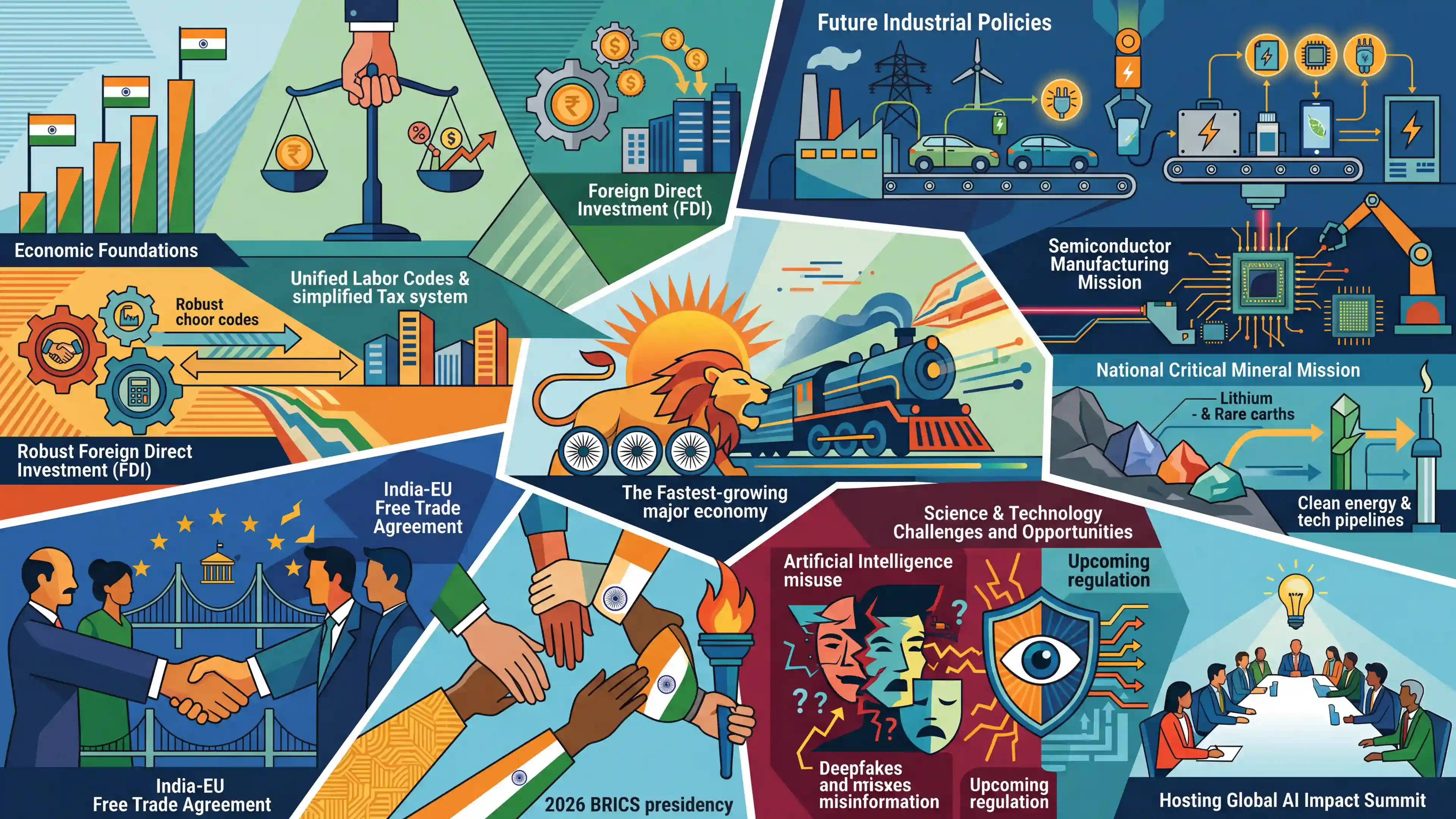
President Droupadi Murmu’s address to both Houses of Parliament on January 28, 2026, comprehensively outlined the government's economic, infrastructural, and diplomatic policy trajectory. She highlighted India's resilience as the fastest-growing major economy, underpinned by robust Foreign Direct Investment (FDI), inflation control, and systemic reforms including unified Labour Codes and a revamped tax regime. The address placed significant emphasis on future-oriented industrial policies, notably the Production Linked Incentive (PLI) scheme, semiconductor missions, and the National Critical Mineral Mission. Diplomatically, the successful conclusion of the India-EU Free Trade Agreement and India's 2026 BRICS presidency were celebrated. Additionally, the President issued a strong warning against the misuse of Artificial Intelligence, specifically highlighting the threats posed by Deepfakes and misinformation, signaling upcoming regulatory focus as India hosts the Global AI Impact Summit.
Key Points
- President Murmu highlighted India's status as the fastest-growing major economy, driven by controlled inflation, record FDI of $750 billion over 11 years, and structural reforms like the GST and revamped Income Tax slabs.
- Archaic labour laws are being consolidated into four unified Labour Codes to balance the ease of doing business with the welfare of workers.
- Crucial industrial and technological advancements were noted, including massive investments through the PLI scheme, the establishment of semiconductor manufacturing units, and the National Critical Mineral Mission.
- On the diplomatic front, India is presiding over BRICS in 2026 and has successfully concluded negotiations for a Free Trade Agreement (FTA) with the European Union.
- The President flagged the dangers of Artificial Intelligence, specifically Deepfakes and misinformation, emphasizing the need for regulation as India prepares to host the Global AI Impact Summit.
Important Terms
Labour Codes

Four comprehensive laws (Wage, Industrial Relations, Social Security, OSH) effective from November 21, 2025, consolidating 29 central statutes to modernize labor markets and improve ease of doing business.
UPSC context
GS Paper 3 (Economy/Labour); tests structural reforms, worker welfare, and formalization of the economy.
Production Linked Incentive (PLI) scheme
A performance-based incentive program offering 4–6% financial rewards on incremental sales to boost domestic manufacturing across 14 strategic sectors, including electronics and semiconductors.
UPSC context
GS Paper 3 (Industrial Policy); tests manufacturing strategies and 'Atmanirbhar Bharat' initiatives.
National Critical Mineral Mission
A ₹34,300 crore initiative launched in 2025 to secure India's supply chain for 30 essential minerals through domestic exploration, processing, recycling, and overseas acquisitions.
UPSC context
GS Paper 3 (Resources/S&T); tests strategic resource management and energy security goals.
India-EU Free Trade Agreement (FTA)
A comprehensive trade pact concluded in January 2026 to reduce tariffs on 90% of goods and deepen market access in services between India and the European Union.
UPSC context
GS Paper 2 (International Relations); tests bilateral trade diplomacy and diversification of partnerships.
BRICS
An expanded grouping of major emerging economies (including Brazil, Russia, India, China, and South Africa) for which India holds the 2026 presidency under a 'Resilience and Innovation' theme.
UPSC context
GS Paper 2 (Global Groupings); tests multilateral cooperation and India's leadership in the Global South.
Deepfakes
AI-generated synthetic media that realistically replaces a person's likeness or voice, identified by the President as a major threat to information security and social harmony.
UPSC context
GS Paper 3 (S&T/Cybersecurity); tests awareness of emerging digital threats and AI regulatory ethics.
Prelims Trap
"The President's address under Article 87 is drafted by the President and delivered at the beginning of every parliamentary session."
The address is drafted by the Union Cabinet, not the President, and is delivered only at the first session of each year (or post-election), not every session.
Static Concepts Connected
What are the constitutional provisions for the President's Special Address?
- Article 87: Mandates the President to address both Houses assembled together at the start of the first session of each year and after general elections.
- Motion of Thanks: The address is discussed via a 'Motion of Thanks'. Its defeat in the Lok Sabha amounts to a defeat of the government.
- Cabinet Drafted: It is drafted by the Union Cabinet and serves as a statement of the government's past achievements and future policy agenda.
What are the four new Labour Codes consolidating central labour laws?
- Code on Wages: Universalizes minimum wages and ensures timely payment to all employees across sectors.
- Industrial Relations Code: Streamlines laws relating to trade unions, conditions of employment, and dispute investigation.
- Social Security Code: Extends a universal social security net, notably including gig workers and platform workers.
- OSHW Code: Consolidates and amends laws regulating occupational safety, health, and working conditions across establishments.
Cross-Topic Patterns
Critical Minerals & Supply Chain Alliances
The National Critical Mineral Mission links domestic PLI ambitions (semiconductors, EVs) directly with external strategic groupings like the US-led Minerals Security Partnership (MSP) to mitigate supply chain dependencies.
India-EU FTA vs. CBAM tensions
While celebrating the FTA conclusion, UPSC often tests friction points in EU-India trade—particularly how the EU's Carbon Border Adjustment Mechanism (CBAM) interacts with India's manufacturing exports.
Deepfakes & Digital India Act linkages
The push for AI regulation signals potential amendments to the IT Rules 2021 or the upcoming Digital India Act to establish strict criminal liability for deepfake creators and platforms.

India-EU FTA completion + BRICS 2026 presidency + Critical Mineral Mission creates a high-probability IR/Economy cluster for 2026.
Linked PYQs · 4
Linked PYQs · 4
- 2024MainsGS3
Discuss the merits and demerits of the four 'Labour Codes' in the context of labour market reforms in India. What has been the progress so far in this regard?
- 2025MainsGS3
Discuss the rationale of the Production Linked Incentive (PLI) scheme. What are its achievements? In what way can the functioning and outcomes of the scheme be improved?
- 2025MainsGS3
India aims to become a semiconductor manufacturing hub. What are the challenges faced by the semiconductor industry in India? Mention the salient features of the India Semiconductor Mission.
- 2023MainsGS3
Introduce the concept of Artificial Intelligence (AI). How does Al help clinical diagnosis? Do you perceive any threat to privacy of the individual in the use of Al in healthcare?
