Left-Wing Extremism Decline and Tribal Welfare Schemes in Bastar
Source:The Hindu ↗
Why It Matters
Provides direct examples of the government's dual strategy (security and development) against Maoism, a recurring GS3 internal security topic. Also offers concrete scheme names (PM-JANMAN, Niyad Nellanar) useful for GS2 governance answers on tribal welfare and PVTGs.
Summary
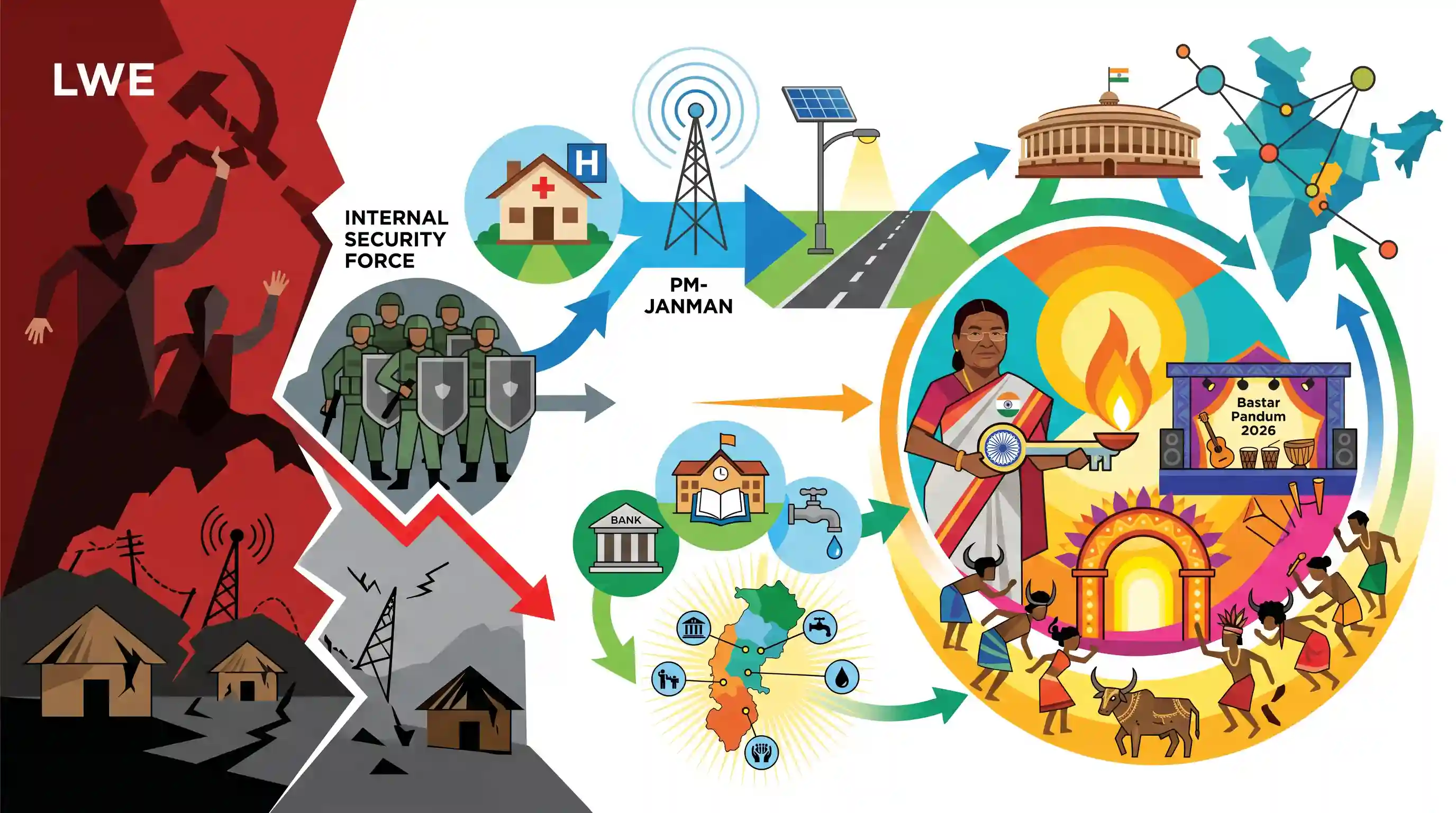
During her visit to Chhattisgarh to inaugurate the 'Bastar Pandum 2026' tribal festival, President Droupadi Murmu underscored the visible decline of Left-Wing Extremism (LWE) in the region. She highlighted that a decades-long atmosphere of fear is being replaced by development, driven by a combination of security measures and socio-economic initiatives. Central schemes like PM-JANMAN and the State's Niyad Nellanar Yojana were specifically praised for integrating deprived tribal communities into the mainstream by providing essential infrastructure and amenities.
Key Points
- President Droupadi Murmu inaugurated the 'Bastar Pandum 2026', a tribal cultural festival in Chhattisgarh, celebrating indigenous heritage.
- The President highlighted a significant decline in Left-Wing Extremism (LWE) in the Bastar region, noting that an atmosphere of fear is being replaced by development and peace.
- She emphasized the success of the 'two-pronged approach'—security operations coupled with surrender and rehabilitation policies—in neutralizing the Maoist threat.
- Central initiatives like the PM-JANMAN Yojana and Dharti Aaba Janjatiya Gram Utkarsh Abhiyan are actively uplifting tribal populations.
- The state government's Niyad Nellanar Yojana is bridging the development deficit by delivering basic amenities like electricity, roads, schools, and hospitals to remote tribal villages.
Important Terms
PM-JANMAN Yojana

A central mission (₹24,104 crore) launched in 2023 to saturate Particularly Vulnerable Tribal Groups (PVTGs) with 11 essential interventions like housing, clean water, and connectivity.
UPSC context
GS Paper II (Social Justice/Govt Policies); tests understanding of targeted welfare for India's most marginalized tribal communities.
Dharti Aaba Janjatiya Gram Utkarsh Abhiyan
An umbrella scheme targeting 63,000 tribal-majority villages to bridge infrastructure gaps in health, education, and livelihood through 25 interventions across 17 ministries.
UPSC context
GS Paper II (Governance); highlights the convergence of multiple ministries for holistic tribal development.
Niyad Nellanar Yojana
A Chhattisgarh government initiative providing 25 basic amenities to Naxal-affected villages within 5 km of security camps, aiming to restore trust and development.
UPSC context
GS Paper III (Internal Security); evaluates the "Development vs Extremism" strategy to counter Maoist influence.
Left-Wing Extremism (LWE)
A socio-political insurgency led by Maoist groups (Naxalites) against the state, primarily in the 'Red Corridor,' driven by radical Marxist-Leninist-Maoist ideologies.
UPSC context
GS Paper III (Security Challenges); core topic for internal security and regional stability in central India.
Particularly Vulnerable Tribal Groups (PVTGs)
A sub-classification of Scheduled Tribes characterized by stagnant population, low literacy, and pre-agricultural technology; there are 75 identified groups in India.
UPSC context
GS Paper I & II (Social Empowerment); critical for identifying specific vulnerabilities within the Scheduled Tribe umbrella.
Bastar Pandum
A regional tribal festival in Bastar, Chhattisgarh, celebrating indigenous culture and heritage; recently used as a platform to signify the return of peace.
UPSC context
GS Paper I (Art & Culture); reflects the socio-cultural fabric of tribal regions and its integration with mainstream development.
Prelims Trap
"The PM-JANMAN scheme aims at achieving 100% saturation of basic infrastructure and amenities for all Scheduled Tribes."
PM-JANMAN specifically targets only the 75 Particularly Vulnerable Tribal Groups (PVTGs). Broad ST saturation is the goal of the Dharti Aaba Janjatiya Gram Utkarsh Abhiyan.
Static Concepts Connected
What criteria determine the classification of Particularly Vulnerable Tribal Groups (PVTGs) in India?
- Primitive technology: Reliance on pre-agricultural levels of technology for hunting, gathering, and early farming.
- Population trends: Experiencing a stagnant or declining population growth rate over recent census periods.
- Low literacy: Extremely low literacy rates compared to other mainstream Scheduled Tribe communities.
- Economic backwardness: Sustenance strictly through a subsistence-level economy with negligible market integration.
What forms the core of India's multi-pronged approach to combat Left Wing Extremism (LWE)?
- Security measures: Deployment of Central Armed Police Forces, intelligence sharing, and fortified police stations under the SAMADHAN doctrine.
- Infrastructure development: Improving road connectivity (Road Requirement Plan) and installing mobile towers in deeply forested LWE-affected districts.
- Rehabilitation policies: Providing stipends, vocational training, and legal assistance to mainstream surrendered Maoist cadres.
Cross-Topic Patterns
Security Camps as Welfare Hubs
Chhattisgarh's Niyad Nellanar directly links security camps to service delivery, merging internal security (GS3) with social justice (GS2) to build local state capacity in LWE zones.
PVTG vs Broader ST Development Strategy
The parallel rollout of PM-JANMAN (for 75 PVTGs) and Dharti Aaba Abhiyan (for general ST villages) reflects a layered tribal welfare strategy, demanding precise differentiation for Prelims.

Expect a multi-statement question distinguishing the specific target groups of PM-JANMAN (PVTGs) vs Dharti Aaba Abhiyan (all STs) in 2026.
Linked PYQs · 5
Linked PYQs · 5
- 2025MainsGS3
The Government of India recently stated that Left Wing Extremism (LWE) will be eliminated by 2026. What do you understand by LWE and how are the people affected by it? What measures have been taken by the government to eliminate LWE?
- 2018MainsGS3
Left Wing Extremism (LWE) is showing a downward trend, but still affects many parts of the country. Briefly explain the Government of India's approach to counter the challenges posed by LWE.
- 2015MainsGS3
The persisting drives of the Government for development of large industries in backward areas have resulted in isolating the tribal population and the farmers who face multiple displacements. With Malkangiri and Naxalbari foci, discuss the corrective strategies needed to win the Left Wing Extremism (LWE) doctrine affected citizens back into the mainstream of social and economic growth.
- 2023MainsGS2
“Development and welfare schemes for the vulnerable, by its nature, are discriminatory in approach.” Do you agree? Give reasons for your answer.
- 2021PrelimsGS1
At the national level, which ministry is the nodal agency to ensure effective implementation of the Scheduled Tribes and Other Traditional Forest Dwellers (Recognition of Forest Rights) Act, 2006?
