International Fleet Review and India maritime diplomacy
Source:The Hindu ↗
Why It Matters
For UPSC aspirants, understanding the International Fleet Review highlights India's maritime strategy, its role as a net security provider in the Indian Ocean Region, and the constitutional duties of the President as the Supreme Commander of the Armed Forces. It directly links to GS2 (International Relations) and GS3 (Security).
Summary
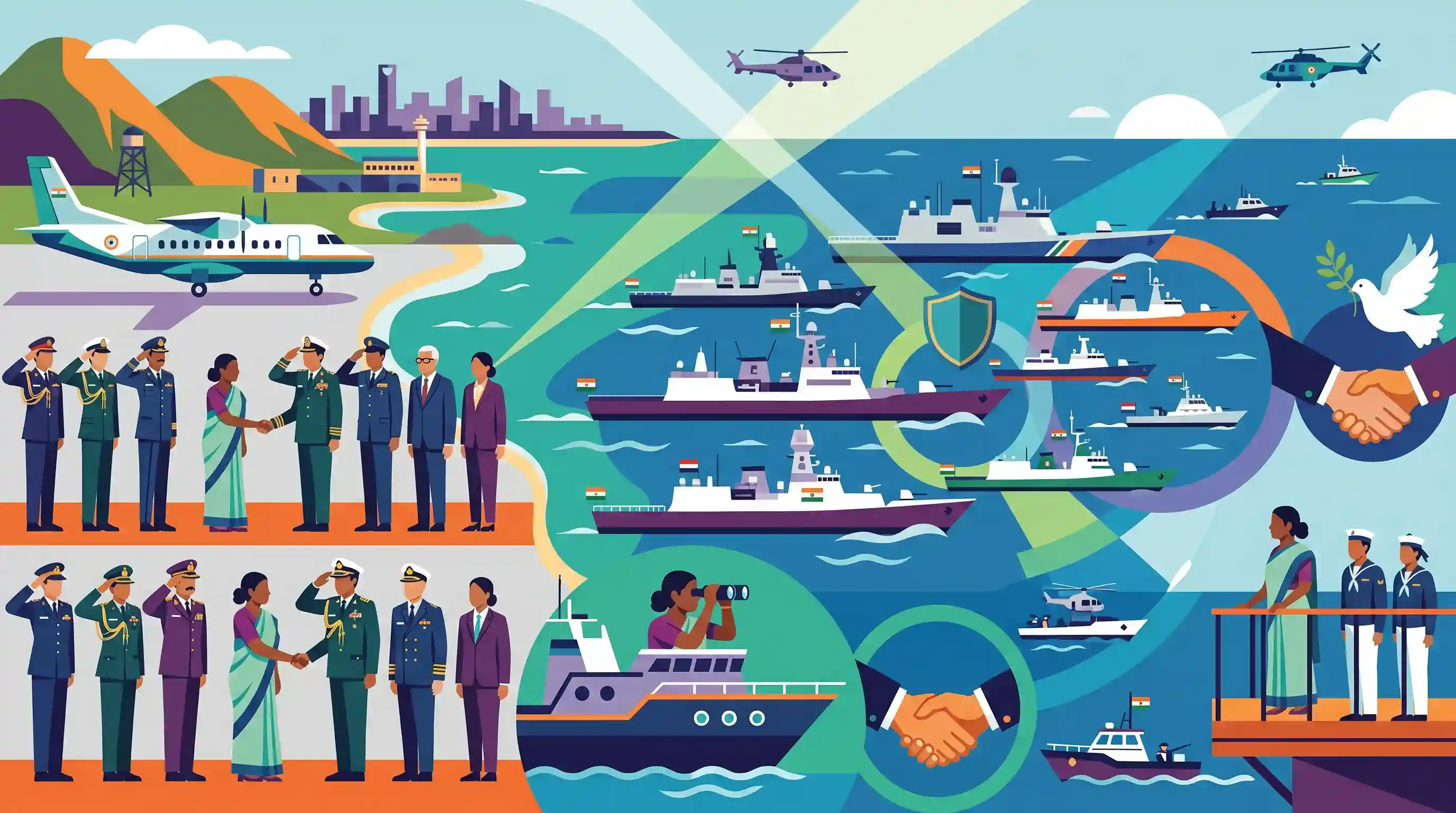
President Droupadi Murmu arrived in Visakhapatnam to attend the International Fleet Review (IFR) 2026 on February 18. Hosted by the Eastern Naval Command, the review is a significant maritime diplomatic event that brings together global navies, demonstrating India's naval strength and fostering cooperation for regional maritime security. Various high-ranking state dignitaries welcomed the President upon her arrival.
Key Points
- President Droupadi Murmu, serving as the Supreme Commander of the Armed Forces, arrived in Visakhapatnam to participate in the International Fleet Review (IFR) 2026.
- The event is hosted by the Eastern Naval Command (ENC) and aims to showcase India's naval prowess and bolster international maritime diplomacy.
- The IFR is scheduled for February 18, 2026, and provides a platform for confidence-building and interoperability amongst participating international navies.
- State dignitaries including Governor S. Abdul Nazeer and Chief Minister N. Chandrababu Naidu formally welcomed the President at INS Dega.
Important Terms
International Fleet Review (IFR)

A ceremonial congregation of naval ships, submarines, and aircraft from multiple countries, reviewed by the President of India to showcase naval strength and foster global maritime cooperation.
UPSC context
GS Paper III: Internal Security (Maritime Security) and GS Paper II: International Relations (Maritime Diplomacy/Soft Power).
Supreme Commander of the Armed Forces
Established by Article 53(2) of the Constitution, this role vests the highest command of the Indian Armed Forces in the President, symbolizing civilian control over the military.
UPSC context
GS Paper II: Indian Polity (Executive powers of the President and Civil-Military relations).
Eastern Naval Command (ENC)
One of the three operational commands of the Indian Navy, headquartered in Visakhapatnam, responsible for maritime security in the Bay of Bengal and strategic Indo-Pacific waters.
UPSC context
GS Paper III: Security Challenges and their Management in Border Areas; Role of specialized commands.
MILAN Exercise
A flagship biennial multilateral naval exercise hosted by the Indian Navy to enhance interoperability, camaraderie, and professional interaction among friendly foreign navies.
UPSC context
GS Paper III: Defence Exercises and GS Paper II: India's Act East Policy and regional leadership.
Maritime Diplomacy
The use of naval assets and activities—such as port calls, joint exercises, and fleet reviews—as instruments of foreign policy to build trust and regional stability.
UPSC context
GS Paper II: Bilateral, Regional and Global Groupings and Agreements involving India.
SAGAR Vision
India's strategic vision for the Indian Ocean, focusing on cooperative security, sustainable economic growth, and collective responsibility for a stable maritime order.
UPSC context
GS Paper II: India and its Neighborhood- Relations; GS Paper III: Maritime Security.
Prelims Trap
"The President is constitutionally mandated to conduct an International Fleet Review once during their tenure."
A Fleet Review is conducted once per presidential tenure by tradition, not constitutional mandate, and it is usually domestic (PFR), not necessarily International (IFR).
Static Concepts Connected
How does the Constitution define the President's role regarding the Armed Forces?
- Article 53(2): Article 53(2) formally vests the supreme command of the Defence Forces of the Union in the President of India.
- Regulated by Law: The exercise of this supreme military command is not absolute; it is specifically regulated by laws made by the Parliament.
- Aid and Advice: Like other executive powers, this function is exercised on the aid and advice of the Council of Ministers (Article 74).
What is the structure and strategic scope of India's Naval Commands?
- Three Naval Commands: The Indian Navy operates under three commands: Western (Mumbai), Eastern (Visakhapatnam), and Southern (Kochi, which is primarily a training command).
- Eastern Naval Command: The ENC oversees the Bay of Bengal and serves as the critical home base for India's strategic nuclear submarine fleet.
- Tri-Service Command: India also operates a unified, tri-service command based in Port Blair to secure the critical Andaman and Nicobar islands.
Cross-Topic Patterns
Naval Diplomacy + SAGAR Doctrine
The IFR is a physical manifestation of India's SAGAR vision (Security and Growth for All in the Region), directly linking military posturing with regional Indian Ocean diplomacy.
Fleet Reviews + Indo-Pacific Strategy
Multilateral reviews like IFR complement minilateral groupings like the Quad, reinforcing India's stated objective to be the 'net security provider' in the broader Indo-Pacific.

Expect a multi-statement question linking Article 53(2) (President's military powers) with India's SAGAR doctrine and naval commands.
Linked PYQs · 4
Linked PYQs · 4
- 2025MainsGS3
Why is maritime security vital to protect India's sea trade? Discuss maritime and coastal security challenges and the way forward.
- 2022MainsGS3
What are the maritime security challenges in India ? Discuss the organisational, technical and procedural initiatives taken to improve the maritime security.
- 2024MainsGS2
Discuss the geopolitical and geostrategic importance of Maldives for India with a focus on global trade and energy flows. Further also discuss how this relationship affects India's maritime security and regional stability amidst international competition ?
- 2024PrelimsGS1
Which of the following is/are correctly matched in terms of equivalent rank in the three services of Indian Defence forces? (Army — Airforce — Navy) 1. Brigadier — Air Commodore — Commodore 2. Major General — Air Vice Marshal — Vice Admiral 3. Major — Squadron Leader — Lieutenant Commander 4. Lieutenant Colonel — Group Captain — Captain Select the correct answer using the code given below:
