Supreme Court Appointments Draw Collegium Dissent Over Seniority Norms
Source:The Hindu ↗
Why It Matters
The unprecedented public dissent within the Supreme Court Collegium brings the debate on judicial appointments back into focus. It raises critical civil services examination themes regarding the opacity of the Collegium system, the ongoing conflict between 'seniority' and 'merit' in elevations, and the unwritten convention of maintaining regional diversity in the higher judiciary.
Summary
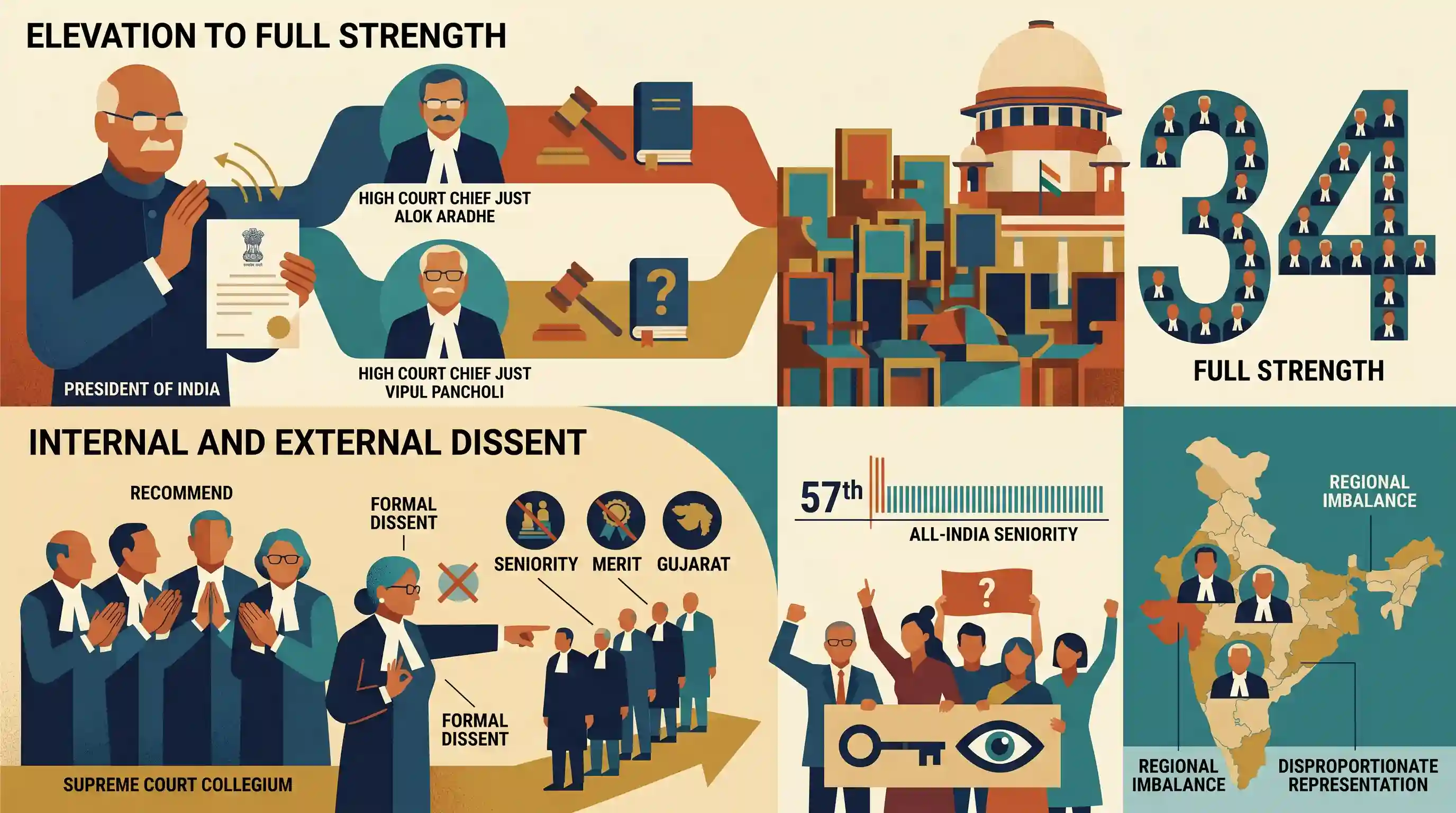
The President of India has elevated Chief Justices Alok Aradhe and Vipul Pancholi to the Supreme Court, bringing the apex court to its full working strength of 34 judges. However, the appointment of Justice Pancholi sparked controversy and drew formal dissent from Supreme Court Collegium member Justice B.V. Nagarathna, who cited the bypassing of senior and meritorious High Court judges. Civil society group Campaign for Judicial Accountability and Reforms (CJAR) also opposed the move, noting that Justice Pancholi was 57th on the all-India seniority list and that his elevation disrupts regional balance by giving Gujarat disproportionate representation on the Supreme Court bench.
Key Points
- The Supreme Court's working strength has reached its maximum sanctioned limit of 34 judges with these two new elevations.
- Justice Vipul Pancholi, formerly Chief Justice of the Patna High Court, is in line to become the Chief Justice of India in 2031.
- Supreme Court Collegium member Justice B.V. Nagarathna registered a formal dissent against Justice Pancholi's elevation, arguing that several senior and meritorious High Court judges were bypassed.
- The Campaign for Judicial Accountability and Reforms (CJAR) criticized the appointment, highlighting that Justice Pancholi was 57th on the all-India seniority list and that his elevation leads to disproportionate representation for Gujarat at the apex court.
Important Terms
Supreme Court of India

The highest constitutional court in India, serving as the final interpreter of laws and the guardian of fundamental rights under Article 124.
UPSC context
GS Paper II: Judiciary. Tests knowledge of its jurisdiction, powers, and role in maintaining the federal balance.
Supreme Court Collegium
An institutional mechanism for judge appointments where the CJI and four senior-most SC judges recommend names, ensuring judicial primacy.
UPSC context
GS Paper II: Appointments to Constitutional posts. Vital for understanding the debate on transparency vs. judicial independence.
Campaign for Judicial Accountability and Reforms (CJAR)
A civil society organization dedicated to promoting transparency, accountability, and ethical standards within the Indian judiciary through advocacy and litigation.
UPSC context
GS Paper II: Role of civil society/NGOs. Relevant for discussions on judicial reforms and public oversight.
Bombay High Court
The premier constitutional court for Maharashtra and Goa; its seniority and merit criteria significantly influence elevations to the Supreme Court.
UPSC context
GS Paper II: Structure and functioning of the Judiciary. Focuses on hierarchical relationships within the judiciary.
Patna High Court
The highest judicial body in Bihar, playing a key role in the regional and linguistic diversity of the apex court's bench.
UPSC context
GS Paper II: Judiciary. Relevant for questions on judicial appointments and the principle of regional balance.
Prelims Trap
"The Constitution of India limits the maximum working strength of the Supreme Court to 34 judges."
Article 124(1) does not fix this number permanently. It empowers Parliament to alter the strength by law, which it did via the Supreme Court (Number of Judges) Amendment Act, 2019.
Static Concepts Connected
What is the rule of dissent in the Supreme Court Collegium?
- Third Judges Case: The 1998 ruling established that the CJI must consult a collegium of the four senior-most judges for elevating judges to the Supreme Court.
- Two-dissent rule: If two or more judges in the Collegium give an adverse opinion, the CJI cannot forward the recommendation to the government.
- Single dissent exception: A single dissent does not block a recommendation. Hence, despite one judge's formal opposition, the elevation can legally proceed.
Who determines the sanctioned strength of the Supreme Court?
- Article 124(1): The Constitution originally fixed the number at 7 plus the CJI, explicitly leaving further alterations to the Parliament.
- Parliamentary authority: Parliament alters the strength by passing the Supreme Court (Number of Judges) Amendment Act. It is not determined by the President or Executive order.
- Current strength: The 2019 amendment increased the maximum working strength to 34 (1 CJI + 33 other judges), which is the current limit.
Cross-Topic Patterns
Collegium opacity & the NJAC debate
Controversies over bypassed seniority and regional imbalances frequently revive GS-2 debates on the struck-down 99th Constitutional Amendment (NJAC) and the delayed finalization of the Memorandum of Procedure (MoP).

Expect a multi-statement question contrasting constitutional criteria for SC judges with Collegium conventions like regional balance.
Linked PYQs · 2
Linked PYQs · 2
- 2025MainsGS2
Discuss the evolution of collegium system in India. Critically examine the advantages and disadvantages of the system of appointment of the Judges of the Supreme Court of India and that of the USA.
- 2017MainsGS2
Critically examine the Supreme Court's judgement on 'National Judicial Appointments Commission Act, 2014' with reference to appointment of judges of higher judiciary in India.
