President Droupadi Murmu Visits Kuno National Park in Madhya Pradesh
Source:freepressjournal ↗
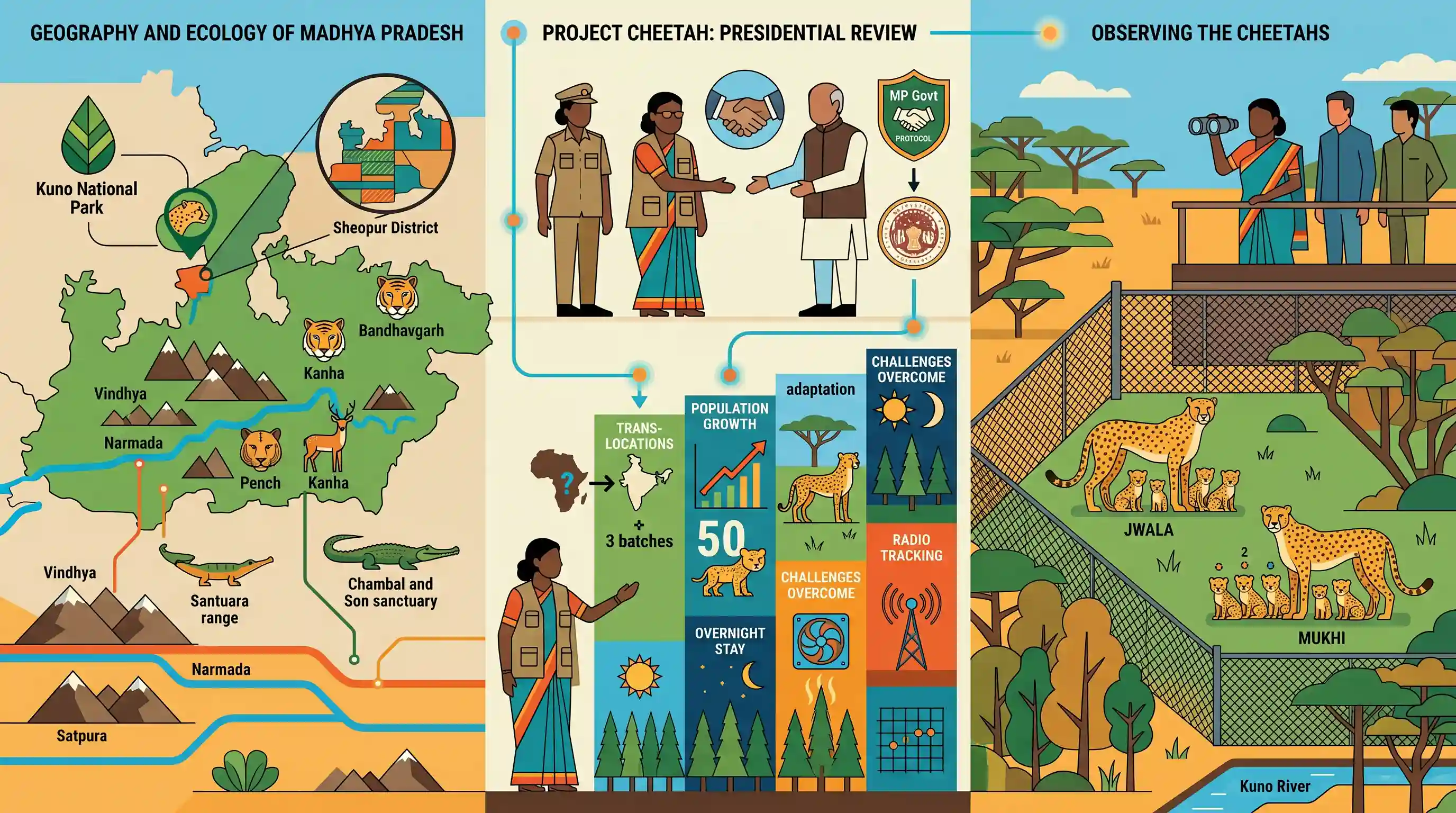
Why It Matters
Madhya Pradesh is known as the 'Cheetah State' and the 'Tiger State'. MPPSC frequently tests candidates on the locations, districts, and rivers associated with various national parks and sanctuaries in MP, making the President's visit to Kuno National Park highly relevant.
Summary
President Droupadi Murmu visited Kuno National Park in Madhya Pradesh's Sheopur district on June 21, 2026, to review the achievements and challenges of India's ambitious Cheetah Reintroduction Project (Project Cheetah). During her overnight stay, she was briefed on the project's milestones and observed translocated female cheetahs Jwala and Mukhi with their cubs. State Minister Rakesh Shukla was authorized by the Madhya Pradesh government to handle protocol and receive the President.
Key Points
- President Droupadi Murmu visited Kuno National Park in Sheopur, Madhya Pradesh, on June 21, 2026, to review India's landmark Cheetah Reintroduction Project.
- She traveled to Kuno via Gwalior Airport and spent an overnight stay tracking the progress of the project, including observing female cheetahs Jwala and Mukhi with their cubs.
- MP Cabinet Minister Rakesh Shukla was authorized to receive and see off the President during her official visit.
- Kuno National Park, situated in the Sheopur and Morena districts, was upgraded from a wildlife sanctuary (established 1981) to a national park in 2018 to facilitate the cheetah reintroduction program.
Important Terms
Project Cheetah

India's flagship wildlife restoration programme launched in 2022, aimed at reintroducing the cheetah—declared extinct in India in 1952—into its historical grassland and open forest habitats.
UPSC context
GS Paper III (Environment & Ecology); tests species recovery programs, biodiversity, and ecosystem restoration strategies.
Kuno National Park
A protected area in Madhya Pradesh's Vindhyan hills bisected by the Kuno River, established to host reintroduced cheetahs and serve as a second home for Asiatic lions.
UPSC context
GS Paper I (Geography) & GS III (Environment); tests national parks, drainage basins, and vegetation zones.
Cheetah Reintroduction Project
The world's first intercontinental translocation project of a large wild carnivore, bringing African cheetahs from Namibia and South Africa to establish a viable metapopulation in India.
UPSC context
GS Paper III (Ecology); tests global conservation partnerships, translocation guidelines (IUCN), and ecological niche restoration.
Madhya Pradesh Government
The state-level executive authority in Madhya Pradesh, responsible under the Seventh Schedule of the Indian Constitution for co-implementing wildlife conservation laws and central forest protection schemes.
UPSC context
GS Paper II (Polity/Federalism); tests Centre-State relations and administrative execution of Concurrent List subjects.
Prelims Trap
Project Cheetah translocated the Critically Endangered Asiatic Cheetah to Kuno National Park to resurrect India's extinct population.
India translocated African cheetahs (Vulnerable) from Namibia/South Africa. The Asiatic cheetah is Critically Endangered, found only in Iran, and was not used.
Static Concepts Connected
How do Asiatic and African Cheetahs differ?
- IUCN Status: African Cheetahs are classified as Vulnerable, whereas the Asiatic Cheetah is Critically Endangered and restricted to Iran.
- Physical Features: Asiatic Cheetahs are smaller, have a much paler coat, thicker fur, and a more cat-like head than African Cheetahs.
What is the National Tiger Conservation Authority (NTCA)?
- Statutory Origin: Established in 2005 through an amendment to the Wildlife (Protection) Act, 1972, operating under the MoEFCC.
- Broad Mandate: While focused on tigers, NTCA is the nodal authority executing the intercontinental translocation of Cheetahs into India.
Cross-Topic Patterns
Federalism and wildlife translocation
The decades-long dispute between Gujarat and Madhya Pradesh over translocating Asiatic Lions highlights how regional political interests can stall Supreme Court-mandated ecological initiatives.
River basins and protected areas
Kuno’s drainage via the Chambal River connects dry-deciduous sanctuaries to the Yamuna basin, demonstrating how riparian corridors facilitate carnivorous gene flow across Central Indian states.

Expect a 2026 question linking Kuno's river basin, its historic Asiatic Lion ties, and the statutory mandate of NTCA in translocation.
Linked PYQs · 2
Linked PYQs · 2
- 2024MPPSC_PRELIMSGS1
Which of the following pairs is false? Sanctuary District
- 2022MPPSC_PRELIMSGS1
Which of the following National Parks is the first in India to officially introduce a mascot named "Bhoorsingh the Barasingha"?
