Ashoka Chakra Award and Human Spaceflight Mission Milestones
Source:The Hindu ↗
Why It Matters
The Axiom-4 mission and the recognition of Shubhanshu Shukla highlight India's advancing capabilities in human spaceflight and international collaborations, which are crucial for the upcoming Gaganyaan mission. The Ashoka Chakra award also brings focus to national gallantry honors.
Summary
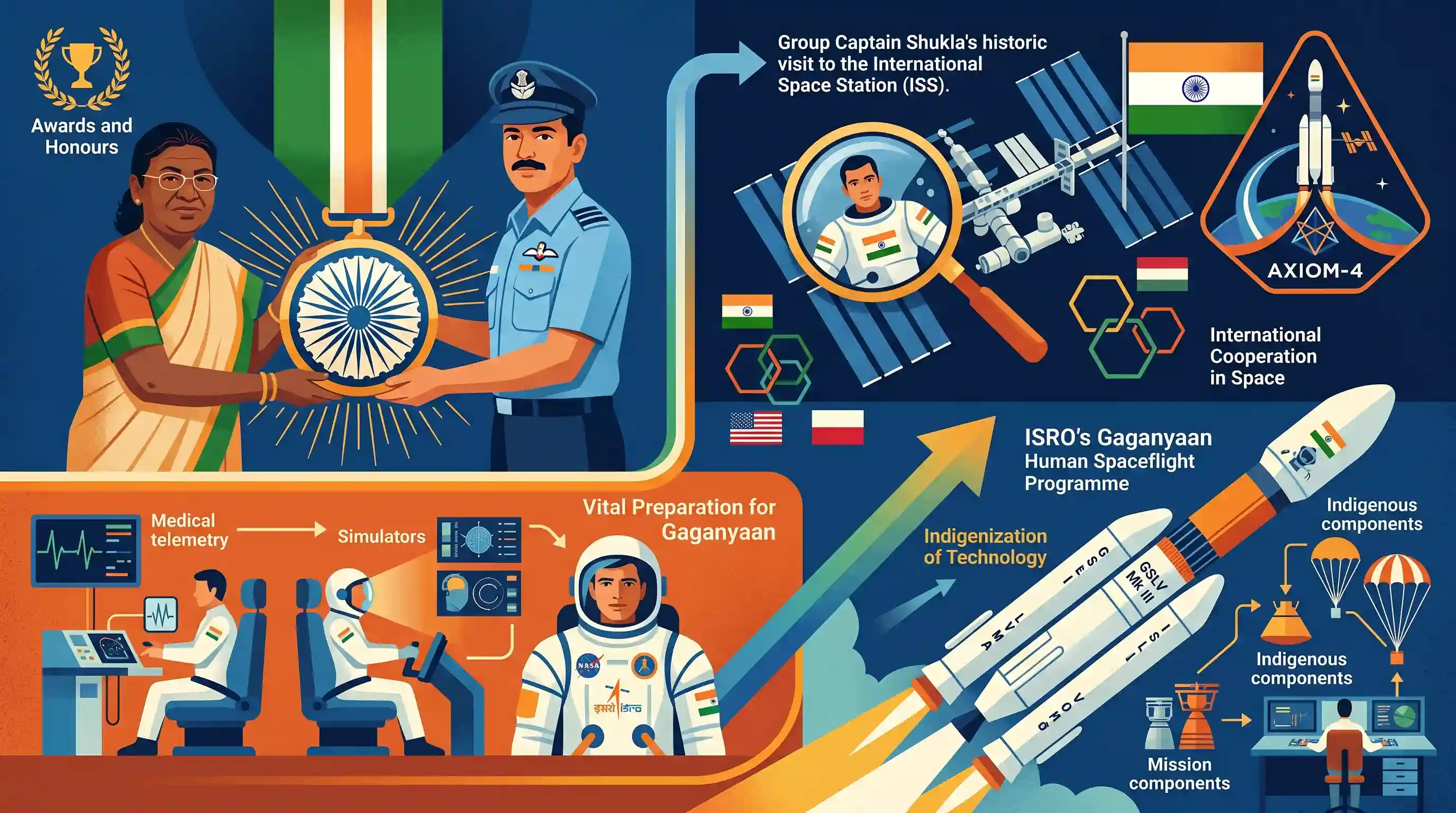
President Droupadi Murmu awarded the Ashoka Chakra to Group Captain Shubhanshu Shukla, who recently became the first Indian to visit the International Space Station as part of the Axiom-4 mission. The mission marks a significant milestone in international space cooperation and serves as vital preparation for ISRO's Gaganyaan human spaceflight programme.
Key Points
- Group Captain Shubhanshu Shukla became the first Indian to set foot on the International Space Station (ISS) and the second Indian in space.
- He was conferred the Ashoka Chakra, India's highest peacetime gallantry award, by President Droupadi Murmu on Republic Day.
- Shukla flew as a mission specialist on the Axiom-4 (Ax-4) mission, a collaboration involving Axiom Space, NASA, ESA, and ISRO.
- His spaceflight occurred 41 years after Rakesh Sharma's mission and serves as a precursor to India's upcoming indigenous human spaceflight programme, Gaganyaan.
Important Terms
Ashoka Chakra

India's highest peacetime military decoration awarded for conspicuous bravery, valor, or self-sacrifice away from the battlefield. It is the peacetime equivalent of the Param Vir Chakra.
UPSC context
GS Paper II/III: Awards and Honors; Internal Security. Tests knowledge of national recognitions and military honors.
Axiom-4 (Ax-4) mission
A private commercial mission to the International Space Station (ISS) involving a collaboration between NASA, Axiom Space, and ISRO. It included the first Indian astronaut to visit the ISS.
UPSC context
GS Paper III: Space Technology. Relevant for international collaborations and private sector participation in space.
Gaganyaan
India's flagship human spaceflight programme by ISRO, aiming to demonstrate indigenous capability by sending a three-member crew to a 400 km orbit for a three-day mission.
UPSC context
GS Paper III: Science and Technology; Indigenization of Technology. A critical milestone in India’s space exploration roadmap.
ISRO
The primary agency of the Government of India responsible for space research, planetary exploration, and the development of space-based technologies and satellite systems.
UPSC context
GS Paper III: Achievements of Indians in Science & Technology. Core agency for all national space-related queries.
International Space Station (ISS)
A modular space station in low Earth orbit, serving as a collaborative international research laboratory for experiments in microgravity and the space environment.
UPSC context
GS Paper III: Science & Technology. Vital for understanding global cooperation and long-duration human space missions.
Axiom Space
A private American space infrastructure developer that manages commercial missions to the ISS and is working to build the first commercial space station.
UPSC context
GS Paper III: Space Tech; Privatization. Highlights the increasing role of private entities in global space governance.
Prelims Trap
Shubhanshu Shukla is the first Indian in space, and the Ashoka Chakra is exclusively awarded to armed forces personnel.
Shukla is the first Indian on the ISS, but the second in space (after Rakesh Sharma). Also, the Ashoka Chakra is open to civilians.
Static Concepts Connected
What are the eligibility criteria for the Ashoka Chakra?
- Peacetime equivalent: It is India's highest peacetime gallantry award, equivalent to the Param Vir Chakra, given for conspicuous bravery or self-sacrifice away from the battlefield.
- Universal eligibility: Unlike some military-exclusive medals, it can be awarded to military personnel, police forces, and civilians (of either sex).
What are Bio-regenerative Life-Support Systems (BLSS) in space?
- Biological recycling: Utilizes organisms like microalgae and cyanobacteria to recycle wastewater, absorb carbon dioxide, and generate oxygen in microgravity.
- Deep-space utility: Crucial for Gaganyaan and deep-space missions because it drastically reduces the payload weight of life-support supplies launched from Earth.
Cross-Topic Patterns
iCET and Space Diplomacy
The ISRO-NASA-Axiom collaboration is a direct outcome of the India-US initiative on Critical and Emerging Technology (iCET), signaling India's deeper integration into global Low Earth Orbit (LEO) ecosystems.
Space Bio-technology and human spaceflight
Testing microalgae and cyanobacteria on Ax-4 merges space tech with biotechnology, showing ISRO's shift from standard satellite payloads to sustained human habitability experiments for deep space.

Expect a 2026 Prelims question mixing ISS firsts, Ashoka Chakra civilian eligibility, and Gaganyaan's microalgae payloads.
Linked PYQs · 2
Linked PYQs · 2
- 2025PrelimsGS1
Consider the following space missions : I. Axiom-4 II. SpaDeX III. Gaganyaan How many of the space missions given above encourage and support micro-gravity research?
- 2017MainsGS3
India has achieved remarkable successes in unmanned space missions including the Chandrayaan and Mars Orbitter Mission, but has not ventured into manned space missions. What are the main obstacles to launching a manned space mission, both in terms of technology and logistics? Examine critically.
