Amaravati Capital Bill Status and Andhra Pradesh Reorganisation Act
Source:newsonair ↗
Why It Matters
The finalization of Amaravati as the sole capital of Andhra Pradesh resolves a major state-level governance dispute and modifies the AP Reorganisation Act, 2014. This is extremely high-yield for APPSC examinations, which heavily test provisions of the AP Reorganisation Act and key political developments within the state.
Summary
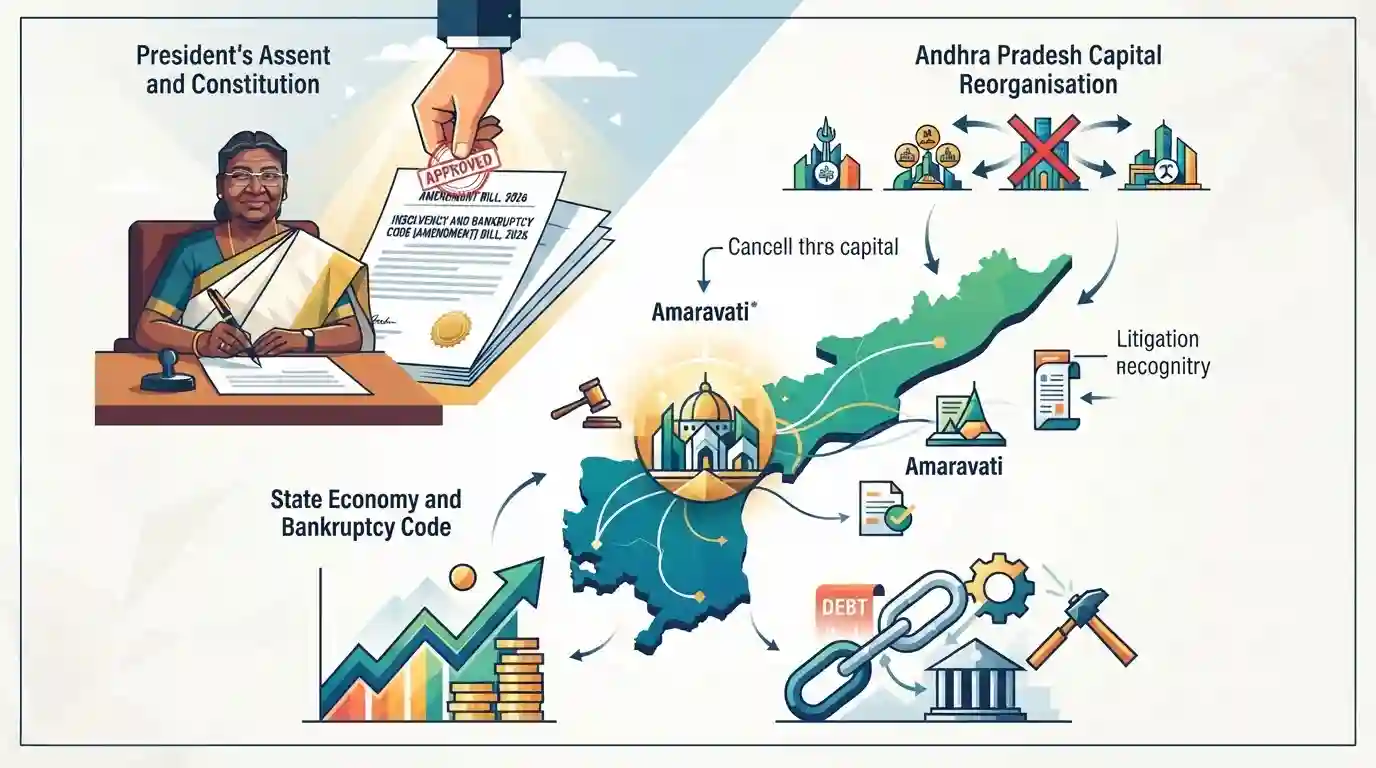
President Droupadi Murmu has granted assent to the Andhra Pradesh Reorganisation (Amendment) Bill, 2026, which accords statutory recognition to Amaravati as the sole and permanent capital of Andhra Pradesh. The legislation amends the original Andhra Pradesh Reorganisation Act, 2014, ending years of political uncertainty and litigation over the capital city, including the previous administration's three-capital proposal. Additionally, the President approved the Insolvency and Bankruptcy Code (Amendment) Bill, 2026.
Key Points
- President Droupadi Murmu has officially granted her assent to the Andhra Pradesh Reorganisation (Amendment) Bill, 2026.
- The legislative assent accords statutory status to Amaravati, confirming it as the sole and permanent capital of Andhra Pradesh.
- The amendment modifies the Andhra Pradesh Reorganisation Act, 2014, finally resolving the longstanding administrative and legal uncertainty over the state's capital.
- The Insolvency and Bankruptcy Code (Amendment) Bill, 2026, also received the President's assent.
Important Terms
Andhra Pradesh Reorganisation (Amendment) Act, 2026

A 2026 parliamentary legislation explicitly recognizing Amaravati as the sole and permanent capital of Andhra Pradesh, officially ending previous multi-capital proposals.
UPSC context
GS Paper 2 (Polity). Tests knowledge of Article 3, state reorganization, and parliamentary powers in determining state capitals.
Insolvency and Bankruptcy Code (Amendment) Act, 2026
A 2026 reform law amending the IBC to reduce procedural delays, introducing new frameworks for creditor-initiated insolvency, group insolvency, and cross-border insolvency.
UPSC context
GS Paper 3 (Economy). Important for topics on corporate insolvency resolution, NPA management, and ease of doing business.
Andhra Pradesh Reorganisation Act, 2014
The 2014 statute that bifurcated the undivided state of Andhra Pradesh to create Telangana, initially designating Hyderabad as the joint capital for ten years.
UPSC context
GS Paper 2 (Indian Constitution). Essential for historical context on state formation and Article 3 provisions regarding bifurcation.
Prelims Trap
A State Legislature can unilaterally amend a Parliamentary Reorganisation Act to change its capital city or state boundaries.
Reorganisation Acts are Parliamentary statutes enacted under Article 3. Only Parliament has the power to amend or repeal provisions of its own Acts.
Static Concepts Connected
What are Parliament's powers under Article 3 of the Constitution?
- Scope of Power: Article 3 authorizes Parliament to form new states, increase or decrease state areas, alter boundaries, or change names of existing states.
- Prior Consent: A bill under Article 3 requires the prior recommendation of the President before introduction in Parliament.
- State Consultation: The President must refer the bill to the affected state legislature for views, but Parliament is not bound by those views.
- Amendment Authority: Since a Reorganisation Act is a Parliamentary law, any subsequent amendment to its provisions must be enacted by Parliament.
What options does the President have under Article 111 for Parliamentary Bills?
- Assent: The President may declare assent to the Bill, making it an Act.
- Withholding Assent: The President can declare that they withhold assent to the Bill (Absolute Veto).
- Suspensive Veto: The President may return non-Money Bills to Parliament for reconsideration; if passed again, assent is mandatory.
Cross-Topic Patterns
Federalism and Article 3 boundary powers
Connects state-level administrative plans (like capital decentralization) with Parliament's supreme statutory power under Article 3 to manage state structures.
Corporate insolvency and financial stability
Links the simultaneous IBC amendment to structural reforms in corporate exit mechanisms, banking recovery, and resolving bankruptcy backlog.

Article 3 amending procedures vs state legislative competence over capitals likely to be tested in GS-II federalism questions.
Linked PYQs · 4
Linked PYQs · 4
- 2023APPSC_PRELIMSGS1
How many Schedules are there in the Andhra Pradesh Reorganisation Act?
- 2023APPSC_PRELIMSGS1
Part V of the Andhra Pradesh Reorganisation Act deals with
- 2019APPSC_PRELIMSGS1
Regarding the powers of the President, which of the following is correct ?
- 2024APPSC_PRELIMSGS1
In connection with the veto power of the Indian President, which one of the following statement/statements is/are valid ? I. The Indian President possesses 'Suspensive Veto' in the case of Money Bills but not in the case of Finance Bills. II. The Indian President can exercise 'Absolute Veto' with respect to the Government Bills at all times. III. The Indian President enjoys 'Pocket Veto' indefinitely whereas the American President possesses 'Qualified Veto'. IV. The objective of the veto power in being conferred upon the Indian President is to ensure a system of checks and balances between the office of the President and that of the power of the Parliament. Select the correct answer using the codes given below :
