President Independence Day Address and National Development Vision
Source:The Hindu ↗
ఇది ఎందుకు ముఖ్యం
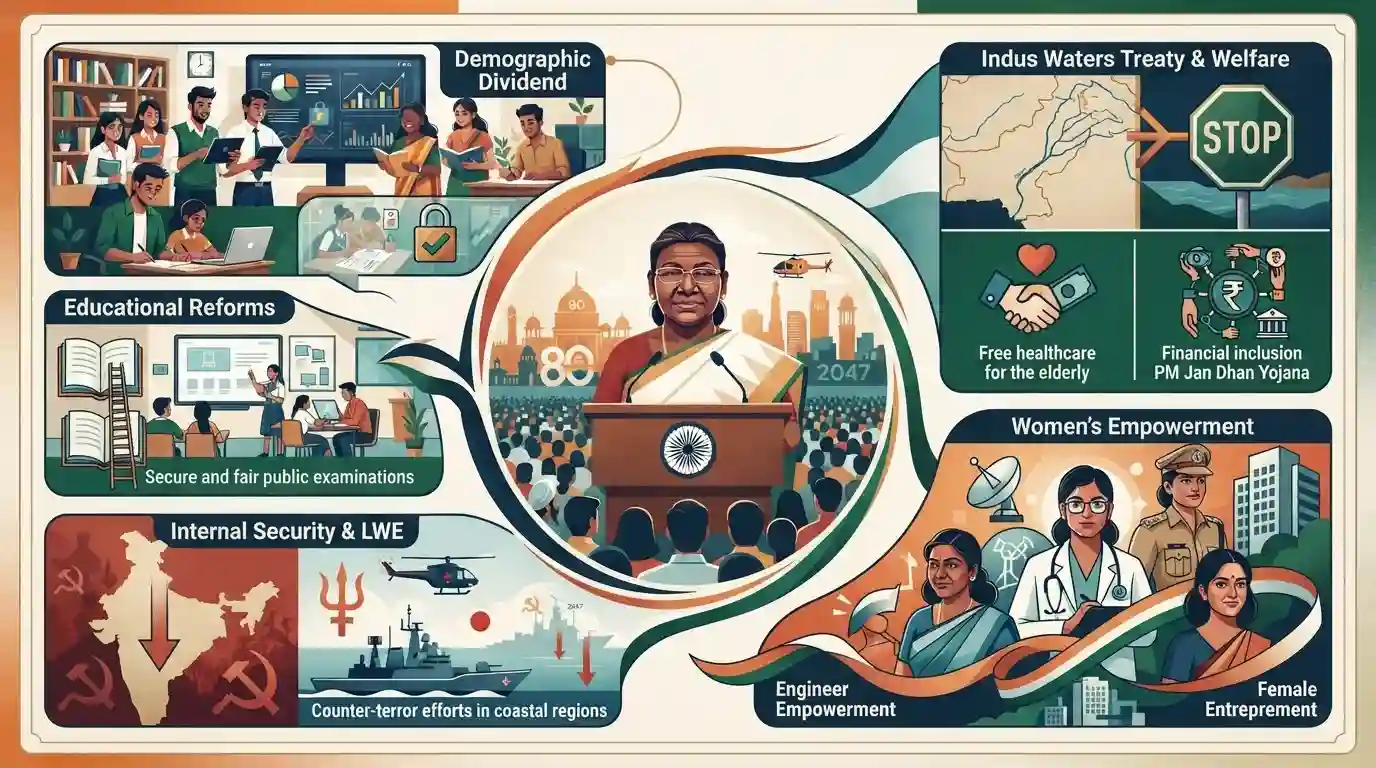
The President's Independence Day address serves as a comprehensive overview of the government's priorities, highlighting crucial areas for UPSC aspirants such as examination reforms, internal security operations, women's political reservation (Nari Shakti Vandan Adhiniyam), and diplomatic maneuvers (Indus Waters Treaty).
సారాంశం
In her address on the eve of India's 80th Independence Day, President Droupadi Murmu outlined a vision for 'Viksit Bharat' by 2047, emphasizing the pivotal role of youth, women, and systemic reforms. Addressing recent student-led protests, she highlighted the necessity of transparent public examinations to safeguard the future of India's demographic dividend. The President underscored achievements in national security, such as counter-terror 'Operation Sindoor', a decline in Left-Wing Extremism, and the suspension of the Indus Waters Treaty. She commended India's welfare milestones, including free healthcare for the elderly and massive financial inclusion through the PM Jan Dhan Yojana, while reaffirming India's leadership in climate action and advocacy for the Global South.
ముఖ్య అంశాలు
- President Murmu underscored India's youth as its greatest asset, emphasizing the need for comprehensive reforms to prevent paper leaks and ensure transparent public examinations.
- Highlighted key national security milestones, including the precision counter-terror "Operation Sindoor", progress toward a Naxal-free India, and the suspension of the Indus Waters Treaty.
- Emphasized women's empowerment through the Nari Shakti Vandan Adhiniyam (legislative reservation), creation of lakhpati didis, and the 'drone didis' initiative.
- Reaffirmed India's foreign policy commitment to the Global South, rooted in 'Vasudhaiva Kutumbakam', and advocated for greater representation in multilateral institutions.
- Praised the achievement of key Sustainable Development Goals (SDGs) and environmental initiatives like 'Ek Ped Maa Ke Naam' and Lifestyle for Environment (LiFE).
ముఖ్యమైన పదాలు
Indus Waters Treaty

A 1960 World Bank-brokered water-sharing agreement between India and Pakistan, allocating Western rivers to Pakistan and Eastern rivers to India. India suspended it in April 2025 following cross-border terror attacks.
UPSC context
GS Paper II (International Relations): Tests bilateral water diplomacy, transboundary river sharing, and strategic implications of putting treaties in abeyance.
Operation Sindoor
A coordinated, precision military strike executed by the Indian Armed Forces in May 2025 targeting terrorist camps in Pakistan and PoJK, signaling a calibrated shift in India's counter-terrorism doctrine.
UPSC context
GS Paper III (Internal Security): Tests doctrines of calibrated response, counter-terrorism, deterrence, and multi-domain operations in nuclearized environments.
Nari Shakti Vandan Adhiniyam
Officially the Constitution (106th Amendment) Act, 2023, it reserves one-third (33%) of all seats in the Lok Sabha, state legislative assemblies, and the Delhi Legislative Assembly for women.
UPSC context
GS Paper II (Polity & Governance): Tests legislative measures for women's political empowerment, constitutional amendments, and representative democracy.
Pradhan Mantri Jan Dhan Yojana
Launched in 2014, India's National Mission for Financial Inclusion providing the unbanked population with affordable access to savings accounts, remittances, credit, insurance, and pensions.
UPSC context
GS Paper III (Indian Economy): Tests policies on inclusive growth, financial literacy, direct benefit transfer mechanisms, and economic empowerment.
Khelo India
A national program introduced in 2017-18 by the Ministry of Youth Affairs and Sports to revive sports culture at the grassroots level, identify young talent, and build infrastructure.
UPSC context
GS Paper II (Social Justice/Governance): Tests youth development schemes, sports infrastructure policies, and human resource development strategies.
ప్రిలిమ్స్ ఉచ్చు
The Nari Shakti Vandan Adhiniyam mandates immediate 33% reservation for women in the Lok Sabha, Rajya Sabha, and State Legislative Assemblies.
It does not apply to the Rajya Sabha (or Legislative Councils). Its implementation is also not immediate, as it is legally tied to post-census delimitation.
అనుసంధానమైన స్థిర భావనలు
What is the dispute resolution framework under the Indus Waters Treaty (IWT)?
- Three-tiered system: Resolves issues via the Permanent Indus Commission (questions), a World Bank-appointed Neutral Expert (differences), or a Court of Arbitration (disputes).
- River allocation: Assigns control of the three Eastern rivers (Ravi, Beas, Sutlej) to India, and three Western rivers (Indus, Jhelum, Chenab) to Pakistan.
- No unilateral exit: Article XII(4) states the treaty can only be modified or terminated via a bilateral, formally ratified treaty; it contains no unilateral revocation clause.
What are the core constitutional parameters of the 106th Amendment Act?
- Targeted assemblies: Inserts Articles 330A and 332A to reserve 33% of seats in the Lok Sabha, State Legislative Assemblies, and Delhi Assembly only.
- Exclusions: Explicitly excludes the Rajya Sabha and State Legislative Councils from any reservation benefits.
- Sunset clause: Under Article 334A, the reservation is set for a 15-year period from commencement, subject to extension by Parliament.
అంతర-అంశ నమూనాలు
Water diplomacy as security deterrence
Links India's review of the Indus Waters Treaty with counter-terror doctrines, demonstrating how transboundary resource treaties are leveraged alongside military tools for national security.
Agrarian tech meets women empowerment
Connects the drone-didi initiative under DAY-NRLM to agricultural modernization, showing how gender-centric rural schemes are transitioning from microfinance to technological capacity building.

Delimitation linkages and the exclusion of Upper Houses in the 106th CAA are highly likely to feature in a multi-statement Polity question.
అనుసంధాన PYQలు · 5
అనుసంధాన PYQలు · 5
- 2023MainsGS2
Discuss the contribution of civil society groups for women's effective and meaningful participation and representation in state legislatures in India.
- 2019MainsGS2
“The reservation of seats for women in the institutions of local self-government has had a limited impact on the patriarchal character of the Indian Political Process.” Comment.
- 2012MainsGS2
The situation today is far different to that prevalent fifty years back when the Indus Water Treaty was signed." Highlight the complexity of the current challenges on both sides of the border in this regard. Do you think that a review of the Treaty is in India's best interests?
- 2014MainsGS3
While we flaunt India's demographic dividend, we ignore the dropping rates of employability. What are we missing while doing so? Where will the jobs that India desperately needs come from? Explain.
- 2022MainsGS3
Naxalism is a social, economic and developmental issue manifesting as a violent internal security threat. In this context, discuss the emerging issues and suggest a multilayered strategy to tackle the menace of Naxalism.
