Presidential Assent To Gujarat Uniform Civil Code Legislation
Source:dailypioneer ↗
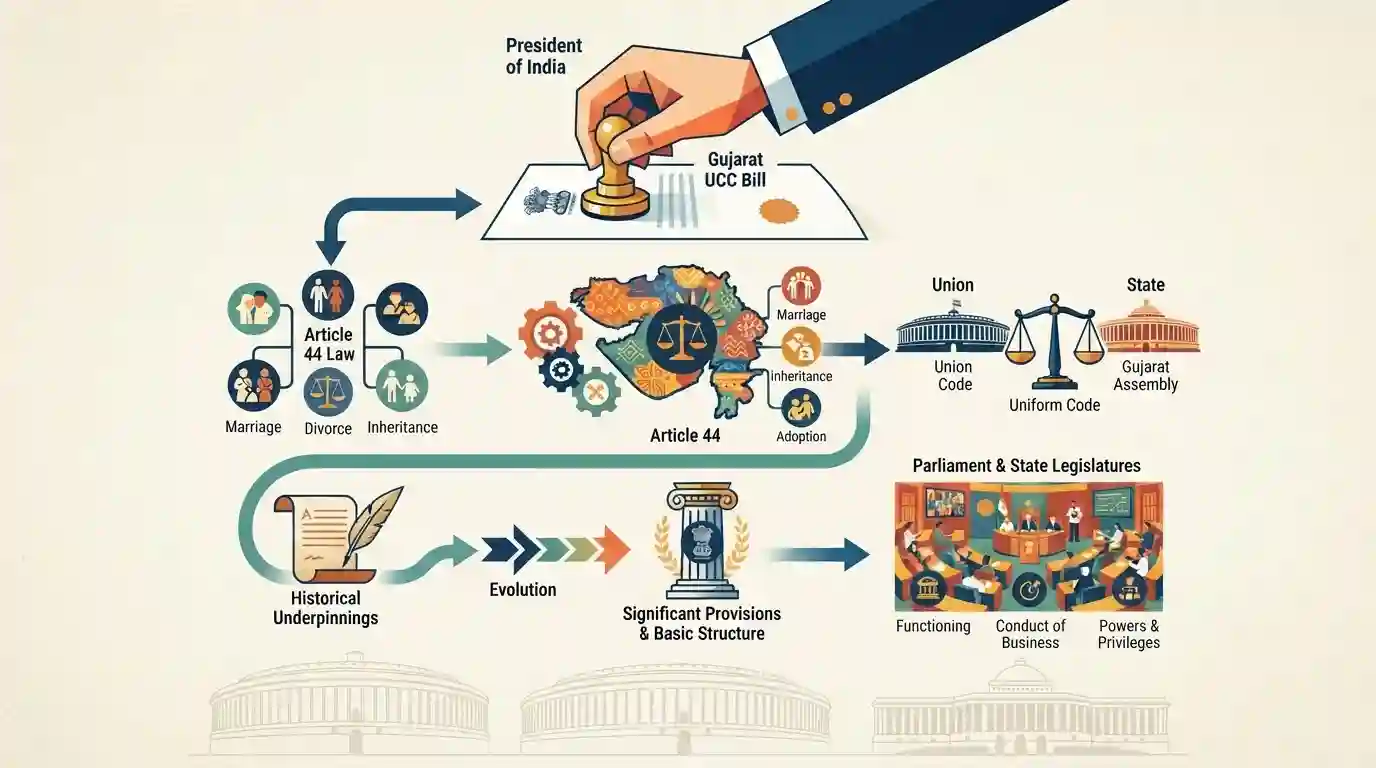
Why It Matters
This development is vital for GPSC and civil services examinations as it involves contemporary developments around Article 44 (Uniform Civil Code) and the presidential assent mechanism for state-level legislation.
Summary
The President of India has cleared the Gujarat Uniform Civil Code (UCC) Bill, marking a significant legislative step towards the implementation of a uniform civil code framework within the state, drawing attention to constitutional provisions under Article 44 and federal governance.
Key Points
- The President of India has granted assent to the Gujarat Uniform Civil Code (UCC) Bill, making Gujarat one of the pioneering states to clear a state-level legislative framework for UCC.
- The Uniform Civil Code relates to Article 44 of the Directive Principles of State Policy (DPSP) under the Indian Constitution, aiming to secure a uniform civil code for citizens throughout the territory of India.
- The legislation touches upon matters of personal laws, civil rights, legal pluralism, and Centre-state legislative dynamics.
Important Terms
Gujarat Uniform Civil Code Bill

A state legislative enactment that seeks to establish a unified legal framework governing personal matters such as marriage, divorce, inheritance, and live-in relationships for all citizens in Gujarat, irrespective of religion.
UPSC context
GS Paper II: Polity & Governance – State Legislatures, federalism, and implementation of Directive Principles of State Policy.
Uniform Civil Code (UCC)
A proposal to formulate and implement a common set of laws governing personal matters (such as marriage, divorce, adoption, and inheritance) for all citizens, superseding diverse religious personal laws.
UPSC context
GS Paper II: Indian Constitution – Significant Provisions, Basic Structure, and Directive Principles of State Policy.
Article 44 of the Constitution
A non-justiciable directive principle under Part IV of the Indian Constitution which mandates that the State shall endeavor to secure for citizens a Uniform Civil Code throughout the territory of India.
UPSC context
GS Paper II: Indian Constitution – Directive Principles of State Policy and their socio-legal implications.
President of India
The constitutional head of the Indian Republic whose assent is mandatory for state bills reserved by the Governor, marking a critical step in federal legislative procedure.
UPSC context
GS Paper II: Parliament and State Legislatures – Structure, Functioning, and Legislative Procedures.
Gujarat State Legislature
The unicameral law-making body of Gujarat responsible for debating, passing, and formulating state-level legislations including state specific civil codes.
UPSC context
GS Paper II: Parliament and State Legislatures – Powers, Functions, and Conduct of Business.
Prelims Trap
Article 44 of the Constitution makes the implementation of a Uniform Civil Code legally enforceable and mandatory for all states immediately.
Article 44 is a Directive Principle of State Policy (Part IV), meaning it is non-justiciable and cannot be enforced by courts through writs, unlike Fundamental Rights.
Static Concepts Connected
What are the key constitutional provisions and judicial precedents regarding a Uniform Civil Code in India?
- Constitutional Basis: Article 44 of Part IV directs the State to endeavour to secure a UCC throughout the territory of India.
- Judicial Precedents: The Supreme Court in the Shah Bano case (1985) and Sarla Mudgal case (1995) urged Parliament to frame a UCC to eliminate discrimination in personal laws.
- Legislative Competence: Personal laws fall under the Concurrent List (List III) of the Seventh Schedule, enabling both Parliament and State Legislatures to enact laws subject to Presidential assent.
Cross-Topic Patterns
DPSP implementation vs. Federal Legislative Competence
Article 44 sits in Part IV (DPSP) and is non-justiciable, unlike fundamental rights in Part III, raising complex federalism questions when states legislate on Concurrent List subjects like personal law.
UCC Exemption vs. Tribal Fifth/Sixth Schedule Protections
State-level exemptions for Scheduled Tribes under the UCC echo the Fifth and Sixth Schedule protections guarding tribal customary laws from overarching state statutes.

UCC constitutional provisions (Art 44) + DPSP enforceability + federal jurisdiction over personal laws will feature in mains and prelims.
Linked PYQs · 2
Linked PYQs · 2
- 2025GPSC_PRELIMSGS1
Which of the following statements accurately reflect/(s) the provisions of the Indian Constitution? Statements: 1. The Directive Principles of State Policy (DPSP) are enforceable by the courts. 2. The Indian Constitution provides a federal system with unitary features. 3. The Fundamental Rights can be amended by the Parliament without any restrictions. Which of the statement/statements given above is/are correct?
- 2020GPSC_PRELIMSGS1
Which of the following statements are correct regarding the powers of Indian Parliament in the context of Article 3? 1. Parliament can introduce a Bill regarding reorganization of the states only with the prior permission of the President. 2. Before giving permission to the Bill, the President can refer the Bill to the state legislature concerned. 3. The President can accept or reject the recommendations of the state legislature. 4. In case of Union Territory, President will take special permission of the Rajya Sabha.
