Mediation as alternative dispute resolution for judicial pendency
Source:The Hindu ↗
Why It Matters
With millions of cases pending in Indian courts, Alternative Dispute Resolution (ADR) mechanisms are critical for the justice delivery system. The recent Mediation Act 2023 gives institutional backing to mediation. UPSC frequently asks about ADR, Lok Adalats, and Gram Nyayalayas (GS2 Mains and Prelims) as essential components of reducing judicial backlogs and bringing justice to the grassroots.
Summary
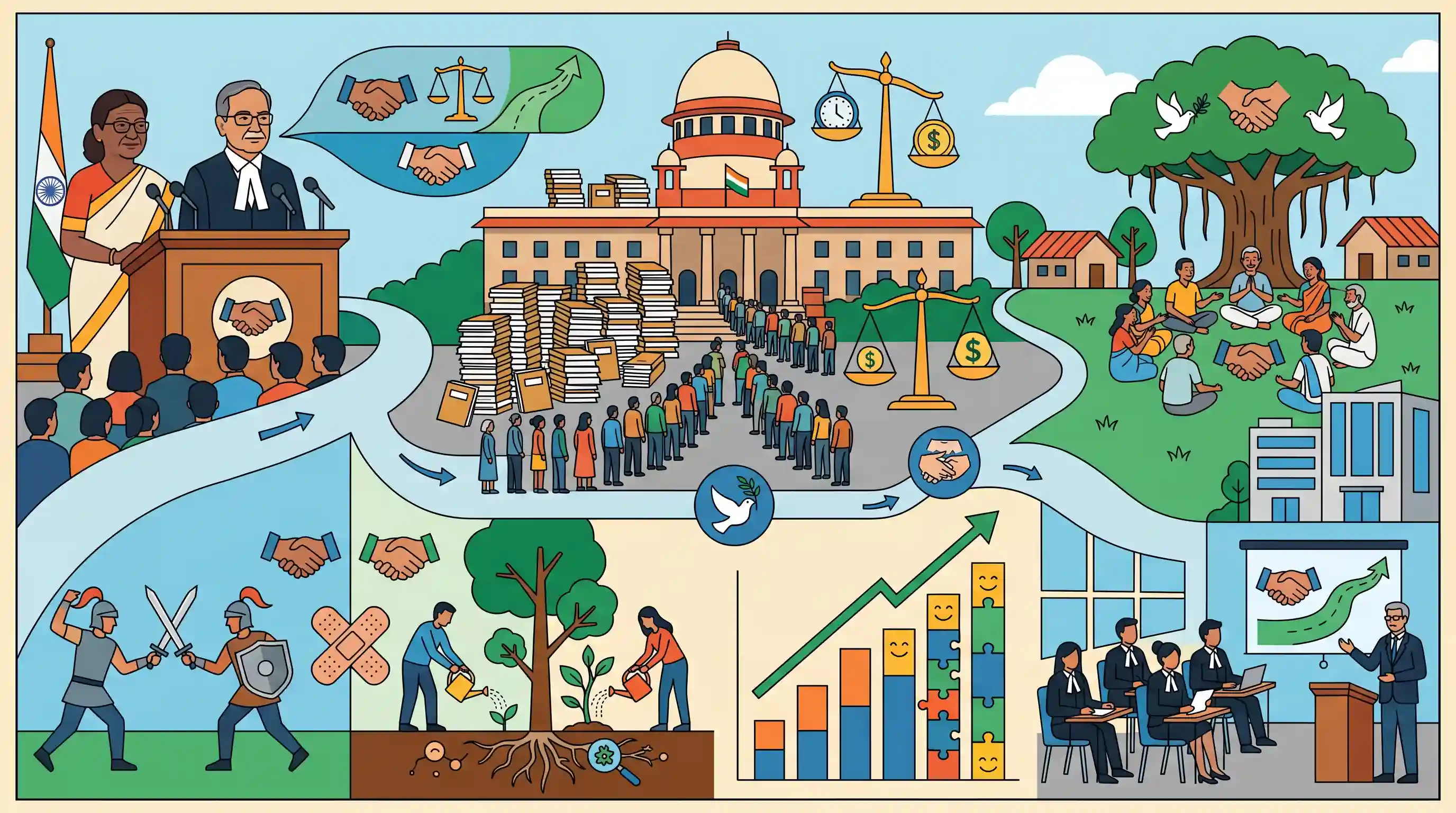
The President of India and the Chief Justice of India, speaking at a national conference organized by the Mediation Association of India, strongly advocated for mediation as a primary tool for dispute resolution to lower the burden on Indian courts. They stressed that mediation addresses the root causes of conflicts rather than merely treating the symptoms through adversarial litigation. Emphasizing the success of Alternative Dispute Resolution (over 7.5 lakh cases settled from 2016-2025), they called for the institutionalization of mediation at the grassroots panchayat level and the integration of practical mediation training in legal education.
Key Points
- President Droupadi Murmu and CJI Sanjiv Khanna emphasized that mediation is a 'wiser' and more effective path to justice, not just a lesser alternative to litigation.
- CJI Khanna noted that adversarial courtroom litigation often addresses only the symptoms of a dispute, whereas mediation resolves the underlying root causes.
- Statistics shared revealed that over 7.5 lakh cases have been settled through mediation between 2016 and 2025.
- The dignitaries highlighted the need to extend mediation to rural India at the panchayat level, empowering local communities to resolve issues amicably.
- Supreme Court judge B.R. Gavai advocated for law schools to include practical mediation courses to shift students away from purely adversarial mindsets.
Important Terms
Mediation Act, 2023

A 2023 legislation providing a comprehensive legal framework for mediation in India, making pre-litigation mediation mandatory for most civil/commercial disputes and establishing the Mediation Council of India (MCI) to regulate practitioners.
UPSC context
GS Paper II (Governance/Judiciary). Tests knowledge of legal reforms aimed at reducing pendency and institutionalizing Alternative Dispute Resolution (ADR).
National Legal Services Authority (NALSA)
A statutory body established under the Legal Services Authorities Act, 1987, to provide free legal aid to weaker sections and organize Lok Adalats for amicable dispute settlement.
UPSC context
GS Paper II (Judiciary/Social Justice). Relevant for Article 39A (Free Legal Aid) and access to justice for marginalized groups.
Lok Adalat
A 'People’s Court' under the Legal Services Authorities Act, 1987, where pending or pre-litigation cases are settled through compromise. Its awards are final, binding, and deemed civil court decrees with no appeal.
UPSC context
GS Paper II (Polity). Tests understanding of statutory bodies and non-adversarial mechanisms for reducing judicial backlog.
Alternative Dispute Resolution (ADR)
A range of dispute resolution processes (mediation, arbitration, conciliation) that allow parties to settle conflicts outside traditional courtrooms, focusing on cooperation, confidentiality, and cost-effectiveness.
UPSC context
GS Paper II (Governance). A core concept for judicial reforms and improving the ease of doing business in India.
Bharatiya Nagarik Suraksha Sanhita (BNSS)
The successor to the Code of Criminal Procedure (CrPC), this law modernizes India's criminal justice system by integrating technology, setting strict timelines for investigations/trials, and introducing reformative measures like community service.
UPSC context
GS Paper II (Judiciary/Governance). Essential for understanding the paradigm shift from colonial laws to a modern, victim-centric criminal justice framework.
Judicial Pendency
The backlog of over 5 crore cases in the Indian judicial system, caused by judge vacancies, procedural delays, and high litigation rates, which ADR and mediation aim to mitigate.
UPSC context
GS Paper II (Judiciary). A critical challenge often asked in the context of 'Access to Justice' and 'Right to Speedy Trial'.
Prelims Trap
The Mediation Act 2023 mandates pre-litigation mediation for both civil and criminal offenses.
The Mediation Act strictly applies to civil and commercial disputes. Criminal offenses (except specific compoundable ones) are excluded, as criminal justice relies on state prosecution.
Static Concepts Connected
What are the key statutory mechanisms for grassroots dispute resolution?
- Lok Adalats: Organized under the Legal Services Authorities Act, 1987. Their awards are final, binding, and deemed as civil court decrees with no provision for appeal.
- Gram Nyayalayas: Established under the Gram Nyayalayas Act, 2008 as mobile courts at the intermediate panchayat level. They possess both civil and criminal jurisdiction.
- Section 89 (CPC): Statutorily empowers civil courts to refer pending disputes to arbitration, conciliation, judicial settlement, or mediation to reduce judicial backlog.
What is the Singapore Convention on Mediation?
- Global Mandate: A UN convention providing a uniform and efficient framework for the cross-border enforcement of settlement agreements resulting from mediation.
- India's Stance: India is a signatory. The Mediation Act 2023 helps align domestic commercial dispute resolution standards with these international treaty obligations.
Cross-Topic Patterns
Mediation & Ease of Doing Business
The Mediation Act 2023 and India's alignment with the Singapore Convention directly improve India's 'Enforcing Contracts' metrics, boosting investor confidence by bypassing judicial bottlenecks.
ADR & Decentralized Justice
Integrating mediation at the panchayat level realizes the 73rd Amendment's vision of decentralized governance, intersecting with the mandates of Gram Nyayalayas and traditional Nyaya Panchayats.

Prelims 2026 will likely feature a multi-statement question contrasting the jurisdictions and binding nature of Lok Adalats vs Gram Nyayalayas.
Linked PYQs · 3
Linked PYQs · 3
- 2024MainsGS2
Explain and distinguish between Lok Adalats and Arbitration Tribunals. Whether they entertain civil as well as criminal cases ?
- 2016PrelimsGS1
With reference to the 'Gram Nyayalaya Act', which of the following statements is/are correct? 1. As per the Act, Gram Nyayalayas can hear only civil cases and not criminal cases. 2. The Act allows local social activists as mediators/reconciliators. Select the correct answer using the code given below.
- 2010PrelimsGS1
With reference to Lok Adalats, which of the following statements is correct?
