Scientific Validation and Integrative Practice in Traditional Medicine
Source:The Hindu ↗
Why It Matters
This article represents India's policy shift towards integrative medicine, where traditional healing sciences like Ayurveda are validated using cutting-edge technologies (like AI-enabled MRI). It addresses several crucial UPSC dimensions: the preservation of India's intellectual/ancient heritage (GS1), scientific validation and intellectual property protection of traditional knowledge (GS3), gender parity in healthcare professionals (GS1/GS2), and the ecological dependency of traditional medicine on biodiversity conservation (GS3).
Summary
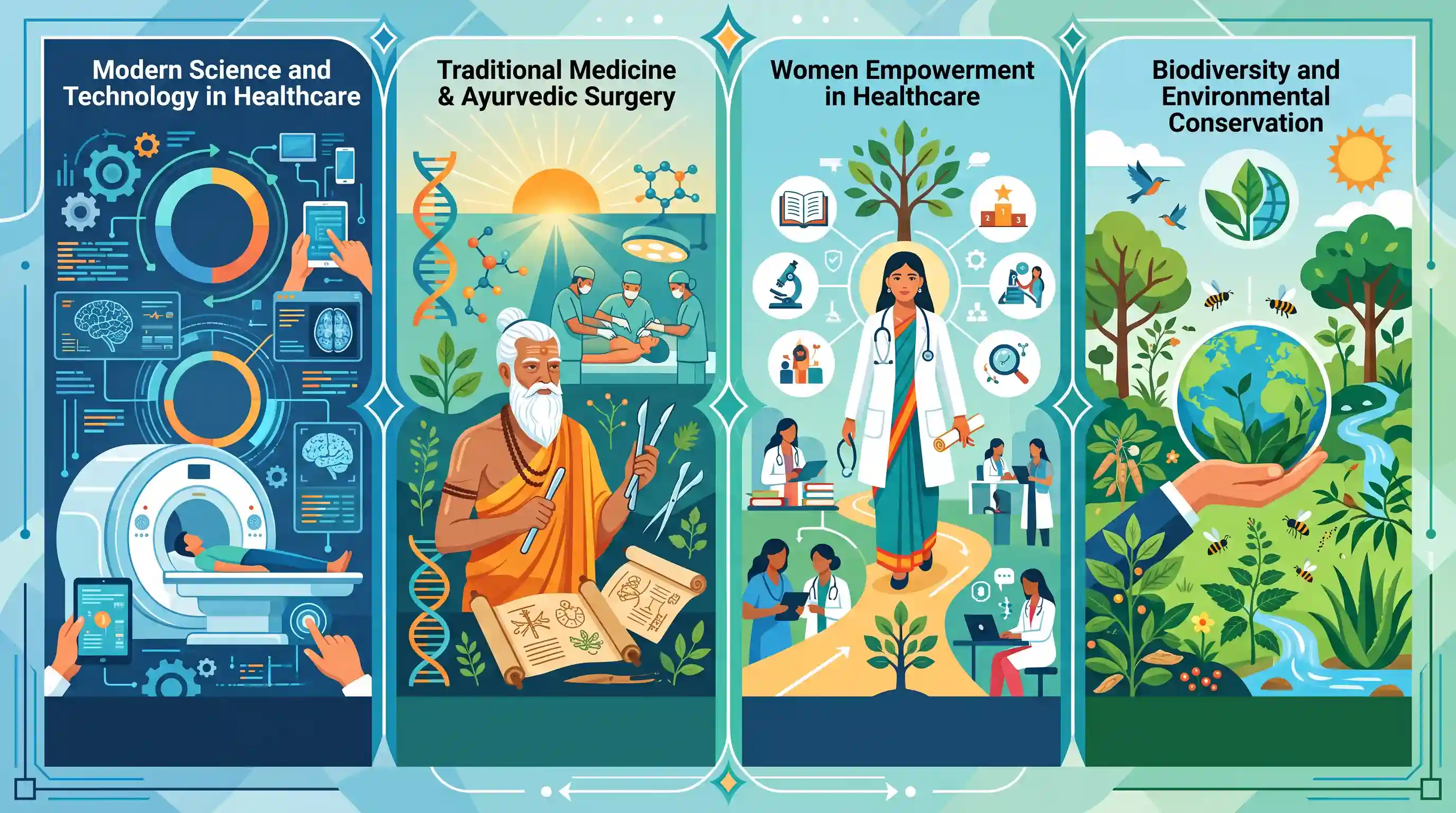
President Droupadi Murmu inaugurated 'Saushrutam 2026', a three-day international seminar on Ayurvedic surgery, at the All India Institute of Ayurveda (AIIA) on Sushruta Jayanti. The President called for a blend of traditional Ayurvedic wisdom with modern scientific advancements to enhance its global credibility and clinical validation. During the event, an AI-enabled 3 Tesla High-Field MRI facility was launched, and an NCISM study addressing the professional pathways of female Ayurveda graduates was released. The address also underlined the critical need for biodiversity conservation to ensure the sustainable supply of medicinal plants.
Key Points
- President Droupadi Murmu inaugurated 'Saushrutam 2026', a three-day international seminar on Ayurvedic surgery, organized at the All India Institute of Ayurveda (AIIA) on Sushruta Jayanti (July 15, 2026) in New Delhi.
- The President highlighted the historical significance of Acharya Sushruta, whose ancient contributions laid the foundational scientific framework for surgical practices, globally known as Shalya Tantra.
- An AI-enabled 3 Tesla High-Field MRI facility was inaugurated at AIIA, illustrating the integration of advanced modern diagnostic tools with traditional medicine to establish empirical evidence-based Ayurveda.
- A key report by the National Commission for Indian System of Medicine (NCISM) on 'Professional Careers of Women Ayurveda Graduates' was released, aiming to address the challenges faced by female Ayurvedic practitioners in career retention and professional growth.
- The President emphasized the preservation of biodiversity and forest ecosystems, noting that the sustainability and future expansion of Ayurveda are inextricably linked to the availability and conservation of medicinal plants.
- Distinguished attendees, including Delhi Lieutenant Governor Taranjit Singh Sandhu and MoS Ayush Prataprao Jadhav, stressed the need for global recognition of Ayurvedic practices, joint research, and policy interventions to bolster women's participation.
Important Terms
Saushrutam 2026

A three-day international seminar on Ayurvedic surgery (Shalya Tantra) organized in New Delhi to promote evidence-based practices, global collaboration, and integration of classical Ayurvedic surgical wisdom with modern biomedical and diagnostic advancements.
UPSC context
GS Paper II/III: Health, S&T; tests policies promoting integrative medicine and indigenous surgical legacy.
Sushruta Jayanti
An annual commemoration on July 15 honoring Acharya Sushruta, the ancient Indian physician widely recognized as the "Father of Surgery" and author of the seminal text Sushruta Samhita on surgery and plastic procedures.
UPSC context
GS Paper I/III: Art & Culture, S&T; tests knowledge of ancient India's scientific achievements and indigenous medicine.
All India Institute of Ayurveda (AIIA)
The apex autonomous institute under the Ministry of Ayush, located in New Delhi, designed to integrate ancient Ayurvedic treatment protocols with state-of-the-art modern diagnostic technologies, clinical research, and education.
UPSC context
GS Paper II: Healthcare Infrastructure; tests institutional frameworks for promoting traditional medicine.
National Commission for Indian System of Medicine (NCISM)
A statutory regulatory body established in 2021 that replaced the Central Council of Indian Medicine to oversee quality, medical education, and professional registration for Ayurveda, Unani, Siddha, and Sowa-Rigpa systems.
UPSC context
GS Paper II: Statutory Bodies, Health Education; tests regulatory reforms and governance in Indian medical systems.
Ministry of Ayush
A Union Ministry of India established to develop, promote, and regulate education, research, and healthcare services in indigenous traditional medicine systems like Ayurveda, Yoga, Naturopathy, Unani, Siddha, and Homeopathy.
UPSC context
GS Paper II: Governance, Welfare Schemes; tests policymaking and institutional support for holistic healthcare systems.
Prelims Trap
The NCISM regulates all components of the AYUSH systems, including Homeopathy, under a single unified statutory framework.
NCISM does not regulate Homeopathy. Homeopathy is governed by a distinct statutory body, the National Commission for Homeopathy (NCH), under a separate 2020 Act.
Static Concepts Connected
What is the National Commission for Indian System of Medicine (NCISM) and its mandate?
- Statutory Status: Established under the NCISM Act, 2020, replacing the Central Council of Indian Medicine (CCIM) in June 2021.
- Scope of Systems: Regulates education, infrastructure, and standards of Ayurveda, Unani, Siddha, and Sowa-Rigpa, explicitly excluding Homeopathy.
- Four Boards: Includes dedicated autonomous boards for Ayurveda, Unani-Siddha-Sowa-Rigpa, medical assessment, and ethics/registration.
What is the structure and historical significance of the Sushruta Samhita?
- Foundational Text: Composed by Acharya Sushruta in ancient Kashi, it represents the foundational treatise of Indian surgical science (Shalya Tantra).
- Surgical Innovations: Details advanced ancient procedures like plastic surgery (rhinoplasty), cataract operations, and lists over 120 surgical instruments.
- Structural Divisions: Organized into 184 chapters and six Sthanas, containing exhaustive details on anatomy, pharmacology, and toxicology.
Cross-Topic Patterns
Traditional medicine and IPR protection
India's TKDL acts as a defensive proprietary database against biopiracy, demonstrating how traditional knowledge can be shielded under WTO's TRIPS framework using 'prior art' status.
Medicinal plant conservation and biodiversity
Over-harvesting of wild medicinal plants threatens AYUSH supply chains, linking biological conservation under the Biological Diversity Act to national healthcare security.

Expect questions linking NCISM's regulatory scope, TKDL's role in patent defense, and Sushruta's historical surgical contributions.
Linked PYQs · 2
Linked PYQs · 2
- 2019MainsGS3
How is the Government of India protecting traditional knowledge of medicine from patenting by pharmaceutical companies?
- 2015MainsGS3
India's Traditional Knowledge Digital Library (TKDL), which has a database containing formatted information on more than 2 million medicinal formulations is proving a powerful weapon in the country's fight against erroneous patents. Discuss the pros and cons of making this database publicly available under open-source licensing.
