Pharmaceutical Supply Chain Vulnerability and Trade Tariffs
Source:The Hindu ↗
Why It Matters
Highlights the vulnerability of the global pharmaceutical supply chain—particularly India's role as a major generic drug and API supplier—to protectionist trade policies and global trade wars.
Summary
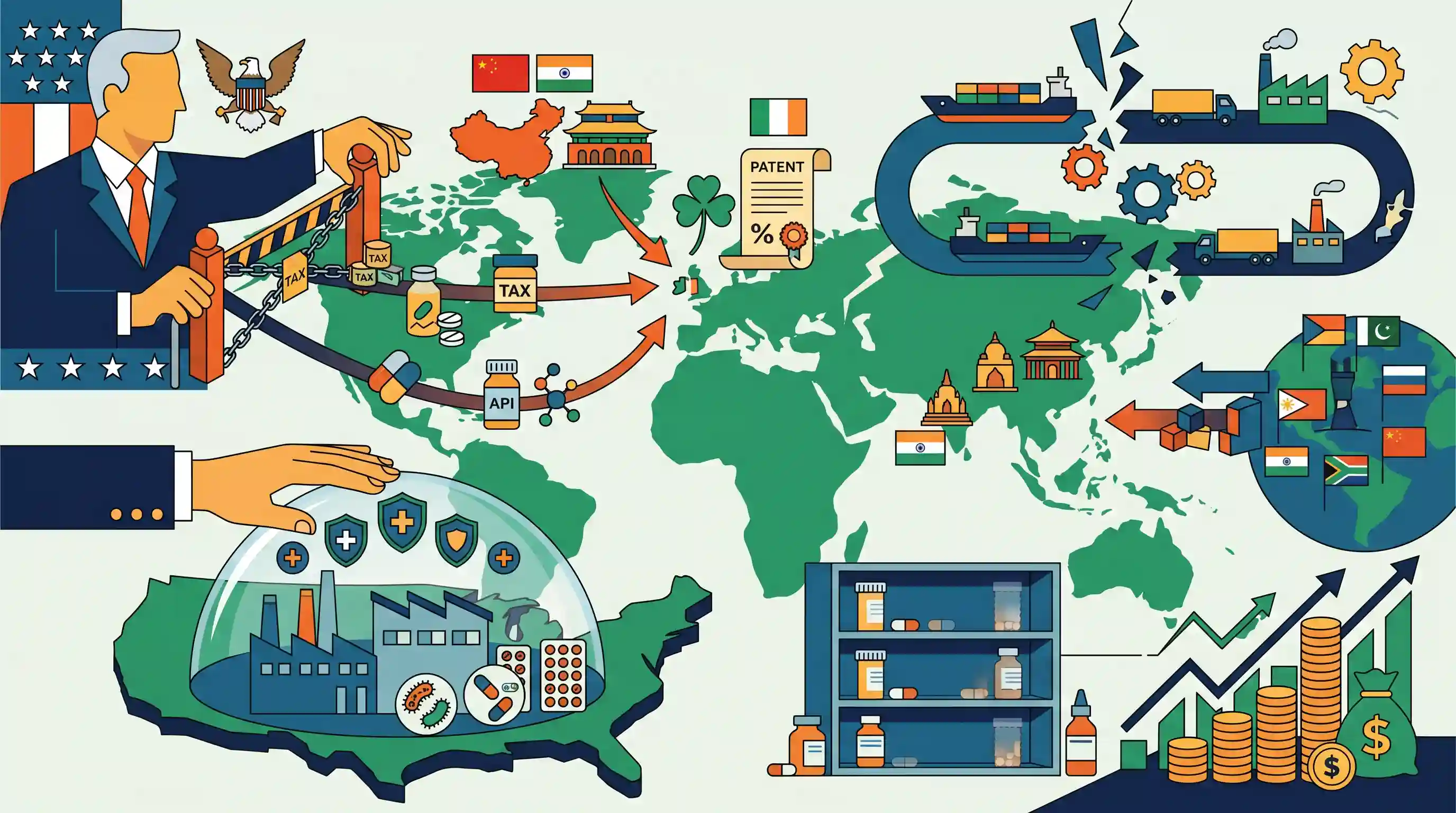
U.S. President Donald Trump's aggressive trade agenda has expanded to target the global pharmaceutical industry. His administration is preparing to impose significant tariffs on imported drugs and Active Pharmaceutical Ingredients (APIs) primarily sourced from China, India, and Europe (notably Ireland, due to its low-tax patent registration). Invoking national security under Section 232 of the 1962 Trade Act, the move intends to reshore the manufacturing of essential medicines, such as antibiotics, back to the U.S. However, experts warn that imposing these tariffs could disrupt complex global supply chains, trigger retaliatory trade measures, and precipitate critical drug shortages and price hikes for generic medicines worldwide.
Key Points
- The Trump administration plans to impose tariffs of up to 25% or more on imported pharmaceuticals and raw ingredients, citing national security concerns under Section 232 of the 1962 U.S. Trade Act.
- The U.S. relies heavily on imports for Active Pharmaceutical Ingredients (APIs) and generic drugs, with China and India being the predominant global suppliers.
- European countries, specifically Ireland, are also targeted because multinational pharmaceutical companies frequently use them as low-tax jurisdictions to register their intellectual property.
- The proposed tariffs aim to force the reshoring of drug manufacturing to the U.S. to ensure self-sufficiency, particularly for essential medicines like antibiotics.
- Health and trade experts warn this protectionist trade war could severely disrupt the fragile global pharmaceutical supply chain, potentially leading to critical drug shortages and increased healthcare costs.
Important Terms
Section 232 of the 1962 U.S. Trade Expansion Act

A U.S. law allowing the President to impose import restrictions or tariffs if specific goods are found to be entering in quantities that threaten 'national security.'
UPSC context
GS Paper 2 & 3: Tests understanding of unilateral trade measures, global trade wars, and their impact on India's export-driven sectors.
Active Pharmaceutical Ingredients (APIs)
The biologically active components in a pharmaceutical drug that produce the intended health effect; also known as 'bulk drugs' in industrial contexts.
UPSC context
GS Paper 3: Critical for discussions on India's pharmaceutical dependency on China and the 'Atmanirbhar Bharat' initiative for bulk drugs.
Inflation Reduction Act (IRA)
A 2022 U.S. federal law that, among other provisions, allows the government to negotiate prices for high-cost drugs under Medicare to reduce healthcare spending.
UPSC context
GS Paper 2: Relevant for analyzing the policies of developed nations that influence global pharmaceutical pricing and Indian generic exports.
Reshoring
The practice of bringing back the manufacturing of goods to a company's home country from overseas to reduce supply chain risks and enhance national security.
UPSC context
GS Paper 3: Essential concept in 'Deglobalization' and shifting global supply chain dynamics (GVCs) impacting Indian industrial growth.
Medicare
The U.S. federal health insurance program primarily for people aged 65 or older, which is a major purchaser of pharmaceutical products globally.
UPSC context
GS Paper 2: International Relations; policy changes affecting Medicare pricing directly impact Indian pharmaceutical companies' profit margins in their largest market.
Generic Medicines
Medications that are chemically identical to brand-name drugs but are sold at lower prices after the original patent expires; India is a global leader in their production.
UPSC context
GS Paper 3: Core to India’s status as the 'Pharmacy of the World' and Intellectual Property Rights (IPR) debates in trade.
Prelims Trap
"India's status as the 'pharmacy of the world' ensures complete self-sufficiency in generic drug manufacturing."
While India dominates generic drug formulations globally, it remains deeply dependent on China for approximately 70% of its Active Pharmaceutical Ingredients (APIs) and Key Starting Materials.
Static Concepts Connected
What distinguishes APIs from Excipients in pharmaceuticals?
- API: The biologically active component of a drug that produces the intended therapeutic, curing, or preventative health effect.
- Excipient: The chemically inactive substance (e.g., lactose, mineral oil) used as a carrier, binder, or preservative to deliver the API safely into the body.
- Formulation vs Ingredients: India leads in formulating finished drugs (combining APIs and excipients) but relies heavily on imports for the foundational APIs.
What is Base Erosion and Profit Shifting (BEPS)?
- Profit Shifting: Tax avoidance strategies where multinationals exploit tax rule gaps to shift profits to low-tax jurisdictions (like Ireland) with little real economic activity.
- IP Registration: Pharmaceutical giants frequently register their Intellectual Property (patents) in these havens to minimize tax liabilities on global drug sales.
- OECD Solution: The OECD/G20 Inclusive Framework addresses this via a Two-Pillar solution, including a 15% Global Minimum Corporate Tax to deter profit shifting.
Cross-Topic Patterns
Pharma PLI + Geopolitical Health Security
US tariffs and global supply chain disruptions transform India’s PLI scheme for bulk drugs from a mere domestic manufacturing boost into a critical geopolitical health security shield.
Tariffs + GATT Article XXI Exception
Using "national security" to justify drug tariffs invokes GATT Article XXI, continuing a controversial trend that weaponizes trade rules and tests the WTO’s dispute settlement authority.

Expect a 2026 multi-statement question linking India's API dependency, the bulk drugs PLI scheme, and WTO's national security exceptions.
Linked PYQs · 4
Linked PYQs · 4
- 2018MainsGS2
What are the key areas of reform if the WTO has to survive in the present context of "Trade War', especially keeping in mind the interest of India?
- 2014MainsGS3
Can overuse and free availability of antibiotics without Doctor's prescription, be contributors to the emergence of drug-resistant diseases in India? What are the available mechanisms for monitoring and control? Critically discuss the various issues involved.
- 2014MainsGS3
In a globalized world, Intellectual Property Rights assume significance and are a source of litigation. Broadly distinguish between the terms-Copyrights, Patents and Trade Secrets.
- 2024MainsGS3
What is the present world scenario of intellectual property rights with respect to life materials? Although, India is second in the world to file patents, still only a few have been commercialized. Explain the reasons behind this less commercialization.
