India R&D Funding and Innovation Ecosystem Structural Reforms
Source:The Hindu ↗
Why It Matters
India’s aspiration to become a developed nation (Viksit Bharat) relies heavily on technological advancement and innovation. Understanding the systemic hurdles in R&D expenditure, patent commercialization, and industry-academia synergy is critical for answering GS-3 questions on economic growth, IPRs, and Science & Technology.
Summary
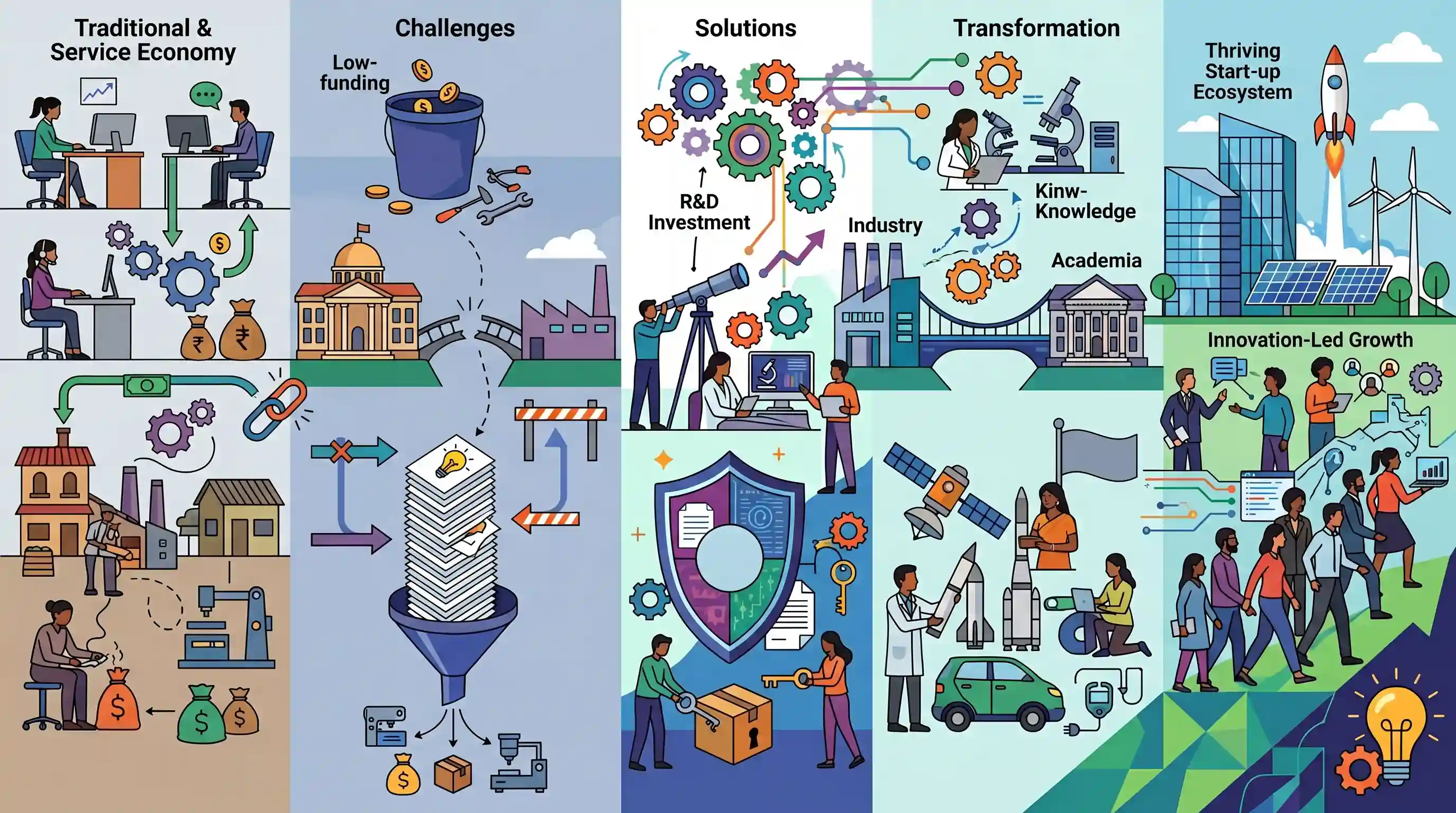
The article emphasizes the imperative for India to transition into an innovation-led economy, moving beyond traditional service-driven or imitation-based growth. It highlights critical challenges such as stagnant R&D expenditure, the lack of effective industry-academia linkages, and the low commercialization rate of patents despite high filing numbers. To unlock India's potential, structural reforms in intellectual property rights enforcement, significantly increased investments in research and development, and a stronger focus on indigenizing technologies are required. Building a comprehensive start-up and innovation ecosystem is essential for translating scientific research into tangible economic productivity.
Key Points
- India needs to transition from a cost-arbitrage and service-oriented model to a true innovation-led economy to sustain long-term economic growth.
- Gross Expenditure on R&D (GERD) in India remains stagnant at around 0.65% of GDP, which is significantly lower than global counterparts.
- Although India ranks high in patent filings, actual commercialization of these patents remains low due to poor industry-academia linkage and structural bottlenecks.
- Promoting indigenous technology and fostering a supportive start-up ecosystem is essential to bridge the gap between scientific research and market-ready innovation.
Important Terms
National Intellectual Property Rights (IPR) Policy

A 2016 roadmap to unify India's intellectual property regime under the slogan 'Creative India; Innovative India.' It fosters innovation, streamlines IP administration, and protects traditional knowledge while remaining TRIPS-compliant.
UPSC context
GS3 (Economy/S&T); tests understanding of intellectual property rights, industrial policy, and their role in fostering a knowledge-led economy.
Department of Science and Technology (DST)
The primary government body for formulating and implementing science and technology policies. It manages R&D funding, oversees the Anusandhan National Research Foundation (ANRF), and supports technology indigenization through various fellowship and research schemes.
UPSC context
GS3 (S&T); essential for topics on technology indigenization, R&D expenditure, and the institutional framework supporting scientific breakthroughs.
NITI Aayog
India's apex policy think tank that replaced the Planning Commission. It promotes cooperative federalism and drives innovation through the Atal Innovation Mission (AIM), acting as a knowledge hub for evidence-based development strategies.
UPSC context
GS2 (Governance) and GS3 (Economy); tests knowledge of cooperative federalism, institutional reforms, and the shift from centralized planning to strategic policy-making.
WIPO (World Intellectual Property Organization)
A UN specialized agency establishing global intellectual property standards. It publishes the Global Innovation Index (GII), a key benchmark for evaluating India's performance in research, technology, and market sophistication.
UPSC context
GS3 (S&T/International Relations); relevant for global IP standards and analyzing India's progress in the Global Innovation Index.
Make in India
A flagship initiative launched in 2014 to establish India as a global manufacturing hub. It targets 27 sectors, aiming to increase manufacturing's GDP share to 25% and attract foreign investment.
UPSC context
GS3 (Industrial Growth/Economy); central to discussions on self-reliance (Atmanirbhar Bharat), manufacturing hurdles, and foreign direct investment (FDI).
Prelims Trap
The private sector contributes the majority of India's Gross Expenditure on R&D (GERD).
In India, the government funds over 60% of GERD. This sharply contrasts with advanced economies where private industries drive 70-80% of R&D spending.
Static Concepts Connected
Who funds India's Gross Expenditure on Research and Development (GERD)?
- Government dominance: The public sector (Central and State governments) accounts for over 60% of R&D funding.
- Private sector lag: Private enterprises contribute only 35-36% of total R&D, severely limiting market-driven innovation.
- Higher education: Universities contribute negligibly to R&D funding and execution compared to global standards.
What is the institutional framework for IPR administration in India?
- Nodal Ministry: Department for Promotion of Industry and Internal Trade (DPIIT) under the Ministry of Commerce.
- CIPAM: The Cell for IPR Promotion and Management (CIPAM) implements the National IPR Policy.
- Global alignment: Administered in compliance with the WTO TRIPS agreement and WIPO conventions.
Cross-Topic Patterns
Innovation & the Middle-Income Trap
Transitioning from low-cost services to high-value product innovation is crucial to increasing Total Factor Productivity and escaping the middle-income trap.
ANRF and University Research
The poor lab-to-market translation rate links directly to the Anusandhan National Research Foundation's mandate to foster R&D in state universities.

Mains 2026 will likely test structural barriers to patent commercialization alongside the mandate of the Anusandhan National Research Foundation.
Linked PYQs · 3
Linked PYQs · 3
- 2024MainsGS3
What is the present world scenario of intellectual property rights with respect to life materials? Although, India is second in the world to file patents, still only a few have been commercialized. Explain the reasons behind this less commercialization.
- 2014MainsGS3
In a globalized world, Intellectual Property Rights assume significance and are a source of litigation. Broadly distinguish between the terms-Copyrights, Patents and Trade Secrets.
- 2022MainsGS3
Economic growth in the recent past has been led by increase in labour productivity." Explain this statement. Suggest the growth pattern that will lead to creation of more jobs without compromising labour productivity.
