Global Crude Oil Price Surge and Macroeconomic Stability Risks
Source:The Hindu ↗
આ શા માટે મહત્વનું છે
Fluctuations in global crude oil prices directly impact India's macroeconomic fundamentals. Understanding this linkage is crucial for GS3 Economy (inflation, CAD, fiscal policy) and Energy Security, as well as analyzing RBI monetary policy responses.
સારાંશ
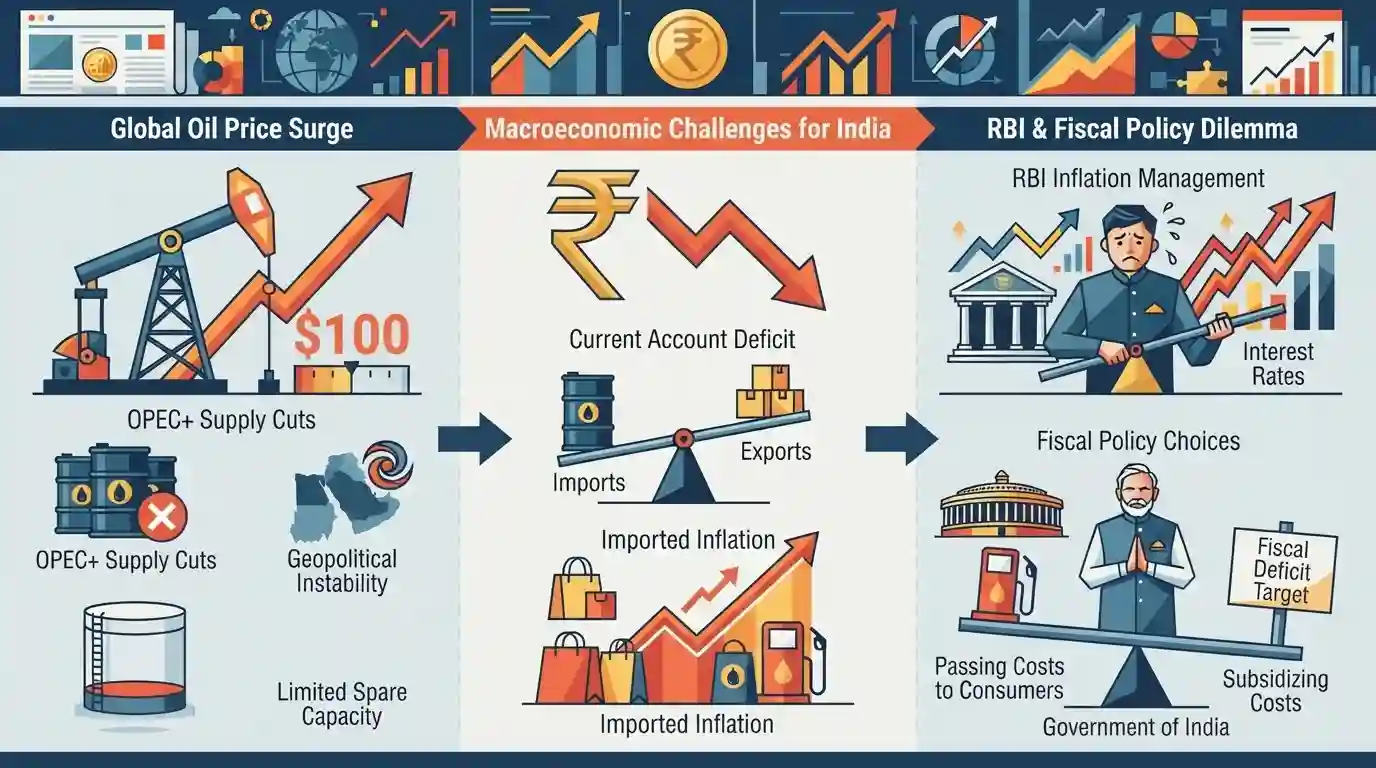
The article warns that global crude oil prices could soon breach the $100 per barrel mark, driven by persistent OPEC+ supply cuts, geopolitical instability in the Middle East, and limited spare production capacity. For India, which imports over 85% of its crude oil, this presents severe macroeconomic challenges. A sustained surge in oil prices will widen the Current Account Deficit (CAD), depreciate the Rupee, and drive up imported inflation. Consequently, this complicates the RBI's inflation management and limits fiscal space for the government, which must balance passing costs to consumers against risking fiscal deficit targets.
મુખ્ય મુદ્દા
- Global crude oil prices are facing upward pressure toward the $100 per barrel mark due to prolonged OPEC+ production cuts, Middle East geopolitical tensions, and structural underinvestment in new oil exploration.
- India remains highly vulnerable as it imports over 85% of its crude oil requirements.
- Elevated oil prices directly widen India's Current Account Deficit (CAD) and weaken the Rupee against the dollar.
- Imported inflation from expensive oil complicates the Reserve Bank of India's (RBI) monetary policy, potentially delaying interest rate cuts.
- The government faces a fiscal trilemma: passing on the costs to consumers risks higher inflation, while absorbing it through fuel tax cuts or subsidies strains the fiscal deficit.
મહત્વપૂર્ણ શબ્દો
OPEC+

An alliance of 12 OPEC members and 10 non-OPEC oil-producing nations (such as Russia) that coordinates crude oil production levels to regulate global oil supplies and stabilize international prices.
UPSC context
GS Paper III (Indian Economy); tests global energy cartels, supply-side trade shocks, and energy security.
Current Account Deficit (CAD)
A macroeconomic condition where a country's total imports of goods, services, and transfers exceed its total exports over a specific period, indicating net foreign borrowing.
UPSC context
GS Paper III (Macroeconomics); tests balance of payments (BoP), trade imbalances, and currency depreciation risks.
Imported Inflation
A general rise in domestic prices caused by the escalating cost of imported raw inputs, such as crude oil, or finished goods, often worsened by domestic currency depreciation.
UPSC context
GS Paper III (Inflation Management); tests cost-push inflation, exchange rate mechanics, and global market disruptions.
Fiscal Deficit
The gap between a government's total expenditure and its total revenue (excluding borrowings) in a fiscal year, indicating the total amount of money the government needs to borrow.
UPSC context
GS Paper III (Fiscal Policy); tests budgetary management, public debt sustainability, and macroeconomic discipline.
Reserve Bank of India (RBI)
India's central bank and monetary authority, statutorily mandated to manage currency, regulate the financial system, and maintain price stability under a Flexible Inflation Targeting framework.
UPSC context
GS Paper III (Monetary Policy); tests inflation targeting, central banking tools, and macroeconomic stability management.
પ્રિલિમ્સ ટ્રેપ
Global crude oil price surges impact CPI inflation more severely and immediately than WPI inflation.
WPI's "Fuel and Power" category carries a weight of 13.15%, almost double the 6.84% weight of "Fuel and Light" in CPI. Consequently, WPI absorbs immediate crude price shocks faster and more severely.
સંલગ્ન સ્થિર ખ્યાલો
How does a crude oil price shock impact macroeconomic stability?
- External Sector: Widens the Current Account Deficit (CAD) due to an inelastic import bill, creating higher dollar demand and depreciating the Rupee.
- Monetary Policy: Causes imported cost-push inflation, complicating the RBI's inflation targeting framework and delaying potential interest rate cuts.
- Fiscal Space: Forces the government to either absorb costs (straining fiscal deficit through fuel tax cuts) or pass them on to consumers (worsening inflation).
What is the status of India's Strategic Petroleum Reserves (SPRs)?
- Phase I Locations: Located in underground rock caverns at Visakhapatnam, Mangaluru, and Padur, offering 5.33 MMT operational capacity (approx 9.5 days of net import cover).
- Phase II Expansion: Approved capacity addition of 6.5 MMT at Chandikhol (Odisha) and Padur (Karnataka) utilizing a Public-Private Partnership (PPP) model.
- IEA Mandate: As an Associate Member, India aims to maintain 90 days of net oil imports (achieved collectively via SPRs and OMC commercial stocks).
આંતર-વિષય પેટર્ન
Oil Prices & Currency Depreciation
High oil prices widen the CAD, draining foreign exchange. This structural dollar outflow forces Rupee depreciation, making other essential imports costlier and triggering a vicious macroeconomic cycle.
OPEC+ Cartel vs IEA Consumer Security
OPEC+ restricts supply to buoy prices, conflicting with consumer nations. India navigates this cartel dominance by leveraging its IEA associate membership, maintaining strategic reserves, and accelerating its renewable transition.

Expect a multi-statement question testing the logical chain: crude shock -> widened CAD -> Rupee depreciation -> imported CPI/WPI inflation.
સંલગ્ન PYQ · 3
સંલગ્ન PYQ · 3
- 2018MainsGS3
How would the recent phenomena of protectionism and currency manipulations in world trade affect macroeconomic stability of India?
- 2025PrelimsGS1
Consider the following activities : I. Production of crude oil II. Refining, storage and distribution of petroleum III. Marketing and sale of petroleum products IV. Production of natural gas How many of the above activities are regulated by the Petroleum and Natural Gas Regulatory Board in our country?
- 2024MainsGS3
What are the causes of persistent high food inflation in India? Comment on the effectiveness of the monetary policy of the RBI to control this type of inflation.
