Gaza ceasefire and humanitarian aid ramp up after two year conflict
Source:The Hindu ↗
Why It Matters
The Israel-Palestine conflict is a highly important geopolitical issue with deep implications for regional stability in West Asia. It frequently features in UPSC examinations due to its strategic, humanitarian, and international diplomatic dimensions, directly aligning with GS Paper 2 (International Relations).
Summary
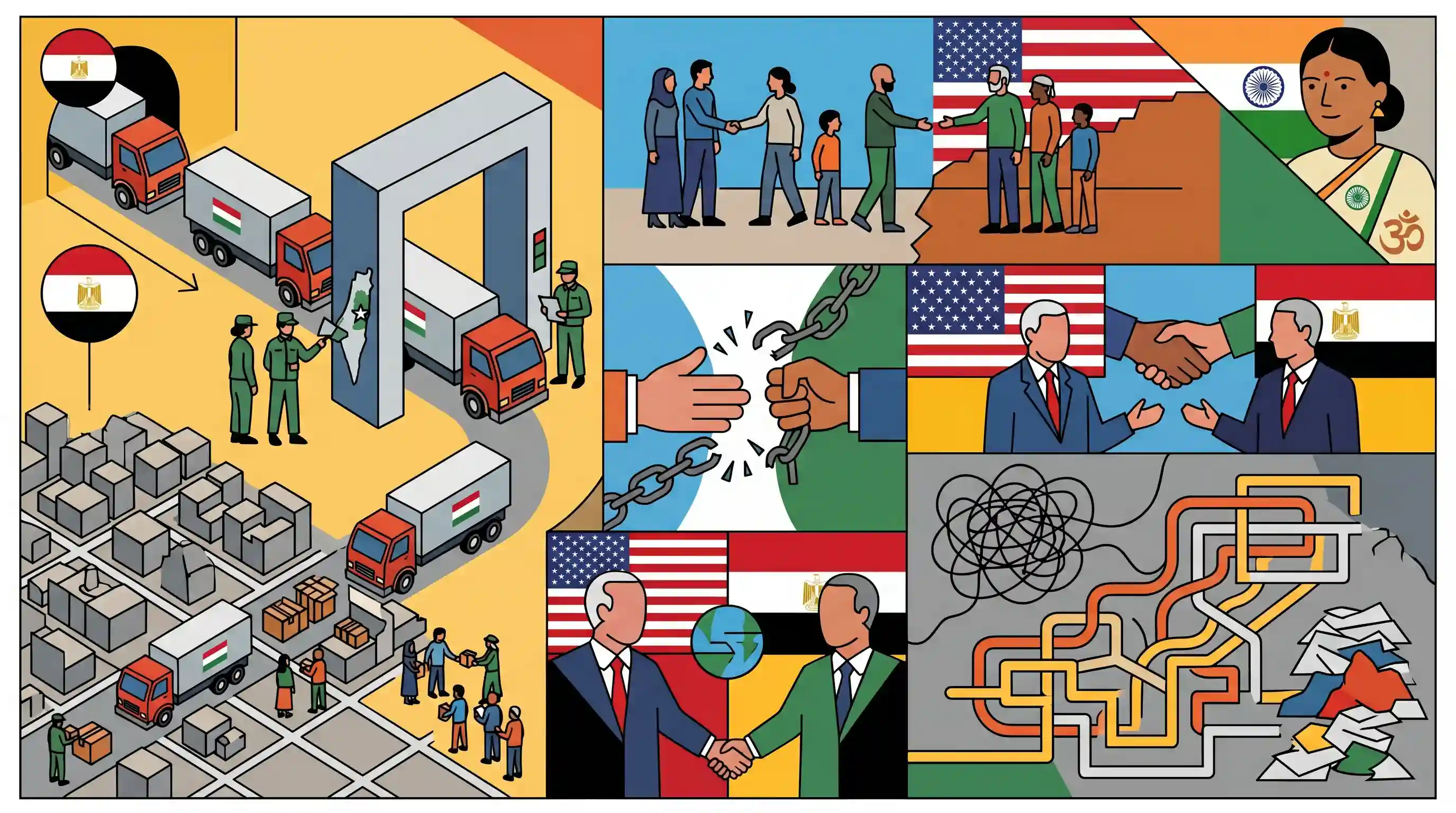
Preparations are actively underway to significantly increase humanitarian aid to the Gaza Strip following a new ceasefire agreement aimed at ending the two-year war. Aid trucks will cross from Egypt and undergo Israeli screening at the Kerem Shalom crossing before delivery. Concurrently, efforts are focused on facilitating a hostage-prisoner exchange between Israel and Hamas. The ceasefire deal is receiving international backing, with high-level mediations from U.S. and Egyptian leaderships, although significant challenges remain concerning post-war aid distribution and the recovery of missing persons.
Key Points
- A new ceasefire deal aims to end the 2-year conflict in Gaza, facilitating a significant ramp-up in humanitarian aid delivery to around 600 trucks per day.
- Aid trucks from Egypt will cross via Rafah and undergo Israeli military screening at the Kerem Shalom crossing.
- Distribution sites of the U.S. and Israeli-backed Gaza Humanitarian Foundation (GHF) have been dismantled amid reports of chaotic operations.
- The ceasefire agreement includes a hostage-prisoner exchange, involving the release of remaining Israeli hostages for around 2,000 Palestinian prisoners.
- International mediation is prominent, with U.S. President Donald Trump and Egyptian President Abdel-Fattah el-Sissi spearheading peace efforts and summit talks.
Important Terms
Hamas

A Palestinian Sunni-Islamic fundamentalist and militant organization governing the Gaza Strip since 2007; it is a central non-state actor in the ongoing Israel-Palestine conflict.
UPSC context
GS II: West Asia geopolitics, non-state actors, and India’s balanced stance on the Israel-Palestine issue.
COGAT
(Coordination of Government Activities in the Territories) An Israeli Ministry of Defense unit facilitating civilian policy and humanitarian aid logistics between Israel, international organizations, and the Palestinian territories.
UPSC context
GS II: Important for understanding administrative mechanisms in conflict zones and international humanitarian law.
Kerem Shalom Crossing
A strategic tri-border transit point between Israel, the Gaza Strip, and Egypt; it serves as the primary gateway for commercial goods and humanitarian aid into Gaza.
UPSC context
GS II: Geography-based topics and the study of humanitarian corridors in international relations.
Egyptian Red Crescent
Egypt's primary humanitarian organization responsible for coordinating the logistics, storage, and delivery of international aid through the Rafah and Kerem Shalom corridors into Gaza.
UPSC context
GS II: Highlights the role of regional NGOs and Egypt’s strategic importance in regional crisis management.
Ceasefire deal
A negotiated agreement to suspend hostilities, often involving third-party mediators (like the U.S. or Egypt) to facilitate humanitarian aid, prisoner exchanges, or peace talks.
UPSC context
GS II: Relates to international mediation, conflict resolution, and global peace-building efforts.
Prelims Trap
"The Gaza Strip shares a land border with Egypt, Israel, and Jordan."
Gaza only borders Israel, Egypt, and the Mediterranean Sea. The West Bank borders Jordan, but Gaza does not. Aspirants frequently confuse the borders of the two Palestinian territories.
Static Concepts Connected
What are the key strategic crossings and corridors around the Gaza Strip?
- Rafah crossing: The sole exit point from the Gaza Strip that connects directly to Egypt's Sinai Peninsula, bypassing Israeli territory entirely.
- Philadelphi Corridor: A narrow demilitarized buffer zone running along the entire 14-kilometer border between the Gaza Strip and Egypt.
- Kerem Shalom: A major commercial goods crossing located near the strategic tri-junction of the Gaza Strip, Israel, and Egypt.
How does a prolonged West Asian conflict impact India's strategic interests?
- IMEC delays: Instability directly stalls the India-Middle East-Europe Economic Corridor (IMEC), threatening the viability of reliable transit routes through West Asian ports.
- I2U2 momentum: The conflict heavily disrupts diplomatic momentum and technological-investment partnerships within the India-Israel-UAE-USA (I2U2) minilateral grouping.
- Energy & Diaspora: Geopolitical shocks threaten crude oil price stability and jeopardize the safety of millions of Indian expatriates working in the Gulf.
Cross-Topic Patterns
Gaza mapping + India's connectivity projects
Map questions frequently pair active conflict zones with their downstream impact on India's geo-economic initiatives, testing Gaza's geography alongside the IMEC connectivity route and the I2U2 minilateral framework.
Humanitarian Law + UN mandate
The crisis revives static syllabus themes around International Humanitarian Law, the Geneva Conventions, and the operational mandate of UN bodies working in active war zones.

Map-based questions will likely pair Gaza crossings (Rafah) and corridors (Philadelphi) with India's IMEC transit nodes in 2026.
Linked PYQs · 3
Linked PYQs · 3
- 2017PrelimsGS1
Mediterranean Sea is a border of which of the following countries? 1. Jordan 2. Iraq 3. Lebanon 4. Syria Select the correct answer using the code given below:
- 2022PrelimsGS1
The term "Levant" often heard in the news roughly corresponds to which of the following regions?
- 2003PrelimsGS1
Israel has common borders with
