West Asia Crisis Impact on Industrial Fuel Pricing in India
Source:Indian Express ↗
Why It Matters
This article is highly relevant for GS3 (Economy) and GS2 (International Relations) as it serves as a live case study of how external geopolitical shocks (West Asia crisis) transmit into the domestic Indian economy. It illustrates the practical nuances of fuel price deregulation, the distinction between retail and wholesale inflation impacts, and the challenges of ensuring energy security while managing macroeconomic stability.
Summary
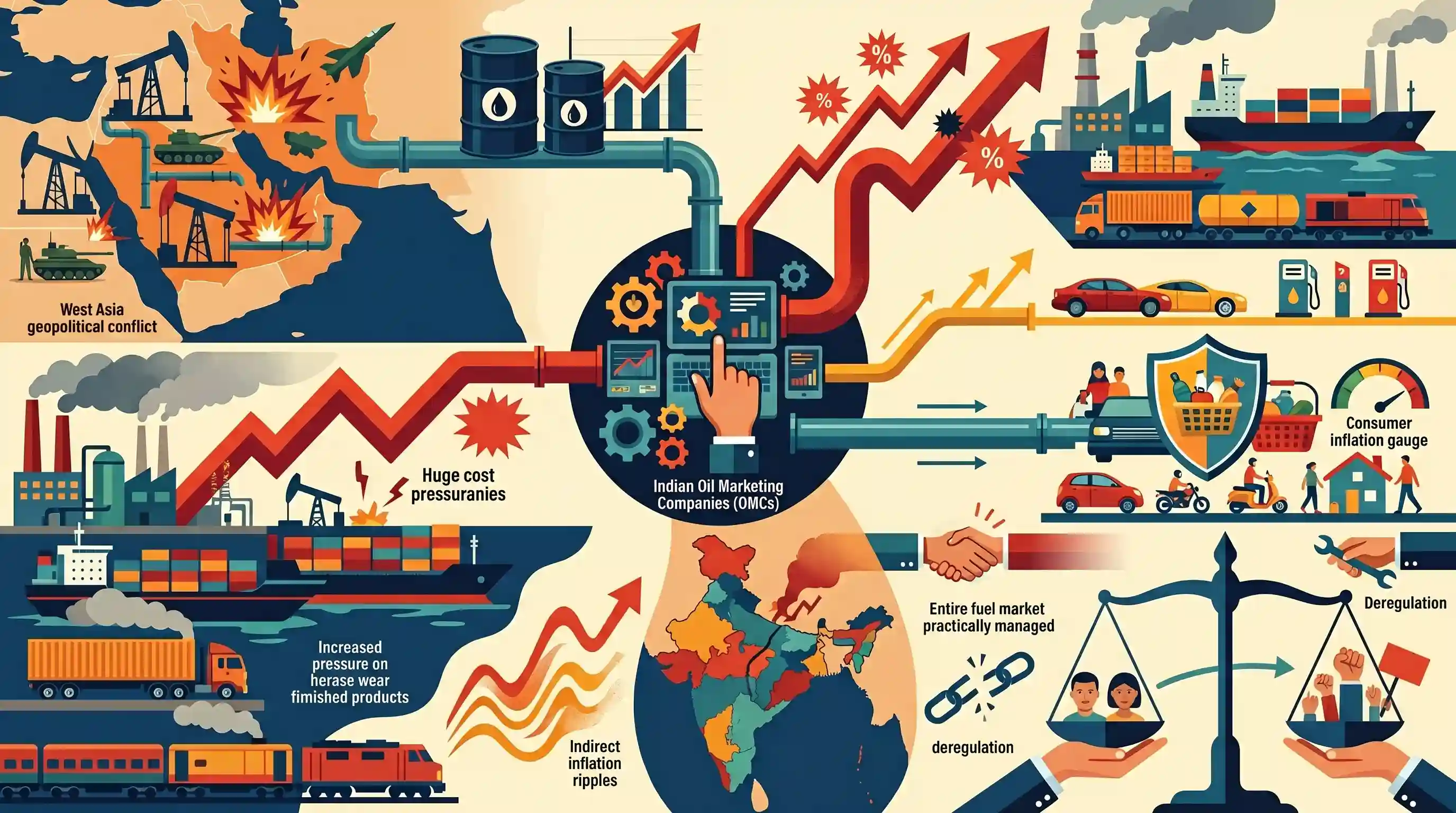
Triggered by the geopolitical fallout of the ongoing conflict in West Asia, oil marketing companies (OMCs) in India have sharply increased the price of bulk/industrial diesel by ₹22 per litre and premium petrol by ₹2 per litre. However, standard retail petrol and diesel rates remain completely unchanged. This bifurcated pricing strategy attempts to absorb the shock of rising global crude prices for everyday consumers to keep retail inflation in check, while passing the massive burden onto industrial and commercial users. While retail inflation is temporarily shielded, the steep rise in industrial diesel will escalate manufacturing, logistics, and transport costs, potentially causing indirect inflationary ripples across the broader economy. The development underscores India's acute vulnerability to Middle Eastern volatility and highlights how India's technically deregulated fuel market is practically managed to balance economic stability and political realities.
Key Points
- The ongoing geopolitical conflict in West Asia has caused a surge in global crude oil prices, directly impacting India's domestic fuel costs.
- Prices for bulk/industrial diesel have been hiked steeply by ₹22 per litre, while premium petrol has increased by ₹2 per litre.
- Normal retail petrol and diesel prices have been kept unchanged, shielding everyday consumers from immediate price shocks and preventing a direct spike in headline retail inflation.
- The massive hike in bulk diesel prices is expected to significantly increase operating, logistics, and manufacturing costs for industries, which could eventually lead to indirect inflationary pressures on goods.
- The situation highlights the complex reality of India's fuel pricing mechanism, where despite theoretical deregulation, retail prices are informally managed during global shocks.
Important Terms
Oil Marketing Companies (OMCs)

State-owned or private entities (e.g., IOCL, BPCL, HPCL) responsible for refining and distributing petroleum products. They manage the 'downstream' oil sector and often balance market prices with government-directed social mandates.
UPSC context
GS III (Economy); tests knowledge of downstream oil sector and the government's role in price management.
Bulk Diesel
Diesel sold in large volumes directly to industrial users like Railways, transport fleets, and factories. Pricing is distinct from retail pump rates, often bearing the brunt of global crude price hikes.
UPSC context
GS III (Inflation); highlights differential pricing strategies and their impact on industrial input costs and logistics.
Fuel Price Deregulation
The policy of letting market forces determine fuel prices. India deregulated petrol (2010) and diesel (2014), though the state frequently intervenes via OMCs to maintain price stability during geopolitical crises.
UPSC context
GS III (Economic Reforms); focuses on state intervention in markets and the management of 'under-recoveries.'
Energy Security
The assurance of reliable, affordable energy supplies. India’s security is vulnerable due to 85%+ dependency on crude imports, making it sensitive to West Asian geopolitical volatility and maritime chokepoints.
UPSC context
GS II & III (IR/Energy); evaluates strategic autonomy and the impact of global conflicts on national stability.
Retail Inflation (CPI)
The rate of price increase for goods and services purchased by households, measured by the Consumer Price Index (CPI). It reflects the cost of living and guides RBI’s monetary policy.
UPSC context
GS III (Macroeconomics); vital for understanding inflation targeting and how fuel shocks affect consumer purchasing power.
Prelims Trap
Petrol and diesel are governed by the Administered Price Mechanism (APM) during global geopolitical shocks.
Petrol (2010) and diesel (2014) are officially deregulated and market-linked. Retail price freezes by OMCs are informal market interventions, not formal APM policy.
Static Concepts Connected
What is the 'Indian Basket' of crude oil?
- Composition: A weighted average of Sour grade crude (Oman and Dubai) and Sweet light crude (Brent Dated).
- Significance: It acts as the primary benchmark indicating the price of crude oil imports specifically for Indian refineries.
How are petrol and diesel priced in India?
- Deregulation: Petrol was officially deregulated in 2010 and diesel in 2014, shifting from government-controlled prices to market-determined rates.
- Dynamic Pricing: Prices are theoretically revised daily based on international benchmarks, though OMCs frequently freeze retail rates informally to absorb global shocks.
Cross-Topic Patterns
Cost-push inflation vs RBI policy limits
Bulk diesel hikes raise manufacturing and logistics costs (WPI), creating cost-push inflation. In such supply-side shocks, traditional RBI repo-rate hikes are less effective compared to demand-pull scenarios.
Crude prices & the Twin Deficit risk
Elevated oil import bills directly widen the Current Account Deficit (CAD). Simultaneously, informal OMC retail freezes risk fiscal strain if the government is forced to compensate their losses.

Expect a 2026 Prelims question linking formal fuel deregulation timelines with the Indian Crude Basket composition and WPI-CPI disparities.
Linked PYQs · 4
Linked PYQs · 4
- 2025MainsGS2
"Energy security constitutes the dominant kingpin of India's foreign policy, and is linked with India's overarching influence in Middle Eastern countries.” How would you integrate energy security with India's foreign policy trajectories in the coming years?
- 2017MainsGS2
The question of India's Energy Security constitutes the most important part of India's economic progress. Analyze India's energy policy cooperation with West Asian countries.
- 2011PrelimsGS1
In the context of global oil prices, “Brent crude oil” is frequently referred to in the news. What does this term imply? 1. It is a major classification of crude oil. 2. It is sourced from North Sea. 3. It does not contain sulphur. Which of the statements given above is/are correct?
- 2021PrelimsGS1
Which one of the following is likely to be the most inflationary in its effects?
