GenomeIndia Project Findings and Personalized Medicine Potential
Source:The Hindu ↗
Why It Matters
The GenomeIndia project is a milestone in Indian biotechnology. Understanding the specific applications of genome sequencing in healthcare—such as precision medicine and population genetics—is a recurring theme in UPSC S&T questions.
Summary
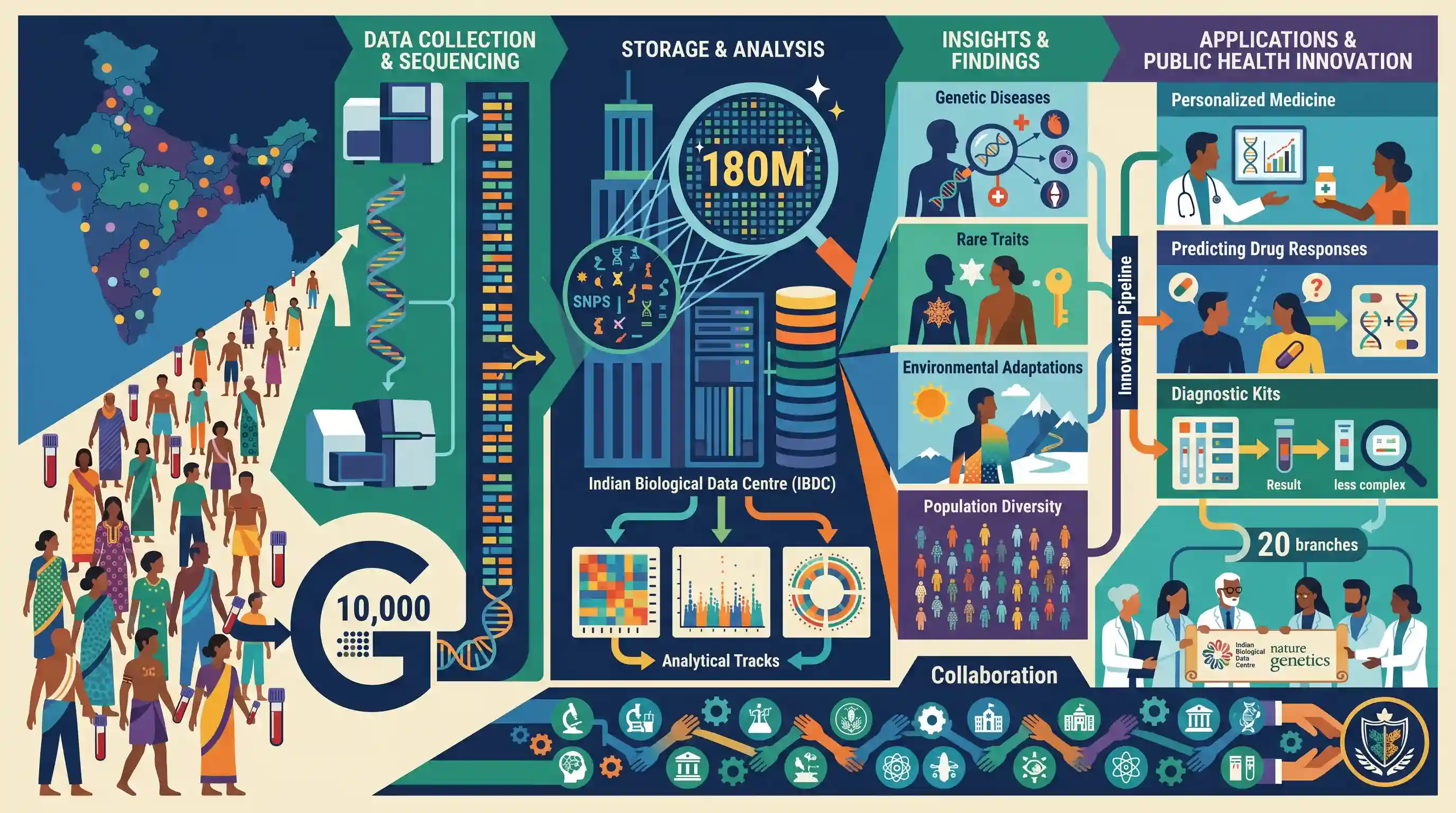
Preliminary findings from the GenomeIndia project, published in Nature Genetics, detail the whole-genome sequencing of over 10,000 individuals from 85 diverse Indian populations. The study uncovered 180 million genetic variants, providing crucial insights into genetic diseases, rare community-specific traits, and environmental adaptations. Housed at the Indian Biological Data Centre (IBDC), this rich genetic database will be instrumental in advancing personalized medicine, predicting drug responses, and developing cost-effective diagnostic kits. The initiative represents a landmark collaborative achievement by 20 Indian scientific institutions.
Key Points
- The GenomeIndia project published preliminary findings after successfully genotyping over 10,000 healthy individuals across 85 tribal and non-tribal populations in India.
- Whole genome sequencing revealed 180 million genetic variants, spanning autosomes and sex chromosomes, including those unique to India and to specific small populations.
- The data, stored at the Indian Biological Data Centre (IBDC) in Faridabad, aims to correlate genetic variants with disease susceptibility, drug responses, and environmental adaptations (e.g., high altitude).
- Applications of this comprehensive genetic database include the development of low-cost diagnostic kits and the kickstarting of precision and personalized medicine efforts in India.
- The project is a vast collaborative effort involving 20 institutions, with major sequencing contributions from CBR, CCMB, IGIB, NIBMG, and GBRC.
Important Terms
GenomeIndia project

A Department of Biotechnology initiative to sequence 10,000 diverse Indian genomes to create a reference database for identifying genetic disease markers and advancing personalized medicine.
UPSC context
GS Paper III (Biotechnology). Tests knowledge of national scientific missions and their impact on public health and precision medicine.
Indian Biological Data Centre (IBDC)
India's first national repository for life science data in Faridabad. It archives publicly funded research data on the 'Brahm' supercomputer to ensure data sovereignty.
UPSC context
GS Paper III (Science & IT). Relevant for data localization, digital infrastructure, and indigenous research capacity.
Centre for Brain Research (CBR)
An autonomous hub at IISc Bangalore that coordinates the GenomeIndia project, spearheading strategic planning, sample biobanking, and standardized protocol execution for the 20-institution consortium.
UPSC context
GS Paper III (S&T Institutions). Highlights the role of institutional hubs in managing large-scale national collaborative research projects.
National Institute of Biomedical Genomics (NIBMG)
A premier DBT institute in West Bengal specializing in genomic medicine. It leads the design of uniform protocols for data generation and variant calling in the project.
UPSC context
GS Paper III (S&T). Important for specialized bodies translating genetic research into clinical and public health applications.
CSIR-Centre for Cellular and Molecular Biology (CSIR-CCMB)
A top CSIR laboratory in Hyderabad focused on modern biology. It acts as a major sequencing center and joint national coordinator for population-scale genomic studies.
UPSC context
GS Paper III (S&T). Often featured in questions regarding India's premier scientific organizations and healthcare innovation.
Institute of Genomics & Integrative Biology (IGIB)
A Delhi-based CSIR institute that pioneered human genome sequencing in India and serves as a core center for medical genomics analysis in national projects.
UPSC context
GS Paper III (S&T). Relevant for its history in genomics and leadership in public health programs like IndiGen.
Gujarat Biotechnology Research Centre (GBRC)
An autonomous Gujarat state institute facilitating GenomeIndia and leading India's first state-specific tribal genome project to address inherited diseases like sickle cell anemia.
UPSC context
GS Paper III (S&T/Social Justice). Tests knowledge of regional research efforts for vulnerable populations like tribal communities.
Prelims Trap
The project primarily sequenced individuals suffering from rare genetic diseases to find targeted cures.
The Genome India Project actually sequenced 10,000 *healthy* individuals across 85 diverse populations to create a baseline Indian reference genome, not diseased patients.
Static Concepts Connected
How does Whole Genome Sequencing (WGS) differ from Whole Exome Sequencing (WES)?
- Whole Genome (WGS): Decodes the entire DNA sequence, encompassing both protein-coding genes and non-coding regulatory regions across all chromosomes.
- Whole Exome (WES): Targets only the exons (protein-coding regions) representing just 1-2% of the genome, making it a faster and cheaper method for finding known mutations.
What is the mandate of the Indian Biological Data Centre (IBDC)?
- National Repository: It is India's first national repository for life science data, located at the Regional Centre for Biotechnology in Faridabad, Haryana.
- Data Sovereignty: Mandated by the DBT to store all publicly funded biological data, utilizing the 'BRAHMA' supercomputer to reduce reliance on foreign servers (like NCBI).
Cross-Topic Patterns
Caste endogamy and genetic bottlenecks
The genomic data validates sociological concepts by showing how historical caste-based endogamy restricts gene flow, preserving rare, community-specific disease susceptibilities across generations in India.
Biological data sovereignty
Storing 180 million variants exclusively at the IBDC Faridabad mirrors India’s broader digital data localization policies, preventing foreign commercial exploitation of indigenous biological resources.

Expect a 2026 prelims multi-statement question combining IBDC's data sovereignty mandate with the technical specifics of genome sequencing.
Linked PYQs · 3
Linked PYQs · 3
- 2017PrelimsGS1
With reference to agriculture in India, how can the technique of 'genome sequencing', often seen in the news, be used in the immediate future? 1. Genome sequencing can be used to identify genetic markers for disease resistance and drought tolerance in various crop plants. 2. This technique helps in reducing the time required to develop new varieties of crop plants. 3. It can be used to decipher the host-pathogen relationships in crops. Select the correct answer using the code given below:
- 2021MainsGS3
What are the research and developmental achievements in applied biotechnology? How will these achievements help to uplift the poorer sections of the society?
- 2023PrelimsGS1
'Microsatellite DNA' is used in the case of which one of the following?
