India Climate Agenda COP31 Predictable Finance and Transition
Source:The Hindu ↗
Why It Matters
Crucial for understanding India's negotiating stance, climate diplomacy, and demands for climate justice and predictable finance at international climate forums like COP.
Summary
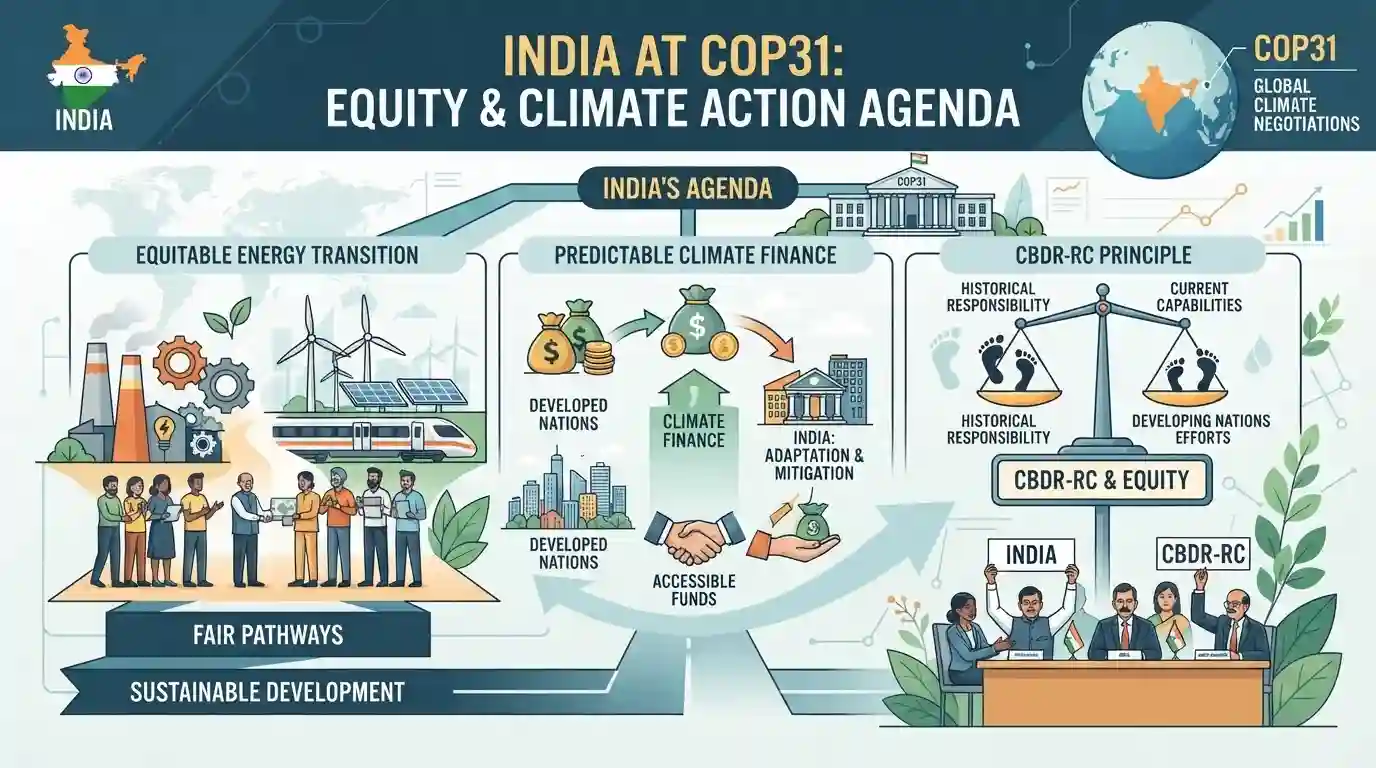
India's agenda for the upcoming COP31 climate conference highlights the critical need for predictable climate finance and an equitable energy transition, reinforcing equity and the principles of CBDR-RC in global climate negotiations.
Key Points
- India's agenda for COP31 focuses on predictable climate finance and an equitable energy transition.
- Emphasizes the core principle of Common But Differentiated Responsibilities and Respective Capabilities (CBDR-RC).
- Highlights the need for developed nations to fulfill financial commitments to support developing countries in climate action.
Important Terms
COP31

The 31st Conference of the Parties to the UNFCCC, where member nations negotiate global climate commitments, focusing on predictable climate finance and equitable transitions for developing countries.
UPSC context
GS Paper III (Environment & Ecology): Important international climate summits, India's negotiating stance, and multilateral environmental diplomacy.
New Collective Quantified Goal on Climate Finance
Financial resources provided by developed to developing nations to assist with mitigation and adaptation, a core contentious issue in global climate negotiations regarding quantum and predictability.
UPSC context
GS Paper III (Environment & Ecology): Funding mechanisms, North-South divides, and financial commitments under UNFCCC frameworks.
Paris Agreement
A landmark 2015 legally binding international treaty on climate change aiming to limit global warming to well below 2 degrees Celsius, anchored in equity and CBDR-RC.
UPSC context
GS Paper III (Environment & Ecology): Core global climate governance architecture, NDCs, and international environmental obligations.
UNFCCC
The parent international treaty body established to combat climate change by stabilizing greenhouse gas concentrations in the atmosphere, governing annual COP sessions.
UPSC context
GS Paper III (Environment & Ecology): Foundational international environmental conventions and institutional mechanisms for global climate action.
Static Concepts Connected
What are the core legal distinctions between CBDR-RC and Article 9 of the Paris Agreement?
- CBDR-RC Basis: UNFCCC Article 3 establishes CBDR-RC, making historical polluters primarily responsible for mitigation and financial support based on capacities.
- Article 9 Obligation: Paris Agreement Article 9 legally obligates developed nations to provide financial resources while encouraging voluntary contributions from other parties.
- NCQG Context: NCQG replaces the old $100 billion goal, aiming to reflect actual needs of developing countries for post-2025 climate action.
Cross-Topic Patterns
Climate Finance vs. Sovereign Debt Crises
India's insistence on public concessional finance ties climate negotiations directly to the sovereign debt distress of developing nations in the post-pandemic global economy.

Expect a statement-based question pairing CBDR-RC's legal basis in UNFCCC Article 3.1 with Paris Agreement Article 9 financial obligations.
Linked PYQs · 3
Linked PYQs · 3
- 2025MainsGS3
Write a review on India's climate commitments under the Paris Agreement (2015) and mention how these have been further strengthened in COP26 (2021). In this direction, how has the first Nationally Determined Contribution intended by India been updated in 2022?
- 2021MainsGS3
Describe the major outcomes of the 26th session of the Conference of the Parties (COP) to the United Nations Framework Convention on Climate Change (UNFCCC). What are the commitments made by India in this conference?
- 2022MainsGS3
Do you think India will meet 50 percent of its energy needs from renewable energy by 2030 ? Justify your answer. How will the shift of subsidies from fossil fuels to renewables help achieve the above objective ? Explain.
