Blind School Crisis Highlights Disability Rights Implementation Gaps
Source:Indian Express ↗
Why It Matters
This article highlights the chronic gap between progressive disability legislation (like the RPwD Act 2016) and ground-level bureaucratic implementation. It serves as an excellent case study for GS Paper 2 questions focusing on the efficacy of welfare mechanisms, institutional neglect, and challenges faced by vulnerable sections.
Summary
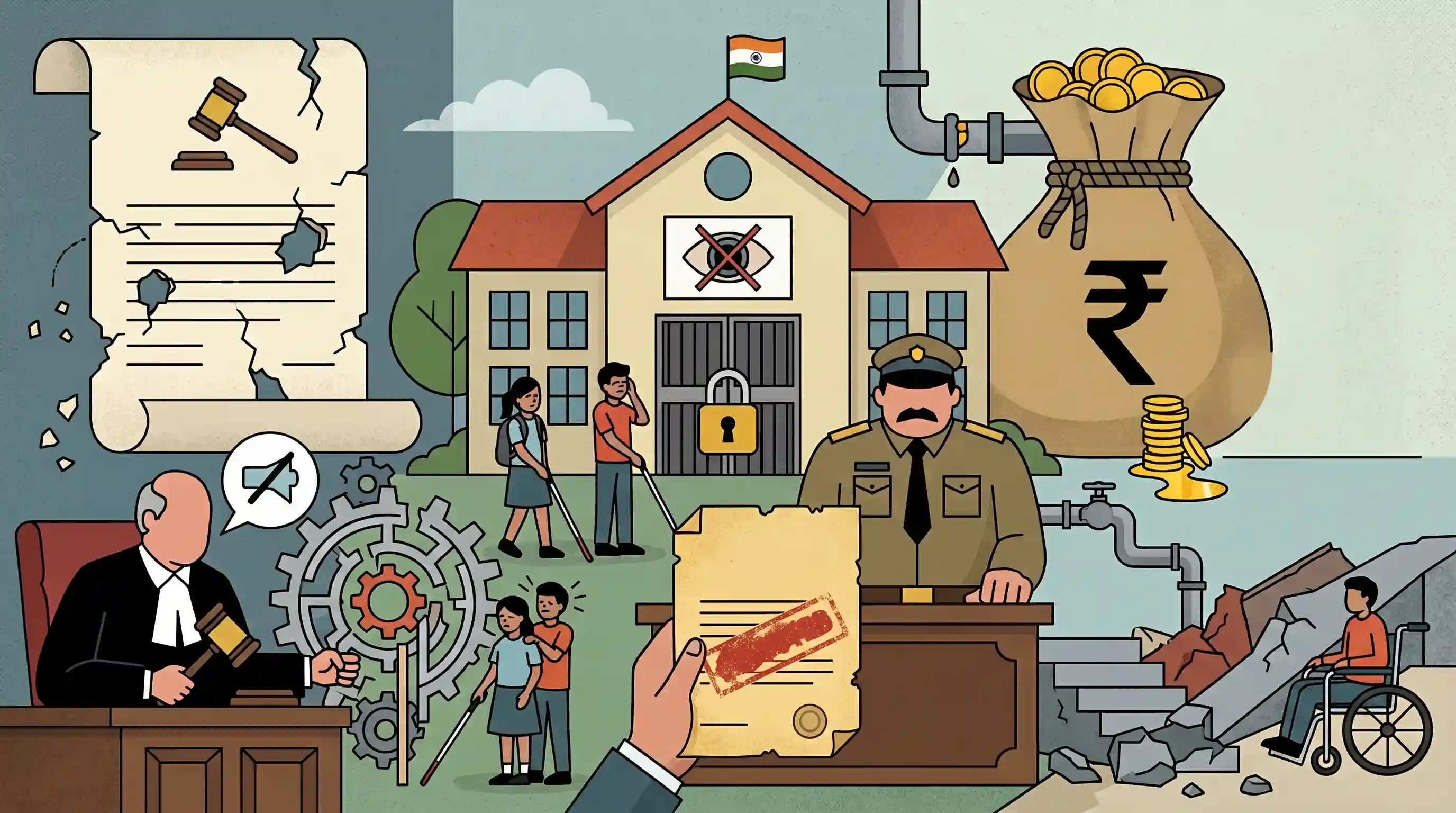
The JPM Senior Secondary Blind School, one of India's oldest institutions for the visually impaired, faces imminent closure due to bureaucratic insistence on Partition-era land documents for its recognition certificate. This predicament highlights the broader institutional neglect and poor implementation of disability rights in India. Despite progressive legislation like the Rights of Persons with Disabilities Act, 2016, and recent Supreme Court directives on accessibility, significant systemic gaps persist. Issues such as the severe underutilization of welfare funds—evidenced by 93% of the allocated budget remaining unspent in 2023-24—and drastic budget cuts to schemes like SIPDA underscore the systemic apathy towards the disabled population.
Key Points
- The JPM Senior Secondary Blind School in Delhi faces closure because the Directorate of Education denied its recognition certificate over missing Partition-era land ownership records.
- Despite a Rs 1,275 crore allocation for disability welfare in the 2025 Union Budget, historical trends show severe underutilization, with 93% of the budget remaining unspent in 2023-24.
- The budget for the Scheme for Implementation of the Persons with Disabilities Act (SIPDA) was drastically slashed from Rs 240 crore in 2022-23 to just Rs 21 crore.
- A 2024 Supreme Court ruling mandated improved accessibility in public spaces, reflecting judicial pushback against the poor enforcement of the Rights of Persons with Disabilities Act, 2016.
- The NHRC has issued notices to the Delhi government over the potential closure, highlighting the threat to the educational rights of visually impaired students.
Important Terms
Rights of Persons with Disabilities Act, 2016

A landmark law replacing the 1995 Act, expanding recognized disabilities to 21 and mandating 4% reservation in government jobs and 5% in higher education.
UPSC context
GS Paper II (Social Justice). Tests legal frameworks for vulnerable sections and the transition to a rights-based empowerment model.
Scheme for Implementation of the Persons with Disabilities Act (SIPDA)
An umbrella scheme providing financial assistance for barrier-free environments, skill training, and technical support to implement the RPwD Act across various government levels.
UPSC context
GS Paper II (Welfare Schemes). Evaluates understanding of funding mechanisms and implementation hurdles in disability-focused government interventions.
National Human Rights Commission (NHRC)
A statutory body that monitors human rights violations and advocates for resources to empower persons with disabilities to live with dignity and full inclusion.
UPSC context
GS Paper II (Statutory Bodies). Tests knowledge of institutional safeguards and grievance redressal mechanisms for marginalized populations.
Supreme Court of India
India's apex court, which has interpreted accessibility as a fundamental right under Article 21, emphasizing the state's duty to provide reasonable accommodation for PwDs.
UPSC context
GS Paper II (Judiciary). Examines judicial jurisprudence regarding substantive equality and the expansion of fundamental rights for the disabled.
JPM Senior Secondary Blind School
A premier residential institution for the visually impaired in Delhi, serving as a critical case study on bureaucratic hurdles affecting disability-inclusive education.
UPSC context
GS Paper II (Governance). Useful case study for analyzing systemic apathy and the gap between policy intent and ground implementation.
Directorate of Education
The administrative authority responsible for school recognition and registration; in this context, it acts as the regulator for disability institutions under Section 51.
UPSC context
GS Paper II (Governance). Highlights the role of executive agencies and administrative bottlenecks in delivering constitutional and statutory rights.
Prelims Trap
The NHRC is the designated statutory authority for enforcing the Rights of Persons with Disabilities Act, 2016.
While NHRC intervenes on broad human rights violations, the RPwD Act specifically establishes the Chief Commissioner for Persons with Disabilities (CCPD) as the nodal enforcement authority.
Static Concepts Connected
What are the core statutory mandates of the RPwD Act, 2016?
- Expanded Scope: Increased the number of recognized disabilities from 7 to 21, adding conditions like dwarfism, acid attack victims, and specific learning disabilities.
- Enhanced Quotas: Raised the reservation quota for persons with benchmark disabilities from 3% to 4% in government jobs and 5% in higher education.
- Institutional Mechanism: Mandated the creation of the Chief Commissioner and State Commissioners specifically for PwD grievance redressal and rights safeguarding.
What is the nature and purpose of SIPDA?
- Scheme Type: It is a Central Sector Scheme, fully funded and administered by the Ministry of Social Justice and Empowerment.
- Core Objective: It provides financial assistance to execute the RPwD Act, driving major initiatives like the Accessible India Campaign (Sugamya Bharat Abhiyan) and skill development.
Cross-Topic Patterns
Bureaucracy vs. Article 21A
Insistence on Partition-era land records to deny educational recognition highlights how rigid, colonial-era administrative processes can effectively violate the fundamental right to education for vulnerable groups.
Welfare fund underutilization patterns
The 93% unspent disability budget mirrors systemic implementation flaws seen in the Nirbhaya Fund and SC/ST sub-plans, typically driven by strict compliance burdens and poor state-level administrative capacity.

Expect a GS2 Mains question linking systemic fund underutilization (like SIPDA) to the poor implementation of the RPwD Act 2016.
Linked PYQs · 3
Linked PYQs · 3
- 2017MainsGS2
Does the Rights of Persons with Disabilities Act, 2016 ensure effective mechanism for empowerment and inclusion of the intended beneficiaries in the society? Discuss.
- 2019MainsGS2
Performance of welfare schemes that are implemented for vulnerable sections is not so effective due to absence of their awareness and active involvement at all stages of policy process. Discuss.
- 2023MainsGS2
“Development and welfare schemes for the vulnerable, by its nature, are discriminatory in approach.” Do you agree? Give reasons for your answer.
